
 CA
 NZ
 UK
 AU
 IND

 US

 Share
 X (Formerly Twitter)
 Whatsapp
 Facebook
 LinkedIn
 Telegram
 Email This Article
 Copy Link
 Summarize with AI
 Chat GPT
 Perplexity
Key Highlights
- Nasdaq's strongest first-half IPO haul on record was led by SpaceX's $86 billion listing, the largest IPO ever.
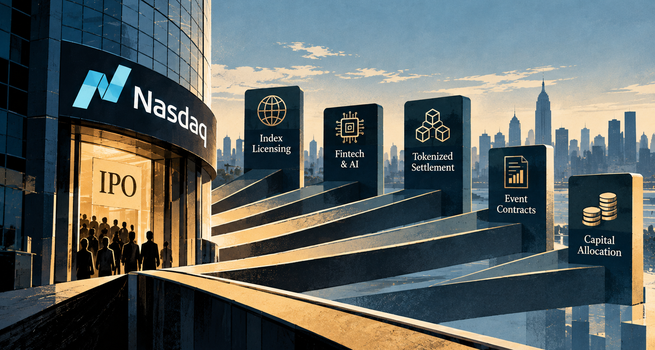
- Beyond listings, Nasdaq runs five other businesses under its "Digital Liquidity Networks" strategy: index licensing, fintech, tokenized settlement, event contracts and Capital allocation.
- Index Assets topped $1 trillion, while Verafin's fraud-detection unit grew Revenue 22 percent with AI tools delivering roughly 4x productivity gains.
- CFO Sarah Youngwood says clients choose Nasdaq for trading quality and for the trust built into its brand.
A Record Half, and Why It Happened
Nasdaq Chief Financial Officer Sarah Youngwood has described a constructive macroeconomic backdrop underpinning the company's recent performance: sustained Investment in artificial intelligence and digital technology, resilient consumer spending, and corporate Earnings she said are supporting current market valuations. Her clearest evidence is the IPO market. Nasdaq recorded its best first half for IPO fundraising on record, with $111 billion raised, including $86 billion tied to the June listing of SpaceX (NASDAQ:SPCX), the largest IPO in exchange history.
The pipeline behind that number was broad rather than narrow. Nasdaq has pointed to AI infrastructure, semiconductors, data centers, AI models, defense, insurance, real estate and a recovering biotechnology market as areas represented in its listings pipeline, alongside a 73 percent listing win rate and seven of the ten largest operating-company IPOs of the prior quarter. Other 2026 debuts filled out that breadth: Cerebras Systems (NASDAQ:CBRS), the largest semiconductor IPO on record; Quantinuum (NASDAQ:QNT), the largest pure-play Quantum Computing IPO on record; Parabilis Medicines (NASDAQ:PBLS), the largest biotechnology IPO on record; and ADARx Pharmaceuticals (NASDAQ:ADRX), part of the broader biotech recovery.
On what draws companies to Nasdaq over competing venues, Youngwood has been direct.
"People are looking for the association with Nasdaq, the quality of trading of course, but also the innovation and trust that is represented in our brand."
That listings business, however, is only one piece of what Nasdaq is building.
Five Businesses Running Alongside the Listings Cycle
Digital liquidity and tokenized markets. Nasdaq has organized its broader strategy around what it calls Digital Liquidity Networks, an effort to serve investor Demand for always-on markets while preserving liquidity, transparency and market integrity. The clearest expression of that strategy is Nasdaq's Acquisition of LeveL Markets' alternative trading system, the third-largest ATS in the country, offering connectivity to 2,500 Buy-Side and Sell-Side participants. Alongside it, Nasdaq is progressing a settlement initiative with the Depository Trust & Clearing Corporation that would let trades settle in either fiat currency or tokenised form; the initiative has received approval and is moving toward launch. Nasdaq has also invested $100 million in Payward, the Parent Company of Kraken, in a strategic Partnership built around a Nasdaq Equity Token, with Kraken set to use Nasdaq's surveillance tools as part of the arrangement.
Event contracts and derivatives. Nasdaq has SEC approval for an off-exchange product involving binary contracts tied to the Nasdaq-100, expected to launch near year-end. The company may consider additional financially focused contracts tied to company or economic key performance indicators, but is not currently focused on sports or political contracts. On perpetual futures, Youngwood has said the product category currently accounts for less than 1 percent of Nasdaq's revenue overlap, though the company remains open to supporting such products with appropriate structure and leverage, including through the trading, surveillance and infrastructure it can provide to other participants.
Index licensing. Nasdaq's index Business has reached $1 trillion in exchange-traded product assets under management, generating $109 billion in net inflows over the Trailing Twelve Months and growing 35 percent in the latest quarter. Youngwood has said 38 percent of those inflows came from products launched within the past five years, spanning Options strategies and data-center-related products, with AI infrastructure a prominent investment theme. About half of index inflows came from outside the United States, distributed through partners including Invesco (NYSE:IVZ), State Street (NYSE:STT) and BlackRock (NASDAQ:BLK).
Fintech and AI adoption. Nasdaq's Fintech segment posted 15 percent revenue growth and 16 percent annual Recurring Revenue growth. Within it, Verafin's financial-crime management business signed 11 enterprise deals through the second quarter, already exceeding the total signed in all of the prior year, drawing on a consortium of 2,800 banks holding $13 trillion in assets. Enterprise clients typically begin with fraud-protection services before adding further products, and the sales cycle for those add-ons runs roughly half the six- to twelve-month timeline tied to initial enterprise contracts.
Verafin has deployed two agentic AI tools since December, now used by 800 clients, which Nasdaq says have produced roughly four times the productivity of manual review, helping institutions identify Fraud faster and streamline case workflows. Verafin revenue grew 22 percent in the latest quarter, with net retention above 110 percent and a medium-term outlook in the mid-20 percent growth range; Nasdaq is now beginning to convert free users of its agentic workforce product into paying customers, though that revenue remains small. Separately, Nasdaq is moving its AxiomSL regulatory reporting platform to the cloud to ease adoption for smaller institutions; the platform already serves all but one globally systemically important bank and works with 114 regulators across 64 countries.
Capital allocation. Nasdaq generates more than $2 billion in free Cash Flow and continues to prioritise organic investment, a progressive Dividend and share repurchases. Through the second quarter the company had repurchased roughly $900 million of shares, already exceeding total Buybacks for the prior year, and launched a new $200 million to $250 million variable accelerated share repurchase programme at the start of the third quarter. Youngwood has said Nasdaq considers its shares undervalued. Gross Leverage stood at 2.6 times following the Adenza transaction, within the company's 2.5-to-3-times target range, with no proactive deleveraging planned and no transformative acquisitions expected, though tuck-in or bolt-on deals remain possible.
The Takeaway
Nasdaq's first-half IPO record is real, and the names behind it, from SpaceX to Cerebras to a biotech cohort still rebuilding after a two-year drought, are genuinely significant. But that record sits alongside five other businesses, tokenized settlement, event contracts, index licensing, fintech and disciplined capital return, each compounding largely independent of any single quarter's listings tally. For a company whose CFO frames trust and Brand as the thing clients are actually buying, the more durable story may be how many different products that trust is now being extended across.
Explainer: Key Terms
- ATS (Alternative Trading System): A trading venue that matches buyers and sellers off the main exchange, outside traditional stock market rules.
- ETP (Exchange-Traded Product): A fund, such as an ETF, that trades on an exchange like a stock and tracks an index or asset.
- Tokenized settlement: Recording ownership and completing trades using blockchain-based tokens instead of traditional paper or electronic book-entry records.
- Event contracts: Regulated financial instruments that pay out based on whether a specific future event occurs, similar to a binary option.
- Perpetual futures: A derivative contract with no expiration date, common in crypto markets, allowing continuous leveraged exposure to an asset's price.
- ARR (Annualized Recurring Revenue): A company's subscription-based revenue projected over a full year, used to gauge the health of recurring-revenue businesses.
- Net retention rate: The percentage of revenue kept and grown from existing customers over a period, excluding new customer additions.
- Gross leverage: A company's total Debt relative to its earnings, used to measure Financial Risk and borrowing capacity.


 Oct 23, 2026





 Please wait processing your request...