
 CA
 NZ
 UK
 AU
 IND

 US

 Share
 X (Formerly Twitter)
 Whatsapp
 Facebook
 LinkedIn
 Telegram
 Email This Article
 Copy Link
 Summarize with AI
 Chat GPT
 Perplexity
Overview
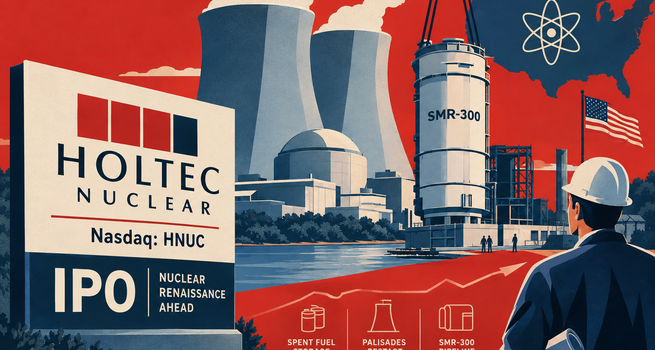
Holtec Nuclear Corporation (Nasdaq: HNUC), the newly formed Holding Company for 39-year-old nuclear technology veteran Holtec International, is preparing to go public on Nasdaq under the ticker “HNUC,” in what stands to be one of the most closely watched energy listings of 2026. The Camden, New Jersey-headquartered company is pitching itself not as a speculative small modular reactor (“SMR”) startup, but as a cash-generative, four-decade-old nuclear services incumbent that happens to be sitting on what may be the most credible SMR deployment pipeline in the United States.
Founded in 1986 by Dr. Krishna P. Singh, who remains Chairman and CEO, Holtec built its Business on unglamorous but highly defensible ground: spent nuclear fuel storage. Today it holds roughly 90% U.S. Market Share in wet fuel storage and about 75% share in dry storage — moats reinforced by patented technology, NRC licensing barriers, and multi-decade customer contracts. That legacy Franchise is now being used to fund a much bigger ambition: becoming America’s leading builder and operator of SMRs through its proprietary SMR-300 reactor, alongside the first-ever restart of a shuttered U.S. nuclear plant, Palisades in Michigan.
Key Highlights
- Holtec Nuclear (HNUC) IPO: 50M Class A shares at $15–$18, raising ~$775M. Exact pricing/listing date not yet set as of the S-1/A filing (September 8, 2026).
- Founder-controlled: Dr. Krishna P. Singh’s family keeps ~99% voting power via super-voting Class B shares.
- Dominant in spent nuclear fuel storage; restarting Palisades, the first-ever U.S. decommissioned plant restart.
- Developing the SMR-300 reactor, with a potential $400M DOE award, but still pre-construction.
- Reported profits are heavily boosted by non-operating trust-fund gains, not core operations.
Deal Structure, Financials, and Strategic Priorities
- Offering structure: 50 million Class A shares offered (57.5 million if the underwriters’ overallotment is exercised in full), representing only about 8.8% of pro forma economic ownership. Founder-controlled Holtec Holdings retains ~91.2% economic interest and, via super-voting Class B shares (10 votes each until a “Sunset” trigger), approximately 99.0% of voting power — making HNUC a controlled company under Nasdaq rules.
- UP-C structure with Tax Receivable Agreement: The IPO uses an umbrella partnership-C-corp (UP-C) structure. Holtec Nuclear will hold Class A Interests in operating entity Holtec International and enter a Tax Receivable Agreement paying legacy owners 85% of realized tax savings from future exchanges — a Liability the company estimates at a present value of roughly $1.6 billion.
- Financial profile: Revenue was $576.6 million in FY2025 (down from $765.5 million in FY2024, largely on lower decommissioning and cask-sale volumes) with EBITDA Margin of 86%, though margins are heavily flattered by non-operating items — realized/unrealized gains on Nuclear Decommissioning Trust (NDT) investments and asset retirement obligation remeasurement gains. Backlog stood at roughly $10.6 billion in NPD and $10.2 billion tied to Palisades as of June 30, 2026.
- Palisades restart — the flagship catalyst: Holtec is on track to complete the first-ever restart of a decommissioned U.S. nuclear plant, an 800 MW Facility in Covert, Michigan, backed by a DOE Loan guarantee facility of up to $1.52 billion and a $300 million Michigan state grant. Nuclear fuel loading began August 30, 2026. Two 28-year power purchase agreements with Wolverine Power and Hoosier Energy underpin the economics.
- SMR-300 pipeline: Holtec submitted Part I of its construction permit application for its first dual-unit SMR-300 project (Pioneer One and Two, also at Palisades) in December 2025 and was selected for a DOE Tier 1 First Mover Award potentially worth $400 million (subject to a definitive funding agreement). Management points to a ~47 GW global “opportunity pipeline,” though none of it is yet contracted or under construction.
- NAMCO Restructuring: Ahead of the IPO, Holtec is shifting ownership of four decommissioning sites (Oyster Creek, Pilgrim, Indian Point, Big Rock Point) to DEAMCO, an affiliate controlled by the same founder family, aiming to reduce Holtec Nuclear’s direct exposure to decommissioning trust Volatility while retaining services revenue through Subsidiary HDI. Phase II of this restructuring still requires NRC approval.
- Use of proceeds: Net proceeds (~$775.2 million at the midpoint) will be used to purchase Class A Interests in Holtec International, funding SMR-300 licensing and Manufacturing capacity, Holtec Green Boiler and HI-THERM HCSP commercialization, and expansion into cybersecurity/defense services.
- Bookrunners: J.P. Morgan, Guggenheim Securities, Goldman Sachs, Citigroup and BofA Securities are lead joint book-running managers, alongside Morgan Stanley, Cantor Fitzgerald, BMO Capital Markets and Oppenheimer.
The Bull Case
Nuclear power has re-entered the center of U.S. energy policy amid surging Data Center and AI-driven electricity demand, and Holtec is arguably the only company that can claim to be simultaneously (1) the dominant incumbent in spent fuel management, (2) the operator restarting the first shuttered U.S. reactor, and (3) a credible SMR developer with an actual site, actual NRC filings, and actual federal funding commitments. Its vertically integrated model — in-house design, licensing, manufacturing across three U.S. plants, and even plant operation — is a genuine differentiator against SMR pure-plays like NuScale or Oklo, which lack manufacturing scale or operating licenses.
The Bear Case
Governance is the standout concern: this is a controlled company in the fullest sense, with the founder and his family retaining near-total voting control indefinitely and material related-party transactions (loans from and to entities like Harbor Associates and Mariner Strategic Investments, insurance arrangements with founder-controlled captives, and the NAMCO Restructuring itself) running throughout the capital structure. The company also disclosed material weaknesses in internal controls over financial reporting for 2025, and reported Earnings are heavily inflated by NDT Investment gains and ARO remeasurement — not organic operating profit. The SMR-300 and Holtec Green Boiler/HI-THERM HCSP technologies remain commercially undeployed, and the $2.6 billion Tax Receivable Agreement liability could weigh on future free cash flow.
Disclaimer: This article is based on Holtec Nuclear Corporation’s Form S-1/A filed with the SEC on September 8, 2026, and is intended for informational purposes only. It does not constitute investment advice or a recommendation to buy or sell any security. Prospective investors should review the full prospectus, including the “Risk Factors” section, before making any investment decision.


 Oct 28, 2026





 Please wait processing your request...