
 CA
 NZ
 UK
 AU
 IND

 US

 Share
 X (Formerly Twitter)
 Whatsapp
 Facebook
 LinkedIn
 Telegram
 Email This Article
 Copy Link
 Summarize with AI
 Chat GPT
 Perplexity
Key Highlights
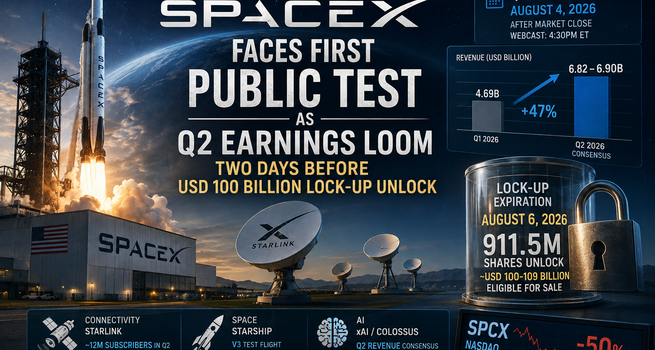
- Wall Street consensus calls for Q2 revenue of USD 6.82-6.9 billion, a roughly 47% sequential jump from USD 4.69 billion in Q1 2026, with a non-GAAP loss of USD 0.23 to 0.26 per share
- Starlink remains the only consistently profitable segment, with subscribers expected to reach roughly 12 million in Q2, though average revenue per user has fallen from USD 99/month in 2023 to about USD 66
- Up to 911.5 million restricted shares, worth roughly USD 100-109 billion, become eligible for sale on August 6, two trading days after the earnings report
A Thin, Troubling Baseline
SpaceX's IPO prospectus disclosed a net loss of USD 4.9 billion for full-year 2025, followed by a further USD 4.28 billion loss in Q1 2026 on revenue of just USD 4.69 billion, a loss-to-revenue ratio that would concern analysts at almost any other company commanding a trillion-dollar-plus valuation. Wall Street consensus calls for Q2 revenue near USD 6.82-6.9 billion and a non-GAAP loss of USD 0.23 to 0.26 per share. Estimates diverge unusually widely, with published analyst forecasts ranging from a loss of USD 1.26 to a profit of USD 0.33 per share, because SpaceX only began reporting under a new three-segment structure (Connectivity, Space, AI) this quarter, and nobody has a full model calibrated to real disclosed numbers yet.
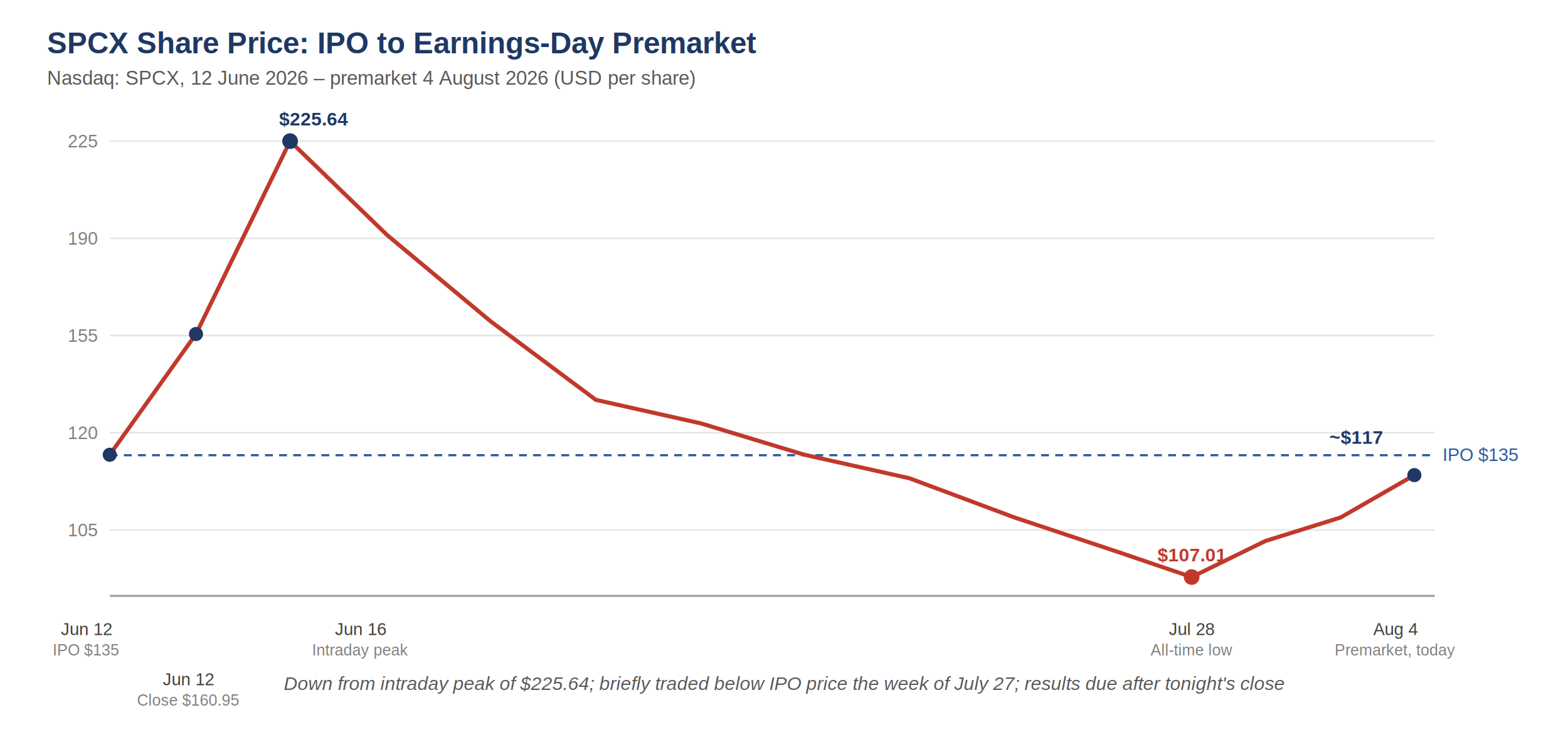
Figure 1: SPCX share price, IPO through premarket trading on earnings day. Source: Nasdaq market data.
Three Segments, Three Stories, One Profitable
Starlink, folded into the Connectivity segment, remains the sole consistently profitable business. It generated USD 11.39 billion of 2025 revenue, 61% of the company total, and USD 4.42 billion of segment income. Q1 2026 subscribers reached 10.3 million across 164 countries, up 105% year-over-year, with consensus expecting roughly 12 million by Q2. The unit economics are softening even as the base grows, however: average revenue per user fell from roughly USD 99 per month in 2023 to about USD 66 in Q1 2026, a 33% decline driven by aggressive expansion into price-sensitive markets across Africa and Southeast Asia. SpaceX's own prospectus disclosed that this trend will continue. Analyst consensus puts Q2 Connectivity margin at 35.9%, expanding to 43.1% by FY2027, an assumption the market has not yet seen validated by an actual reported quarter.
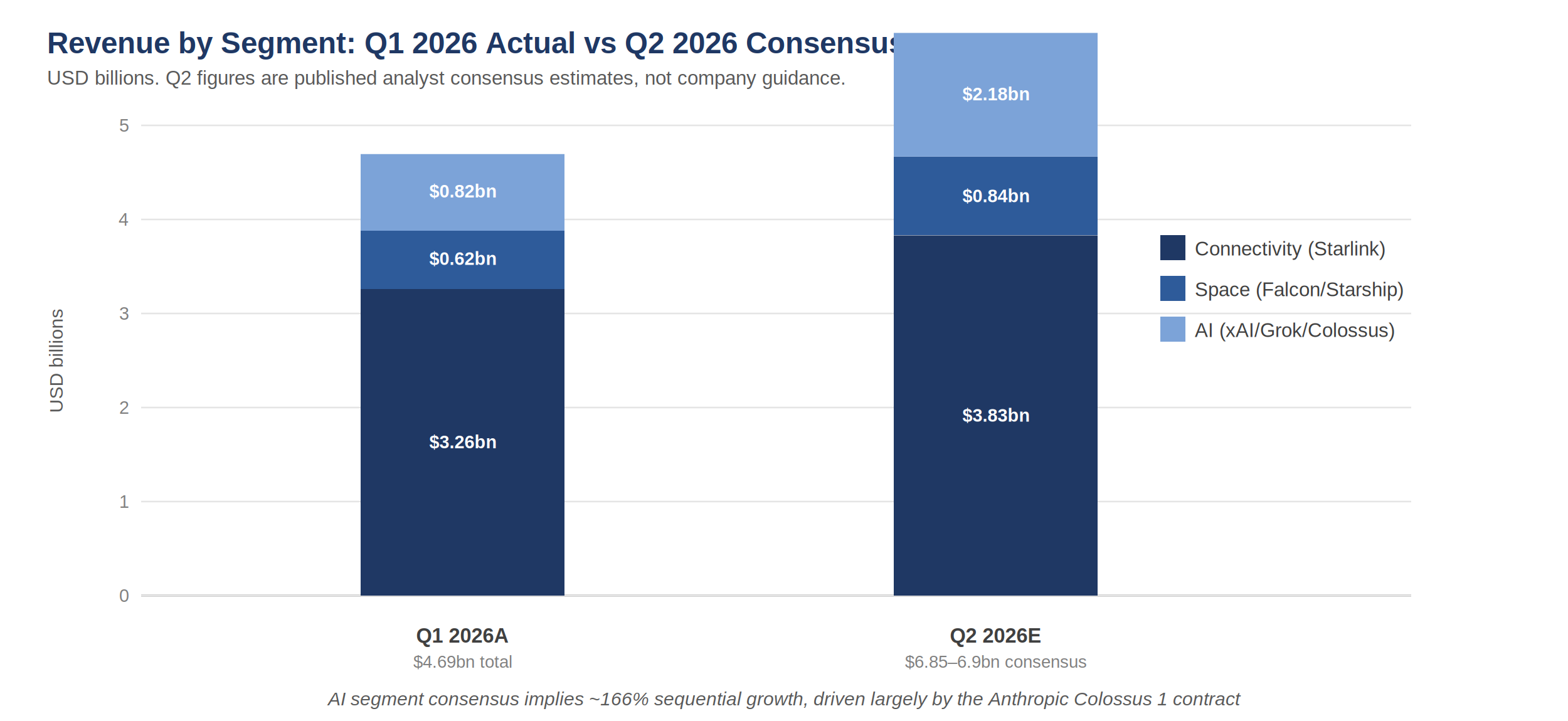
Figure 2: Revenue by segment, Q1 2026 actual vs Q2 2026 consensus. Source: SpaceX IPO prospectus, published analyst consensus.
The Space segment, covering Falcon, Dragon and Starship, is structurally lossmaking even as launch cadence scales, and it now carries the added weight of Starship's development bill. SpaceX has spent more than USD 15 billion on the Starship program to date. The twelfth Starship test, and the first flight of the V3 variant with Raptor 3 engines, flew on May 22, 2026; SpaceX flew only five Starship missions in all of 2025 against an internal target of 25. That cadence gap matters directly to the Connectivity story, because V3-class Starlink satellite deployment depends on Starship reaching operational tempo, and any further slippage compounds the capacity constraint just as Amazon's Kuiper enters commercial service. Amazon has committed USD 10 billion to Kuiper and signed beta distribution partnerships with Verizon, AT&T and Vodafone.
AI is the newest and most consequential variable, and it is the segment analysts admit they understand least. SpaceX absorbed Elon Musk's xAI in a February 2026 all-stock merger, and the combined AI business, comprising Grok, X, and AI infrastructure including the Colossus GPU clusters, posted USD 818 million of Q1 revenue against a USD 2.46 billion operating loss and negative USD 609 million adjusted EBITDA. Consensus expects AI revenue to nearly triple sequentially to roughly USD 2.18 billion in Q2, though the quarter's outcome is widely regarded as highly uncertain because of this segment's opacity. One disclosed data point offers a partial explanation: Anthropic agreed in May 2026 to pay USD 1.25 billion per month for exclusive access to Colossus 1, SpaceX's Memphis facility housing an estimated 220,000 to 325,000 NVIDIA GPUs, on a contract running through May 2029. Q2 captures roughly two months of that revenue, an estimated USD 2.5 billion, which on its own accounts for most of the segment's expected growth.
The Capital-Intensity Math
The figure that should draw the most institutional scrutiny is spending relative to cash generation. Consensus places Q2 capital expenditure near USD 12.9-13.2 billion against adjusted EBITDA of only about USD 2.1 billion, meaning spending runs more than six times cash generation in a single quarter. Annualised, that implies roughly USD 51.8 billion of 2026 capital expenditure against a USD 39 billion consensus full-year revenue estimate, a spending-to-revenue ratio of 133%. Free cash flow is expected to be near negative USD 1.9 billion for the quarter alone.
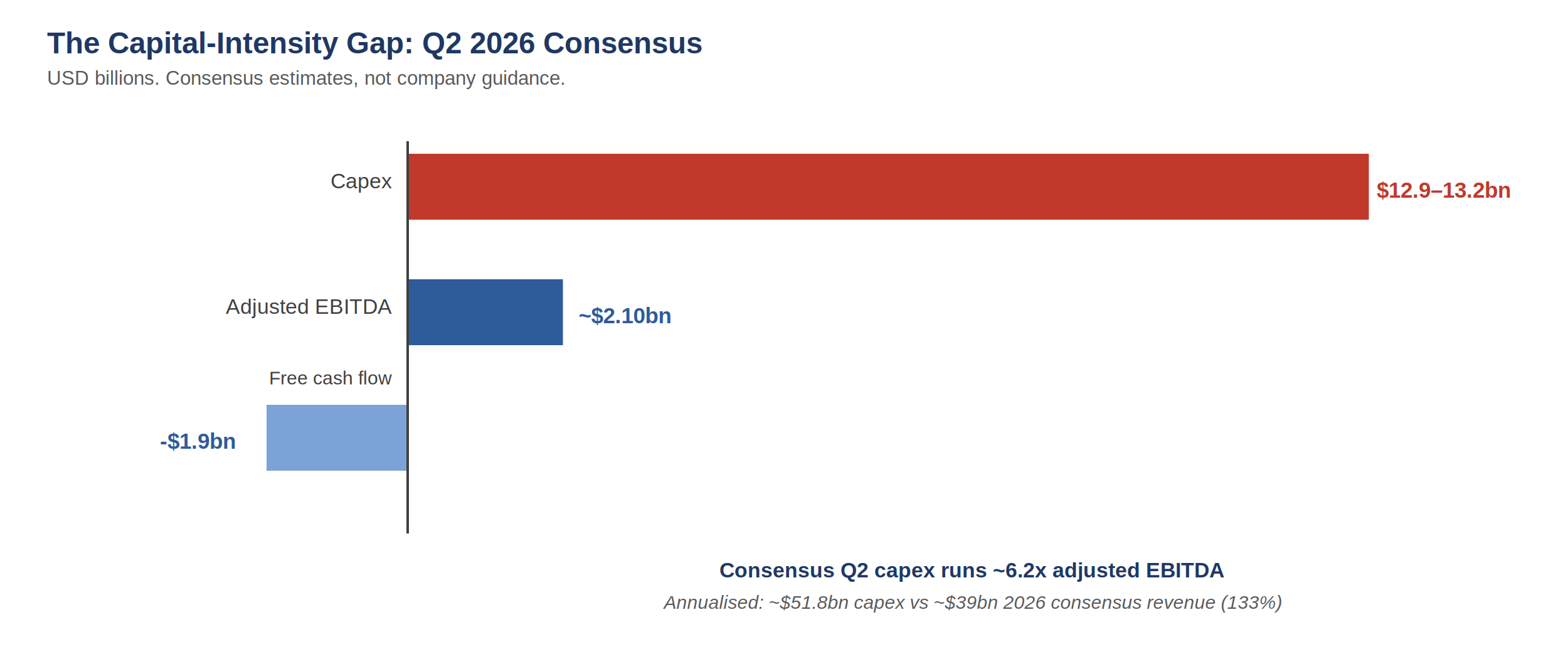
Figure 3: Consensus Q2 2026 capex, adjusted EBITDA, and free cash flow. Source: Published analyst consensus, company disclosures.
The Compressed Catalyst Window
The timing compounds the stakes. Two trading days after the earnings report, on August 6, up to 911.5 million restricted shares, representing 20% of insider holdings and worth roughly USD 100-109 billion at recent prices, become eligible for sale under SpaceX's staggered lock-up structure. That is a supply shock larger than the original IPO itself. SpaceX priced its IPO at USD 135 per share on June 12, 2026, raising USD 85.7 billion in the largest listing in history and implying a valuation north of USD 1.77 trillion. The stock closed its debut day at USD 160.95 and touched an intraday high of USD 225.64 four days later, before falling to as low as USD 104.83 by early August, a decline of over 50% from peak that briefly took shares below the IPO price itself.
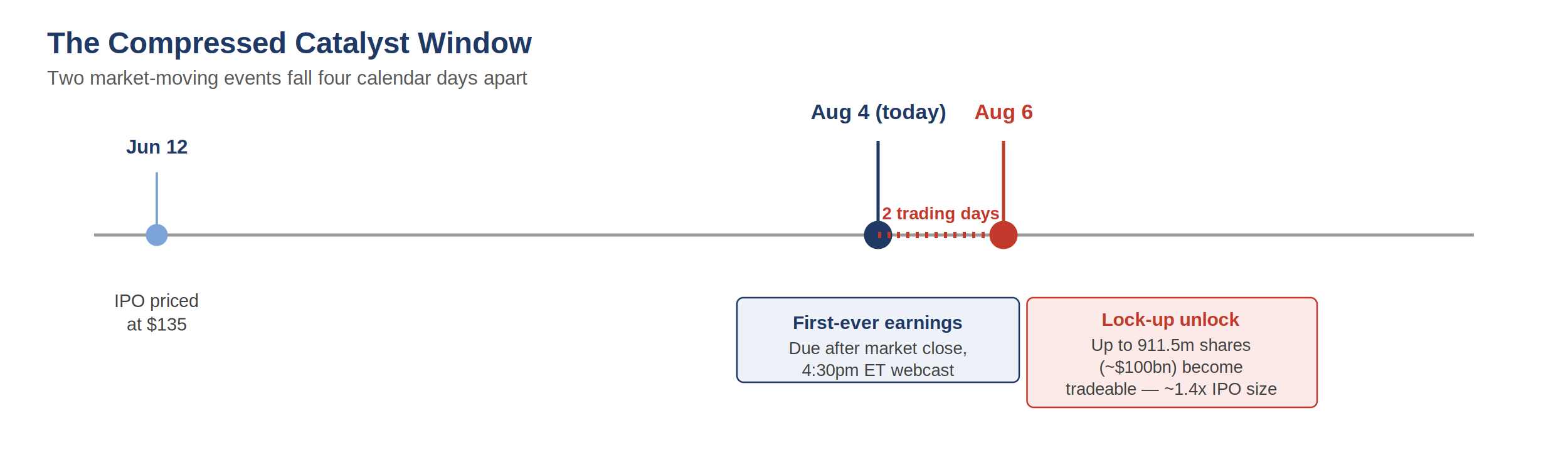
Figure 4: The two-event catalyst window bracketing the first earnings report. Source: SpaceX IPO prospectus, lock-up agreement terms.
Future Outlook
SpaceX currently trades around 36 to 49 times expected revenue depending on the estimate used. At least one major bank maintains an Overweight-equivalent rating with a USD 300 price target, implying over 170% upside from recent levels, though its own valuation model attributes more than half of that target to the unproven enterprise-AI business rather than the launch franchise that built the company. That is the real test this earnings report sets: whether Starlink's cash generation, AI's monetisation path, and Starship's schedule can jointly justify a valuation built mostly on the segment nobody has yet seen a clean quarter from.
Investors will be watching for four signals in particular, summarised below, and the company's ability to deliver on these fronts simultaneously will be critical to stabilising the stock ahead of the lock-up expiration.
|
Signal |
Why it matters |
|---|---|
|
Starlink near 12M subscribers with stable ARPU |
Confirms the core cash engine is scaling, not just growing; margin, not just users, must hold |
|
AI revenue near USD 2.18bn with clearer contract disclosure |
Separates durable Colossus/enterprise revenue from one-off infrastructure rent |
|
Capex near or below USD 12.9bn, or a credible return framework |
Higher spend may be tolerated only if tied to dated Starship and capacity milestones |
|
Explicit guidance connecting spend to future free cash flow |
The market needs a timeline, not a restated long-term vision |
Analysis based on SpaceX’s IPO prospectus and published Wall Street analyst consensus estimates ahead of the Q2 2026 earnings release scheduled for 4 August 2026; figures are consensus estimates unless stated as company-disclosed.
This article is for informational purposes only and does not constitute financial advice. Please consult a licensed financial adviser before making investment decisions.


 Oct 28, 2026





 Please wait processing your request...