
 CA
 NZ
 UK
 AU
 IND

 US

 Share
 X (Formerly Twitter)
 Whatsapp
 Facebook
 LinkedIn
 Telegram
 Email This Article
 Copy Link
 Summarize with AI
 Chat GPT
 Perplexity
Key Highlights
- Sanofi agrees to buy Insmed for USD 175 per share in cash.
- Deal values Insmed Equity at about USD 41.0 billion, a 46% premium.
- Insmed rose 14.32% premarket to USD 170.44; Sanofi ADRs gained 5.22%.
- Closing is scheduled for the first half of 2027.
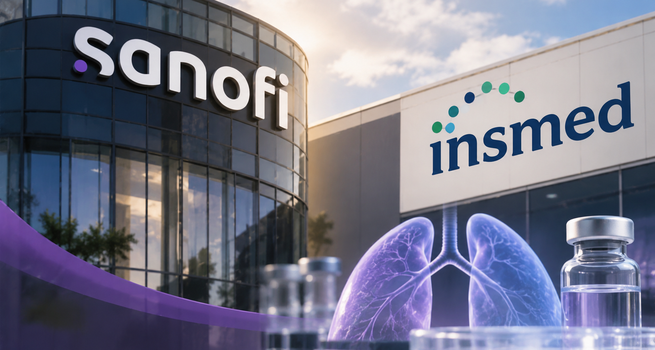
Sanofi (NASDAQ:SNY) announced on Tuesday that it agreed to acquire Insmed (NASDAQ:INSM) for USD 175 per share in cash, valuing the New Jersey drugmaker's equity at about USD 41.0 billion (EUR 37.6 billion). The price sits 46% above Insmed's unaffected close on Nov. 18, the day before media reports of a Takeover approach. The purchase adds two approved lung medicines and a late-stage pipeline to Sanofi as it prepares for the loss of Patent protection on its blockbuster asthma drug Dupixent.
The Deal: USD 175 in Cash per Share
The offer works out to about 17.5% above Insmed's Monday close of USD 149.09, and 46% above the Nov. 18 close that predates the takeover reports. Insmed's Market Value stood at about USD 32.7 billion at Monday's close, so the USD 41.0 billion price adds roughly USD 8.3 billion to what public investors valued the company at before the announcement. Sanofi pays with a mix of Debt and cash on hand and has secured committed financing.
Both boards approved the agreement. Closing needs a vote from Insmed shareholders, clearance from U.S. and certain non-U.S. regulators and other customary conditions, and Sanofi schedules completion for the first half of 2027.
On finances, Sanofi sees the deal adding to Business Earnings Per Share by the end of 2028 and leaves its 2026 guidance unchanged. The company keeps its progressive dividend, expects to hold a strong Credit rating and says cash generation supports rapid debt reduction.
Stock Reaction: Insmed Jumps, Sanofi Rises
Insmed shares climbed USD 21.35, or 14.32%, to USD 170.44 in premarket trading, up from USD 149.09 at Monday's close. That leaves the stock about 2.6% below the USD 175 offer, a gap that covers the time and approvals still ahead.
Sanofi trades on Euronext Paris under SAN and in the United States through ADRs under SNY. Those ADRs gained USD 2.44, or 5.22%, to USD 49.21 in premarket trading, after closing Monday at USD 46.77.
What Sanofi Is Buying: Two Medicines and a Late-Stage Pipeline
Insmed is based in Bridgewater, New Jersey, and employs about 1,700 people. BRINSUPRI is its lead product. This once-daily pill treats non-cystic fibrosis bronchiectasis, a chronic lung disease in which damaged airways stay permanently widened and cause ongoing cough and flare-ups. It is the first and only approved treatment for the condition and the first drug that blocks DPP1, an enzyme behind airway inflammation. Regulators in the United States, the European Union, the United Kingdom and Japan approved it, and the U.S. and Japanese labels cover adults and children aged 12 and older. Since its U.S. launch in August 2025, it has generated USD 1.09 billion in Revenue through Sept. 30, 2026. Insmed estimates that about 500,000 people in the United States, 600,000 in five major European markets and 150,000 in Japan carry a diagnosis.
ARIKAYCE is an inhaled antibiotic for certain adults with a lung infection called mycobacterium avium complex, or MAC, who did not respond to earlier treatment. It is the only approved inhaled therapy specifically for these treatment-refractory patients in the United States, the European Union and Japan. Revenue reached USD 433.8 million in 2025, up 19%. In September, the U.S. Food and Drug Administration accepted a priority-review application to broaden its use in MAC lung disease.
TPIP (treprostinil palmitil inhalation powder) is a once-daily inhaled therapy in phase 3 trials for pulmonary arterial hypertension, pulmonary hypertension linked to interstitial lung disease and progressive pulmonary fibrosis. A phase 3 study in idiopathic pulmonary fibrosis is scheduled to start in the first half of 2027. Sanofi sees TPIP as a growth driver beyond 2030 if development, approvals and launches succeed. No regulator has approved it, and its safety and efficacy remain unestablished.
Sanofi also gains earlier-stage programs and research capabilities in immunology and rare diseases.
Why Sanofi Wants It: Life After Dupixent
Sanofi Chief Executive Belen Garijo took over in May with a mandate to strengthen the pipeline before Dupixent loses patent protection in the early 2030s. Since then she has launched a strategic review, reshaped the executive committee and reached an expanded deal with partner Regeneron. The Insmed purchase is her largest move so far.
Garijo calls the Acquisition a major strategic step that speeds up growth and strengthens the mid- and early-stage pipeline. She says it builds on Sanofi's respiratory presence and its experience in immunology and rare diseases. Sanofi puts combined peak sales potential for the Insmed portfolio above USD 10 billion through the end of the next decade, and a Sanofi executive said the deal brings annual cost benefits of more than USD 500 million. The company keeps room for smaller deals, mainly in early-stage immunology, rare disease and Vaccine assets.
Insmed Chair and Chief Executive Will Lewis said his team made BRINSUPRI the standard of care within just over a year of launch. He called the transaction immediate, certain cash value for shareholders and said Sanofi's global reach brings the medicines to more patients faster. Sanofi's former chief executive, Paul Hudson, joined Insmed's board in October.
What Happens Next
Insmed shareholders hold a cash offer of USD 175 per share at a 46% premium to the unaffected price. Sanofi holds two commercial lung medicines, one of which produced USD 1.09 billion in revenue in its first 13 months on the U.S. market, plus a phase 3 pipeline in rare respiratory disease. Completion rests on the Insmed Shareholder vote and regulatory approvals, scheduled for the first half of 2027.


 Nov 23, 2026





 Please wait processing your request...