
 CA
 NZ
 UK
 AU
 IND

 US

 Share
 X (Formerly Twitter)
 Whatsapp
 Facebook
 LinkedIn
 Telegram
 Email This Article
 Copy Link
 Summarize with AI
 Chat GPT
 Perplexity
Key Highlights
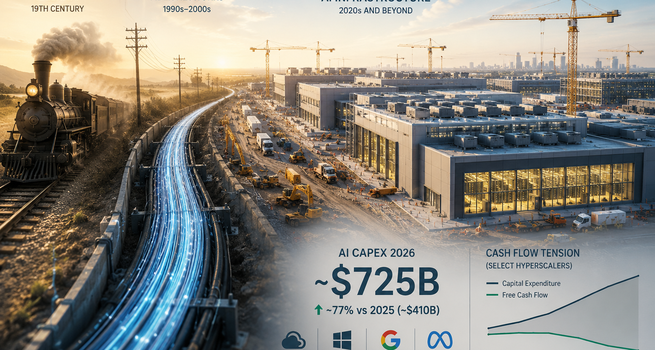
- Four major hyperscalers are guiding toward roughly USD 725 billion in combined 2026 capital expenditure, up about 77% from approximately USD 410 billion in 2025
- Free Cash Flow has already turned negative at multiple hyperscalers, with one company's quarterly free cash flow falling more than 90% year over year
- Nvidia's Data Center Revenue has grown sharply year over year, with financing arrangements increasingly linking its results to the spending of its own customers
- The Bank for International Settlements and the International Monetary Fund have both flagged hyperscaler Debt growth and valuation concerns in mid-2026 reports
- The core tension sits between decades-long infrastructure Economics and a cash flow picture that is deteriorating far faster than revenue is growing
A Record Spending Cycle Meets a Market That Is Starting to Flinch
Alphabet Inc (NASDAQ:GOOGL) raised its 2026 Capital Expenditure guidance alongside second-quarter Earnings in late July, and the market response was immediate. Shares slid even though cloud revenue growth had accelerated sharply from the prior year, and the company's quarterly free cash flow turned negative for the first time since its 2004 public listing. The decline pulled Amazon (NASDAQ:AMZN), Meta (NASDAQ:META), and Microsoft (NASDAQ:MSFT) down with it as all three prepared to report their own results days later. For a company that Wall Street had long favoured for its ability to convert heavy capital spending into revenue, the reaction marked a shift. Investors who had spent recent quarters cheering capex increases as proof of Demand began treating them instead as a warning sign.
The scale of the spending is difficult to overstate. The four hyperscalers are collectively guiding toward roughly USD 725 billion in capital expenditure for 2026, up around 77% from approximately USD 410 billion the prior year, and some estimates that include the broader hyperscaler cohort put the figure closer to USD 860 billion. Amazon has raised its own 2026 guidance from USD 200 billion to USD 220 billion. Microsoft is tracking near USD 190 billion. Alphabet has lifted its guidance to a range of USD 195 to 205 billion. Meta has raised its guidance floor twice, most recently to a range of USD 130 to 145 billion. Some analysts now project combined hyperscaler capex could approach nearly USD 1.2 trillion in 2027.
The question the market is now asking is not whether artificial intelligence represents a genuine technological shift. It is whether the cash generated by these businesses can keep pace with what they are committing to spend, and what happens to the companies most exposed if it cannot.
The Growth Case: Supply Constrained, Not Demand Constrained
The companies making this spending commitment argue their constraint is capacity, not demand. Microsoft has described its cloud Business as capacity constrained, meaning it is turning away revenue it cannot yet serve. The company's AI business reported an annual revenue run rate above USD 37 billion as of its fiscal third quarter, growing well over 100% year over year, alongside a sharp rise in commercial remaining performance obligations, a measure of contracted future revenue, which reached USD 678 billion in the fiscal fourth quarter, up 84% year over year. Notably, Microsoft remains the only major hyperscaler to keep Operating Cash Flow comfortably ahead of capital expenditure, reporting operating cash flow of roughly USD 55.4 billion against capital expenditure of about USD 35.8 billion in its most recent quarter, even as that capex more than doubled year over year, growing far faster than cash flow itself.
Alphabet has pointed to a similar demand picture. Google Cloud revenue growth accelerated to 82% year over year, and its backlog, a measure of contracted future work, has grown to USD 514 billion. Amazon Web Services grew revenue by close to 37% in its most recent quarter, and Amazon's custom AI chip business has reached an annualised revenue run rate near USD 25 billion. Nvidia Corporation (NASDAQ:NVDA), the dominant supplier of AI Training chips, reported data center revenue growth of roughly 92% year over year in its most recent quarterly results, with networking revenue growing considerably faster still.
Executives have also pushed back on the idea that this capital is being spent carelessly. Amazon's Leadership has argued that data centers, once built, can generate revenue for thirty years or more, even though the servers and networking equipment inside them typically have a useful life closer to five or six years and can break even in under three. On this view, the headline capital expenditure figure overstates the risk, because the underlying real estate and power infrastructure retains long-term value even as individual hardware generations are replaced quickly.
The Cash Flow Case: Where the Growth Story Meets Its Limits
The counterargument is no longer theoretical. It is visible in the same earnings reports that support the growth case. Meta's free cash flow fell approximately 91% year over year in the second quarter to just USD 784 million, down from USD 8.55 billion a year earlier, as quarterly capital expenditure of USD 31.1 billion consumed roughly 98% of operating cash flow. The company still paid out more in dividends than it generated in free cash flow for the quarter, without repurchasing any shares, and separate reporting has noted Meta's overall cash balance falling sharply year over year as the buildout accelerates.
Amazon's trailing twelve-month free cash flow turned negative at approximately negative USD 7.6 billion, down from positive USD 18.2 billion a year earlier, even as quarterly capital expenditure reached USD 54.2 billion. Alphabet's own quarterly free cash flow also turned negative in the same period, at roughly negative USD 5.9 billion, even though its trailing twelve-month figure remained positive at approximately USD 53.3 billion. Alphabet ended the second quarter with total cash, cash equivalents, and marketable securities of USD 242.5 billion, after issuing USD 20.3 billion in debt through senior unsecured notes and pricing an Equity raise of roughly USD 84.75 billion, combining common and mandatory convertible preferred stock with an at-the-market share program, specifically to help fund the buildout. One estimate puts aggregate free cash flow across the eight largest global hyperscalers swinging from a positive USD 180 billion in 2025 to roughly negative USD 64 billion in 2026, and deteriorating further to negative USD 144 billion in 2027 and negative USD 186 billion in 2028.
Layered on top of this is the financing structure connecting the companies supplying AI infrastructure to the companies buying it. Nvidia has been in discussions to backstop financing for a large OpenAI data center project and has explored financing OpenAI's purchases of its own chips. Commentators have labelled this pattern circular financing, where chip suppliers invest in the companies that buy their chips and cloud providers sign multi-year purchase commitments with AI model developers who in turn depend on those same providers for computing capacity. Estimates of the total value of these interlinked arrangements across the major hyperscalers, chipmakers, and leading AI model developers run into the hundreds of billions of dollars in equity stakes alone, with multi-year purchase commitments considerably larger still. Analysts have also noted that headline figures in these arrangements often start as non-binding letters of intent well before, or instead of, signed contracts, and that the gap between the two can be worth hundreds of billions of dollars once deals are formalised.
Regulators have taken note of both threads. The Bank for International Settlements, in its Annual Economic Report 2026, named the sustainability of the AI Investment boom as one of the top pressure points facing the global financial system, warning that hyperscaler capital expenditure now exceeds earnings and free cash flow for several firms and is increasingly funded through debt and opaque financing structures. The International Monetary Fund's July 2026 World Economic Outlook update flagged the risk of a sharp correction in valuations tied to AI-exporting economies. Underlying model developers add to the concern: some leading AI companies are reportedly on track for multibillion dollar annual losses in 2026 even as revenue grows quickly, meaning parts of the financing structure depend on continued access to capital rather than on current profitability.
Historical Precedent: Why Transformative and Overbuilt Are Not Opposites
Framing this as a binary choice between Bubble and industrial revolution may be the wrong starting point. Historically, the two have coexisted rather than competed. Railway construction in nineteenth-century Britain was both a genuine transportation revolution and a speculative capital cycle that wiped out large numbers of investors when the bubble collapsed. Electrification followed a similar arc. The telecom fiber buildout of the late 1990s and early 2000s left the United States with genuinely transformative internet infrastructure, built in large part by companies that went bankrupt because they had laid capacity years ahead of the demand that would eventually use it.
The pattern in each case was the same: the technology's long-term value was real, but the first wave of capital funding its buildout was priced for a demand curve that arrived later, or looked different, than investors expected. Applying that lens to AI capital expenditure today does not require betting against the technology itself. It requires separating the question of whether artificial intelligence will matter economically, which the revenue and Backlog figures above suggest it already does, from the separate question of whether the current financing structure and cash flow trajectory are pricing that outcome correctly.
What to Watch Rather Than Predict
Rather than forecasting an outcome, a small set of measurable indicators will show which way this resolves. Free cash flow trends at Alphabet, Amazon, and Meta are the most immediate signal, given that all three hyperscalers have now reported at least one negative free cash flow reading and forecasts point to a wider aggregate shortfall through 2028. Hyperscaler debt issuance and equity raises, of the kind Alphabet has already undertaken, offer a second marker of how much of this buildout is being funded with cash on hand versus external capital. The gap between announced letters of intent and signed, binding contracts across major AI financing deals is a third useful check, given how often headline deal values have been revised once formalised. Finally, the relationship between enterprise AI revenue growth and infrastructure spending growth will indicate whether demand is catching up to capacity or falling further behind it.
Conclusion
The revenue growth behind this spending cycle is real and, in several cases, accelerating. Google Cloud's growth has accelerated to 82%, Microsoft's AI business has crossed a USD 37 billion run rate, and Nvidia's data center revenue continues to expand at pace. At the same time, the cash flow evidence from the same earnings season is difficult to dismiss. Multiple hyperscalers have now reported negative free cash flow in at least one recent period, one has raised debt and equity specifically to fund capital spending, and the financing structure linking chipmakers, cloud providers, and AI model developers has drawn direct warnings from the Bank for International Settlements and the International Monetary Fund. Neither observation cancels out the other. The more useful question for markets over the coming quarters is not whether artificial intelligence is transformative, but whether the companies now spending at this pace can sustain it on their own cash generation, or whether the gap will need to be filled with debt, equity, and financing arrangements that concentrate risk among a small number of interlinked firms.

 Nov 03, 2026





 Please wait processing your request...