
 CA
 NZ
 UK
 AU
 IND

 US

 Share
 X (Formerly Twitter)
 Whatsapp
 Facebook
 LinkedIn
 Telegram
 Email This Article
 Copy Link
 Summarize with AI
 Chat GPT
 Perplexity
Key Highlights
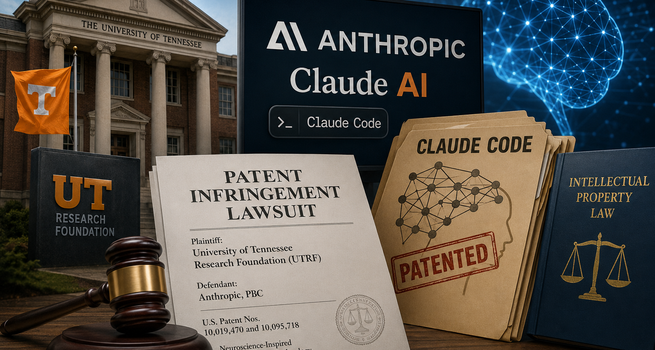
- Anthropic faces its first-ever patent infringement lawsuit, filed by the University of Tennessee Research Foundation.
- UTRF alleges Claude Code and its underlying software infringe two patents covering neuroscience-inspired neural network technology.
- The lawsuit follows just one day after a federal judge approved Anthropic's $1.5 billion copyright settlement with authors.
- Anthropic is reportedly preparing for a potential IPO as early as October 2026, targeting a $1 trillion valuation.
Anthropic, the AI company behind the Claude chatbot, is facing its first-ever patent infringement lawsuit, filed by the University of Tennessee Research Foundation (UTRF) in federal court in Delaware. The nonprofit organization claims Anthropic used patented neural network technology in its AI systems without permission. The lawsuit adds a new front of legal pressure on the privately held company just as it works toward a potential initial public offering, layering a patent dispute on top of a recently settled copyright case and underscoring the growing legal scrutiny facing major AI developers over the technology and data underpinning their products.
University Foundation Claims Claude Code Infringed AI Patents
UTRF filed the lawsuit on Monday, July 20, though it was made public a day later. In its complaint, the organization alleged that Anthropic's AI systems infringed two patents covering machine-learning technology built by researchers at the University. According to the filing, the disputed patents, U.S. Patent Nos. 10,019,470 and 10,095,718, cover improvements to neural networks and AI systems inspired by neuroscience.
The UTRF also claimed that Anthropic used this patented technology in Claude Code and its underlying software. The foundation said the products used protected methods for building brain-like computer networks, including systems that manage tasks in the background and improve memory use. As a result, UTRF is seeking legal action over the unauthorized use of its inventions, and the lawsuit is believed to be the first patent infringement case filed against Anthropic.
The specificity of the allegations, pointing to Claude Code and its underlying software rather than Anthropic's broader model lineup, suggests UTRF's complaint is targeting particular engineering choices in how Anthropic's coding-focused product handles background task management and memory, rather than the company's AI systems as a whole. Patent disputes of this kind typically hinge on detailed technical comparisons between the patented methods and the accused product's actual implementation, a process that can take months or years to work through in litigation before any finding of infringement is reached.
Patent Dispute Adds New Legal Pressure on Anthropic Ahead of IPO
The new patent dispute comes at a critical moment for Anthropic. Just one day before the lawsuit became public, a California federal judge approved the AI company's $1.5 billion settlement in a high-stakes copyright case. The suit was brought by authors who alleged that their books were used to train Claude AI without permission. While that dispute centered on training data, the new patent lawsuit targets the technology behind Anthropic's products.
This distinction is significant: the copyright settlement addressed how Anthropic's models were trained, while the UTRF complaint addresses the architecture and engineering methods used to build the systems themselves. Together, the two cases illustrate that Anthropic's legal exposure spans both the data inputs used to develop its models and the underlying technical design of its products, two separate categories of intellectual property risk that the company must now navigate in parallel.
UTRF is also seeking damages and has asked the court to stop Anthropic from using the disputed technology if it finds the AI firm infringed on the patents. An injunction of that kind, if granted, could carry significant operational implications for Anthropic, since Claude Code and its underlying software are specifically named in the complaint as the products said to incorporate the protected methods.
Anthropic's IPO Plans Continue Despite Legal Pressure
Meanwhile, the new legal pressure comes as Anthropic nears a potential IPO. The company has reportedly been meeting with investors and has already filed confidential draft IPO papers with the U.S. Securities and Exchange Commission. Reports also say that Anthropic may be targeting a public debut as early as October 2026.
The timing places the patent lawsuit squarely within the pre-IPO window during which the company's legal and financial disclosures typically draw heightened scrutiny from prospective investors and underwriters. Contingent liabilities such as active patent litigation are commonly disclosed in IPO prospectuses, meaning the UTRF case is likely to be a point of diligence as Anthropic's public listing process moves forward, alongside the terms and financial impact of the already-settled copyright case.
Prospective IPO investors evaluating Anthropic will likely want clarity on the potential financial exposure tied to the UTRF case, including the possibility of damages or an injunction affecting Claude Code specifically, since that product is named directly in the complaint as incorporating the disputed neural network methods.
Is Anthropic on the Stock Market?
Anthropic is still a privately held company with no publicly traded stock yet. However, reports show that the AI firm may be targeting a $1 trillion stock market debut in 2026, a valuation that would place it among the largest technology listings in history if achieved.
For now, investors and industry observers have no public shares to trade, meaning the immediate financial impact of the UTRF lawsuit, the copyright settlement, and the broader IPO preparations falls on Anthropic's private valuation and its ongoing conversations with prospective investors rather than on a publicly quoted stock price. Should the company proceed toward an October 2026 listing as reported, the resolution or continuation of both legal matters would likely factor into how the offering is eventually priced and received by public market investors.
What does the UTRF lawsuit against Anthropic allege?
The University of Tennessee Research Foundation alleges that Anthropic's Claude Code and its underlying software infringe two patents, U.S. Patent Nos. 10,019,470 and 10,095,718, covering neuroscience-inspired neural network technology.
Is this Anthropic's first patent lawsuit?
Yes, the lawsuit is believed to be the first patent infringement case filed against Anthropic.
Is Anthropic a publicly traded company?
No, Anthropic remains privately held, though reports say it may be targeting a $1 trillion IPO as early as October 2026.


 Nov 13, 2026





 Please wait processing your request...