
 AU
AU
 UK
UK
 CA
CA
 NZ
NZ
 IND
IND

 US
US

 Share
Share
 X (Formerly Twitter)
 Whatsapp
 Facebook
 LinkedIn
 Telegram
 Email This Article
 Copy Link
 Summarize with AI
 Chat GPT
 Perplexity
America's biggest cloud firms are spending at historic scale on AI infrastructure, sending free cashflows into negative territory. This analysis examines the structural shift in big tech's Capital model, its implications for investors, and whether the returns will ever justify the bill.
Key Highlights
- Amazon, Meta, and Microsoft are each projected to report negative free cashflow in at least one quarter this year.
- Combined Capital Expenditure by the five largest cloud firms is set to reach $800bn in 2025, surpassing the shale boom and dotcom-era telecoms build-outs.
- Future contracted Revenue commitments across Amazon, Google, Microsoft, and Oracle have risen to $2trn, from $730bn just a year ago.
- Off-balance-sheet data-centre Lease obligations now stand at $820bn, up threefold in twelve months.
- Chip suppliers including Nvidia, Broadcom, and Micron are capturing a disproportionate share of the profit pool the hyperscalers are generating for others.
For most of the past decade, the financial profile of America's dominant cloud-computing companies appeared close to impervious. Revenues compounded at double-digit rates, margins widened steadily, and free cashflows were ample enough to fund aggressive share buyback programmes while simultaneously financing the next phase of growth. That model has now fractured. The proximate cause is artificial intelligence, and the scale of what is being spent to pursue it is without precedent in corporate history.
The cashflow inversion
Profits at Amazon (Nasdaq:AMZN), Alphabet (NASDAQ:GOOGL), Meta (NASDAQ:META), Microsoft (NASDAQ:MSFT), and Oracle (NYSE:ORCL) continue to rise. Yet the gap between reported Earnings and actual cash generation has widened sharply. Accounting rules allow Capital Assets to depreciate gradually once built; they do not require the cash outlay to appear on income statements at the moment of spending. Cashflow statements are less permissive. Analysts now expect Amazon, Meta, and Microsoft each to record negative free cashflow in at least one quarter this year. Alphabet will barely remain above zero. Oracle, the most constrained of the group, has already moved decisively into negative territory.
The mechanism is not obscure. The five firms are collectively expected to spend $800bn this year outfitting data centres with the computing hardware required to train and deploy large-scale AI models. Expressed as a share of their combined revenues, capital expenditure will reach approximately 40%, a ratio that exceeds the oil industry during the United States shale expansion of the 2010s and the telecommunications sector at the peak of the dotcom build-out in the late 1990s. Both of those earlier episodes ultimately produced significant capital destruction. Whether this one will differs largely on the question of whether AI revenues can grow to match the infrastructure being assembled to support them.
Reassessing the valuation anchors
Arguments that the current spending wave is fundamentally different from prior episodes of capital excess have lost much of their force. The big spenders generate real cashflows, went one argument; that is no longer straightforwardly true. Buybacks signal management confidence in valuation, went another; repurchase activity collapsed in the most recent quarter across several of the hyperscalers. A third argument held that valuations remain moderate at roughly 23 times forecast earnings. That figure is less reassuring when the denominator, reported earnings, captures almost none of the capital being deployed. Earnings-based multiples are poorly suited to valuing businesses undergoing balance-sheet transformations of this magnitude.
Investors have increasingly shifted their attention toward forward revenue commitments as an alternative anchor. Total contracted future revenues at Amazon, Alphabet, Microsoft, and Oracle, now stand at approximately $2trn, compared with $730bn a year earlier. The majority of these contracts involve selling computing capacity to AI model developers, many of which are themselves consuming capital at a rate that exceeds their revenues. The chain of financial dependency is therefore longer and more fragile than headline contract figures imply.
The restructuring of big tech's balance sheets
The capital transformation is visible in how these companies are financing themselves. Since the beginning of last year the five firms have collectively raised $260bn from bond markets, representing approximately one quarter of all Investment-grade non-financial Corporate Bond issuance in the United States over that period. Nearly a third of new bond issuance this year is denominated in currencies other than the dollar. Alphabet is preparing its first yen-denominated bond offering, a structural shift for a company that historically required no external financing whatsoever.
Obligations that do not appear directly on balance sheets are growing faster still. Future payments committed to leasing data centres not yet built have risen to $820bn, up from $270bn a year ago. Commitments to procure chips and other equipment to Fill those facilities add a further $680bn at Amazon, Alphabet, Meta, and Oracle. Special-purpose vehicles have been constructed to house portions of this exposure off the primary corporate Balance Sheet. The bond issued to finance Meta's new Louisiana data centre was the largest single corporate bond transaction in history at the time of issuance. Oracle's chief financial officer recently described plans to structurally separate the company's cashflows from its capital expenditure profile, language that signals further financial engineering ahead.
Where the returns are actually accruing
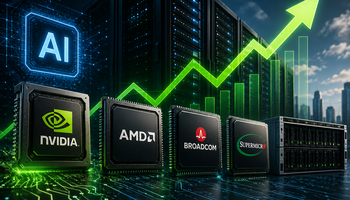
The capital being deployed by the hyperscalers has created an unusual dynamic in Equity markets. The five firms have effectively assumed the role of infrastructure financiers for the broader AI economy, absorbing costs that the model-making layer cannot yet bear. The beneficiaries of this arrangement are largely their suppliers. Nvidia (NASDAQ: NVDA), Broadcom (NASDAQ: AVGO), Micron Technology (NASDAQ: MU), and Western Digital's (NASDAQ:WDC) recently spun-out flash storage unit Sandisk together account for approximately one quarter of expected profit growth in the S&Amp;P 500 this year. Only Alphabet's shares have outperformed the NASDAQ Composite index over the past twelve months among the hyperscalers themselves.
Contract quality is also receiving more scrutiny. Investors have penalised Oracle's shares after concluding that its contracted revenue is heavily concentrated in a single counterparty relationship with OpenAI, a privately held firm with its own acute capital pressures. More broadly, legal professionals advising lenders report that documentation in AI financing structures has deteriorated as transaction volumes have accelerated. The terms governing data-centre leases, in particular, may offer hyperscalers more room to renegotiate than the headline commitment figures suggest. Whether those provisions will be tested depends entirely on the pace at which enterprise Demand for AI products and services scales to absorb the capacity being built.
The structural question that remains unanswered
None of the forces driving capital expenditure higher show any near-term sign of moderating. The operating logic is straightforward: AI models continue to require more computing power as they scale, equipment costs remain elevated, and no individual hyperscaler is willing to risk competitive disadvantage by pulling back unilaterally.
The result is a build-out that is rational at the level of the individual firm but that carries macro-level Financial Risk. At around 40% of revenues, the implied payback period on invested capital requires enterprise AI adoption to follow an exceptionally steep upward trajectory. Whether demand delivers that trajectory remains the defining uncertainty in the valuation of every major technology company listed in the United States.


 Jun 05, 2026



 Please wait processing your request...