
 CA
 NZ
 UK
 AU
 IND

 US

 Share
 X (Formerly Twitter)
 Whatsapp
 Facebook
 LinkedIn
 Telegram
 Email This Article
 Copy Link
 Summarize with AI
 Chat GPT
 Perplexity
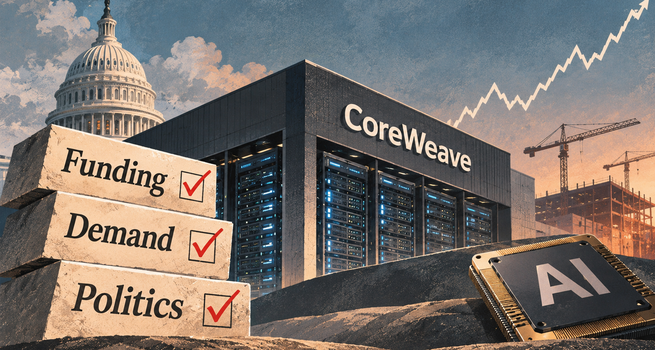
The GPU cloud provider grew Revenue 168%, lifted guidance, and said it will stay out of the unsecured Bond Market at current yields. Investors sent the stock up nearly 25% on the day.
Wall Street went into CoreWeave's third-quarter report wanting answers to three questions. Can a company carrying nearly $47 billion of Debt keep funding itself while its bonds trade at distressed levels? Is the Demand behind that debt pile real? And did last week's Democratic election sweep just kneecap the Data Center build-out it depends on?
On Wednesday, the market delivered its verdict. CoreWeave (NASDAQ:CRWV) shares closed at $60.77, up $12.04, or 24.71%, from Tuesday's close of $48.73. The move rippled outward: Nebius closed up 15.44% at $154.69, Applied Digital gained 7.37% and IREN 5.63%. Nvidia, CoreWeave's chip supplier and backer, rose 2.87% after dropping nearly 10% at the start of the week, though it slipped in premarket trading on Thursday. The Nasdaq Composite finished 1.60% higher. For a stock that entered the print down about 27% over the prior month, it was a sharp reversal.
The report earned it. Revenue for the quarter ended September 30 came in at $3.66 billion, up 168% from a year earlier and more than $1 billion higher than the prior quarter, clearing the top of management's guidance.
"This was a breakout quarter for CoreWeave," CEO Michael Intrator said in the release.
Question one: The Money
The crisis of the past month was never really about CoreWeave's income statement. It was about credit. In mid-October, the cost of insuring the company's debt through credit-default swaps widened past 11%, a distress level. Its high-yield bonds slid, and a "doom cycle" narrative took hold, in which rising borrowing costs and a falling share price would feed each other until something broke.
On Tuesday's call the company split its debt into two piles. One pile is unsecured parent-level debt, the paper that sold off. The other is asset-level secured borrowing: delayed-draw term loans tied to specific customer contracts, drawn as equipment is delivered and repaid from the contracted cash flows. Those loans, management noted, have traded around par through the entire storm. CFO Nitin Agrawal reaffirmed that Cash Flow from existing customer commitments is sufficient to service and repay all debt outstanding today, secured and unsecured alike, along with any additional debt it expects to raise to deliver those contracts, before counting any renewals.
Then came the headline commitment: CoreWeave does not intend to issue unsecured debt at current yields through 2027, and says it doesn't need to. The replacement funding is already visible. The company expects roughly $9 billion in customer prepayments and deposits over the next three months alone, having collected prepayments on 70% of deals signed this year. It ended the quarter with $6.5 billion in cash, restricted cash and marketable securities (about $4.1 billion of it unrestricted) and nearly $5 billion of undrawn committed Loan capacity. Its weighted average cost of debt fell to 7.9%, down 250 basis points year over year, and more than $4 billion of borrowings have been repaid, including close to half of its two costliest facilities.
The proof point is meant to arrive within weeks: the company expects to launch a new term loan Facility that multiple rating agencies have indicated will carry a high investment-grade rating. Management expects it to price at a Yield of 7% to 7.5%, based on early discussions, while financing more than 90% of the associated Capital spending. For a company whose unsecured bonds were being priced for trouble a month ago, placing investment-grade paper at those terms would be the clearest possible rebuttal. Management now expects to raise less than $5 billion of incremental parent-level capital through 2027, with EBITDA less interest expense, a measure that excludes prepayments, set to more than double next year.
None of this makes the carrying cost small. Net interest expense hit $846 million in the quarter, up from $310 million a year ago, and is guided to $1.05 billion to $1.15 billion in the fourth quarter. The net loss widened to $709 million from $110 million. Adjusted Net Income is still a first-half-2028 promise. But the financing question has shifted from whether the money is available to what it costs, and that is a different, survivable argument.
Question two: The Demand
Adjusted Operating Margin reached 10%, up from 5% in the second quarter and roughly 1% in the first, hitting double digits a quarter ahead of the company's own plan. It remains below the 16% recorded a year earlier, so this is a recovery, not a record. Adjusted EBITDA of $2.26 billion carried a 62% margin, the best in five quarters. Operating Cash Flow was about $2 billion, though a $2.1 billion rise in deferred revenue, which captures customer prepayments, did much of the work. Revenue Backlog climbed 138% year over year to $132.5 billion, and more than half of it attaches to contracts on which delivery starts by year-end.
CoreWeave says it is essentially sold out through 2027, with qualified demand at ten times remaining capacity, and that it has not yet brought 2028 capacity to market, preferring to be patient. It raised prices across its products by about 25% in July and another 10% later in the quarter, with increases continuing into the fourth quarter. Agrawal told analysts the demand is "transforming into pricing power": long-dated contracts of four to five years are now signing at $20 million to $25 million per megawatt annually, while short-term capacity clears above $40 million per megawatt and pays back its hardware cost in six to 18 months.
Roughly 130,000 GPUs come off contract in 2027 and another 170,000 in 2028, all on infrastructure that will be fully paid off under the amortization schedules of the original loans. Even older Ampere and Hopper chips repriced 30% to 50% quarter over quarter, above their original contract rates. At current pricing, the company estimates those renewals represent nearly $4 billion of incremental annualized revenue in 2027, approaching $10 billion with 2028 included, requiring no new capital spending and none of it counted in the backlog. Guidance moved up accordingly: full-year revenue of $13 billion to $13.3 billion, adjusted Operating Income of $1.275 billion to $1.375 billion, a 26% midpoint increase, and an exit run-rate of $20 billion to $21 billion in annualized revenue.
Question three: The Politics
The November 3 midterms were supposed to be the macro blow. Voters approved data center restrictions in 40 of 41 ballot measures across ten states, and incoming Democratic governors in Texas, Ohio and Georgia all favor some restrictions on new data centers. J.P. Morgan Asset Management flagged projects from 2028 onward as most exposed to permitting, power and financing uncertainty.
CoreWeave's defense is sequencing. The overwhelming majority of its Texas power is either online or fully permitted and under construction, categories that, according to Intrator, governor-elect Gina Hinojosa has said will proceed. Its longer-dated hedge is geographic: more than 1.3 gigawatts of its 4.6 gigawatts of contracted power now sits outside the United States, with new entries into India and Indonesia and a larger footprint in Spain and Denmark this quarter. There is even a contrarian upside case, made by Intrator on the call: if data center construction slows across the sector, installed compute becomes scarcer, prices stay elevated longer, and CoreWeave's paid-off fleet becomes more valuable.
Intrator supplied a Goodwill gesture of his own, telling in interview that he has shelved the 10b5-1 plan under which he had sold 8.26 million shares at an average of $96.14, about $794 million in total, a long-running irritant for shareholders sitting on an 18% year-to-date loss even after the rally.
What the rally doesn't settle
The bear case has been postponed, not refuted. Bernstein, while calling it close to an ideal quarter, warned CoreWeave would be among the first and hardest hit when the compute shortage eases. The logic is plain: every number above, from $40 million-per-megawatt pricing to the renewal windfall, assumes Scarcity persists. The Federal Reserve looks about 90% likely to raise rates again in December after October's 0.4% monthly Inflation print, an unwelcome backdrop for a company guiding to $37 billion to $39 billion of capital spending this year. And SoftBank's $3.7 billion writedown on data center equipment, disclosed the same day, showed how quickly aggressive AI capex can sour.
What Tuesday offered is narrower but meaningful: a credible path to funding without the hostile bond market, customers paying in advance, and, by management's account, lenders who never blinked. The AI trade's most stressed Balance Sheet just bought itself a longer runway. How long depends on how long the shortage lasts.


 Nov 12, 2026





 Please wait processing your request...