
 CA
 NZ
 UK
 AU
 IND

 US

 Share
 X (Formerly Twitter)
 Whatsapp
 Facebook
 LinkedIn
 Telegram
 Email This Article
 Copy Link
 Summarize with AI
 Chat GPT
 Perplexity
Key Highlights
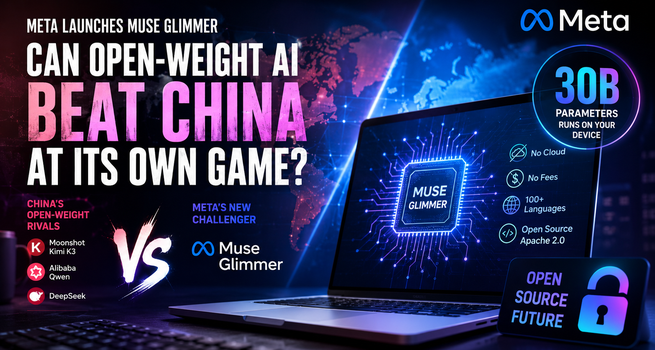
- Meta released Muse Glimmer on August 10, a 30-billion-parameter AI model that runs locally on a laptop or desktop with a single consumer GPU.
- The model is freely available under an Apache 2.0 license via Hugging Face, developed by the newly formed Meta Superintelligence Labs.
- Chinese open-weight models from Moonshot, Alibaba, and DeepSeek are closing the performance gap with US frontier AI at significantly lower cost.
- CEO Mark Zuckerberg is calling on Washington to ease restrictions on Training data use and AI distillation to help American open-source models remain globally competitive.
- Meta plans further releases including Muse Spark 1.2 and an internally developed model codenamed Watermelon, with open-weight status for the latter still unconfirmed.
A Different Kind of AI Model
Most of the artificial intelligence products that have entered mainstream use over the past two years, from ChatGPT to Google Gemini, run on servers housed in large data centres and are accessed over the internet. Every query travels to the cloud, is processed remotely, and returns as a response. The infrastructure behind that process is expensive, energy-intensive, and entirely controlled by the company providing the service.
Meta Platforms ( Nasdaq : META) is making a different bet. On August 10, the company released Muse Glimmer, a 30-billion-parameter AI model that runs directly on a personal laptop or desktop using a single consumer-grade GPU, with no cloud connection required. The weights, the numerical parameters that define how the model processes information and generates outputs, are publicly available for free download via Hugging Face under a permissive Apache 2.0 license, meaning developers can inspect, modify, and self-host the model without paying for API access or being bound by the restrictions of a proprietary system.
This combination of local deployment and public availability places Muse Glimmer in a category distinct from the leading models of OpenAI, Anthropic, and Google, all of which remain closed and cloud-dependent.
Engineering a 30-Billion-Parameter Model for Consumer Hardware
Running a model of this scale on personal hardware is not straightforward. A 30-billion-parameter system would typically require more than 55GB of memory, well beyond what most consumer devices can provide. Meta narrowed that requirement to under 20GB through quantisation, a compression technique that reduces the precision of model weights to approximately 4-bit, shrinking memory Demand substantially while preserving practical performance on agentic tasks.
The model's architecture also incorporates speculative decoding, pairing a smaller drafter model with the main system. The drafter generates entire blocks of tokens simultaneously, which the main model then verifies. This parallel process is considerably faster than the sequential token-by-token generation used by most language models, enabling response speeds suitable for real-time conversation and autonomous task execution.
Meta validated the setup on three hardware configurations: a MacBook with the M4 Max chip, a MacBook with the M5 Max chip, and a desktop running an Nvidia RTX-5090 GPU. All three delivered sufficient throughput for fluid interaction without network dependency.
The training process drew on a mix of synthetic and organic data spanning more than 100 languages. Post-training combined supervised fine-tuning with on-policy distillation and reinforcement learning across general reasoning, coding, and agentic domains. Muse Glimmer was developed by Meta Superintelligence Labs (MSL), the AI research unit formed last year under the Leadership of Alexander Wang.
What the Model Is Designed to Do
Muse Glimmer is built for agentic use, meaning AI that can execute sequences of actions across multiple steps to complete a task, rather than simply responding to a single prompt. Its core capabilities include long-horizon task execution, precise tool calling, multimodal input processing, long-context memory, and reliable instruction following.
In practice, this positions the model to manage schedules, draft communications, organise files, and navigate multi-step workflows, all running locally on the user's device. The on-device architecture carries structural advantages in cost, latency, and data privacy relative to cloud-based alternatives, since inference never leaves the machine.
Within its parameter class, Meta reports that Muse Glimmer outperformed Google's 31-billion-parameter Gemma model and Alibaba's 27-billion-parameter Qwen model across agentic, coding, multimodal, safety, and reasoning benchmarks. Developer integration support for llama.cpp, MLX, and ExecuTorch is expected in the near term.
The Chinese Open-Weight Challenge
The strategic context for this launch extends well beyond product competition. Over the past year, a wave of capable, freely available AI models has emerged from Chinese developers, including Moonshot AI's Kimi K3, Alibaba's Qwen, and DeepSeek's V4-Flash. These models have demonstrated benchmark performance that rivals leading US frontier systems while being available at a fraction of the cost or at no cost at all.
Because these are open-weight models, any developer anywhere in the world can download and use them without engaging a US-based cloud provider. For businesses and researchers operating under cost constraints, they represent a compelling alternative to the proprietary, metered offerings from American AI companies. The leading models from OpenAI, Anthropic, and Google remain closed source, which has created an opening for Chinese developers to build significant developer mindshare globally.
Zuckerberg has positioned Meta's open-weight push as the most effective response to this dynamic, arguing that attempting to restrict access to foreign open-source models would not address the competitive gap and could further disadvantage American developers in the global market.
What Zuckerberg Wants Washington to Change
Alongside the launch, Zuckerberg published a lengthy essay calling for US policy reform on two fronts. The first concerns training data: he argued that American AI developers operate under significantly more restrictive rules on permissible training data than their Chinese counterparts, creating a structural disadvantage that compounds over successive model generations.
The second concerns distillation, the practice of using the outputs of a powerful model to train a smaller, more efficient one. It is a standard technique in the field and central to how Muse Glimmer itself was developed. Some US lawmakers have characterised it as a form of intellectual property extraction, particularly when applied to outputs from proprietary frontier models. Zuckerberg pushed back on that framing, arguing that restricting distillation would handicap domestic open-source development without meaningfully closing the gap with Chinese rivals.
He also confirmed that Meta would establish a governance mechanism giving its independent board directors formal authority to approve the safety criteria for future model releases, a structural concession to concerns about the risks of open-weight AI.
What Follows Muse Glimmer
Meta confirmed that the weights for Muse Spark 1.2, described as its latest foundation model, will be released publicly in the coming months. Further out, the company is developing a more capable system internally codenamed Watermelon, which Zuckerberg has described as more powerful than Spark. Whether Watermelon will be released as an open-weight model or retained as a proprietary asset has not been confirmed, and that decision will serve as the clearest signal yet of how durable Meta's open-source commitment is at the frontier level.
Meta shares were up approximately 1% in premarket trading on the day of the announcement, against a year-to-date decline of around 10%. The company's Capital Expenditure is projected to reach up to $145 billion in the current fiscal year, a figure investors are watching closely for evidence that the spending translates into measurable competitive positioning.
This article is intended for informational and analytical purposes only. It does not constitute financial advice or a recommendation to buy, sell, or hold any security. Readers should conduct independent research or consult a qualified financial professional before making Investment decisions.


 Nov 03, 2026





 Please wait processing your request...