
 CA
 NZ
 UK
 AU
 IND

 US

 Share
 X (Formerly Twitter)
 Whatsapp
 Facebook
 LinkedIn
 Telegram
 Email This Article
 Copy Link
 Summarize with AI
 Chat GPT
 Perplexity
Key Highlights
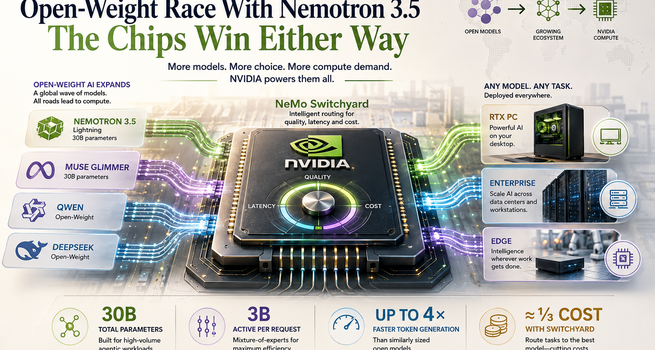
- NVIDIA released Nemotron 3.5 Lightning on August 11, a 30-billion-parameter open-weight model built for high-volume agentic workloads on consumer and enterprise hardware.
- The model uses a mixture-of-experts architecture with only 3 billion active parameters per request, delivering up to 4x faster token generation than similarly sized open models.
- NeMo Switchyard, released alongside the model, routes AI workloads automatically across a system of models, cutting task completion costs to roughly one-third of running a frontier model alone.
- The release arrives one day after Meta's Muse Glimmer launch, marking a convergence of two of the world's largest technology companies around open-weight, on-device agentic AI.
- For NVIDIA, open-source AI is a structural Demand driver: every model that runs locally runs on NVIDIA silicon, making ecosystem growth directly accretive to hardware revenue.
Two Releases in Two Days. One Industry Turning Point.
On August 10, Meta (NASDAQ:META) released Muse Glimmer, a 30-billion-parameter open-weight model built to run locally on a laptop without cloud infrastructure. On August 11, NVIDIA (NASDAQ: NVDA) released Nemotron 3.5 Lightning, a 30-billion-parameter open-weight model built to run locally on a laptop without cloud infrastructure.
The parallel is not coincidental. It is a signal.
Within the span of 24 hours, two of the most capitalised technology companies in the world made the same strategic bet: that the next significant battleground in AI is not the frontier model leaderboard, but the local device. And both chose to fight that battle with open weights, freely available to any developer in the world to download, modify, and deploy.
The context matters. Chinese developers including Moonshot AI, Alibaba (NYSE:BABA), and DeepSeek have spent the past year building a commanding lead in open-weight AI, releasing capable models that rival US frontier systems at a fraction of the cost. American AI leaders, principally OpenAI, Anthropic, and Google (NASDAQ:GOOGL), have remained almost entirely closed source. The gap in the open-weight market has been widening, and two of America's largest technology companies have now chosen the same week to close it.
NVIDIA's entry carries a dimension that Meta's does not. NVIDIA is not a model company competing for developer mindshare. NVIDIA is the company that builds the chips those models run on. Every open-weight model that runs locally runs on NVIDIA silicon. The more open-weight AI expands, the more hardware demand expands with it. This is not altruism. It is architecture.
What Nemotron 3.5 Lightning Is Built to Do
Nemotron 3.5 Lightning is a 30-billion-parameter mixture-of-experts model with 3 billion active parameters, developed by NVIDIA and the Nemotron Coalition, a group of partners that contributed evaluation methodologies, inference software, and Training datasets.
The mixture-of-experts architecture is fundamental to understanding why the model performs the way it does. A conventional dense model activates all of its parameters for every request, regardless of the complexity of the task. A mixture-of-experts model routes each token through a small subset of specialised sub-networks, activating only the parameters relevant to that specific input. The result is the effective capacity of a much larger model at the computational cost of a small one.
In practical terms, NVIDIA claims Nemotron 3.5 Lightning delivers up to 4x faster token generation and 30% faster task completion compared to similarly sized open models. The model incorporates speculative decoding, where a smaller companion model drafts output in parallel with the main model's verification pass, compressing latency further. Quantisation is available in both NVFP4 and BF16 checkpoint formats, balancing memory efficiency against output precision based on deployment requirements.
The training methodology combined supervised fine-tuning with reinforcement learning across agentic, coding, and general reasoning domains. NVIDIA confirmed the use of distillation, training Nemotron 3.5 Lightning on outputs from its larger Nemotron models to transfer high-level capability into the compact architecture. Alongside the model, NVIDIA is releasing Nemotron-RL-Agentic-Terminal-Pivot, the agentic reinforcement learning dataset used to develop its coding agent capabilities, continuing the company's practice of publishing training data and techniques to the extent licensing allows.
Designed for Agents, Not Conversation
Nemotron 3.5 Lightning is not a general-purpose conversational model. It is built for a specific and increasingly commercially important role: the high-volume execution layer within multi-agent AI systems.
Modern enterprise AI architectures are moving away from single-model deployments toward systems of models, where different models handle different types of tasks. A large frontier reasoning model plans and orchestrates a workflow. Smaller, faster, specialised models execute the individual steps, handling tool calls, result validation, code review, security monitoring, and other repetitive high-frequency tasks where speed and precision matter more than broad reasoning capability.
Nemotron 3.5 Lightning is designed for that execution layer. Companies including CrowdStrike (NASDAQ:CRWD) for cybersecurity, Harvey for legal services, and CodeRabbit for code review have already customised the model for domain-specific agentic workflows. Lila Sciences is applying it to reasoning tasks in physical and life sciences. Fastino Labs reports leading accuracy on software development, finance, and healthcare workloads.
Because the model is fully open and customisable, organisations can post-train it on their own domain data, tools, and internal workflows using NVIDIA NeMo, tailoring its behaviour to specific operational requirements without starting from scratch.
The model runs locally on NVIDIA RTX PCs, DGX Spark, DGX Station, and Jetson devices, and scales to RTX PRO workstations, data centres, and cloud environments for enterprise deployments. Hardware availability spans systems from Acer, ASUS, Dell Technologies (NYSE:DELL), HP (NYSE:HPQ), Lenovo, and others running NVIDIA Blackwell architecture.
NeMo Switchyard: The Infrastructure Layer Underneath
The more strategically interesting release may not be the model itself.
NeMo Switchyard is an open-source routing library that automatically directs each step of an AI agent workflow to the most appropriate and cost-efficient model for that task. Rather than sending every request to a single expensive frontier model, or requiring developers to manually build routing logic into their applications, Switchyard makes routing decisions in real time based on configurable priorities: quality, latency, and cost.
The commercial problem it addresses is real. As enterprise AI deployments grow more complex, the cost of running frontier models at every step of every workflow has become a significant operational concern. Switchyard allows organisations to reserve frontier model capacity for the tasks that genuinely require it, while routing routine execution tasks to faster, cheaper specialised models.
Internal NVIDIA benchmarks show that a Switchyard-routed system mixing open models with Anthropic's Opus 4.8 maintained frontier-level task accuracy while cutting total completion costs to roughly one-third of running Opus 4.8 alone. Early partner data supports the direction, if not uniformly the magnitude.
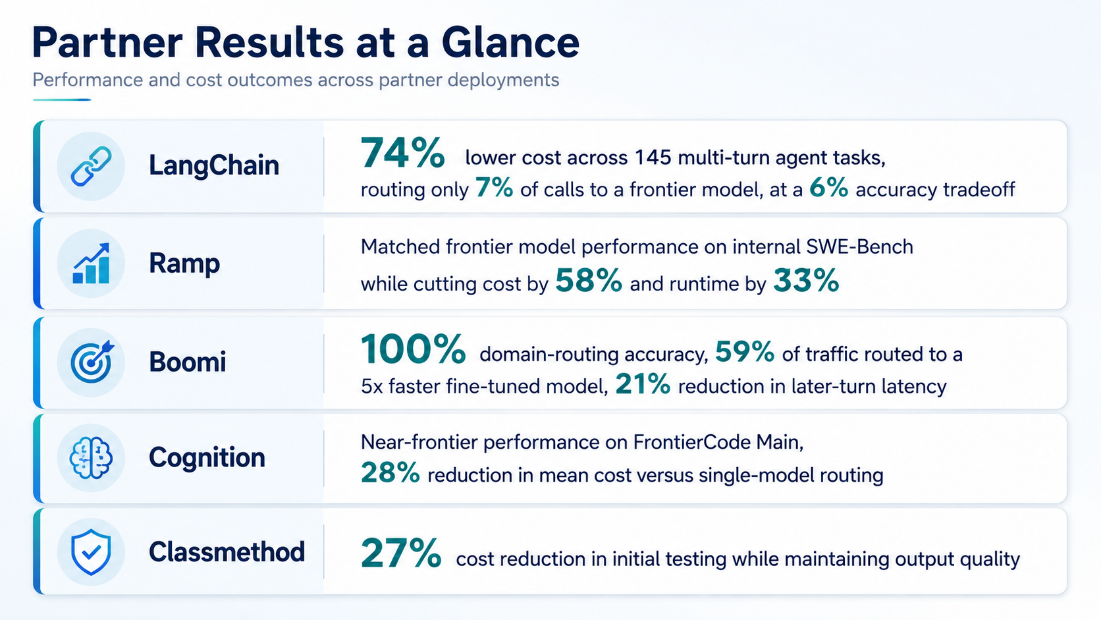
NeMo Switchyard is available on GitHub. Kong AI Gateway, LangChain, LiteLLM, and Nous Research are among the platforms integrating it natively.
Jensen Huang's Policy Position Becomes a Product
In late July, NVIDIA CEO Jensen Huang posted on X for the first time, publishing an open letter arguing that open-weight AI models strengthen safety and cybersecurity, accelerate innovation, and enable technological sovereignty. He urged the US government to support open models while avoiding premature restrictions. Days later, NVIDIA co-founded an AI safety consortium with Microsoft (NASDAQ:MSFT) focused on using open-source models for Cybersecurity defence.
Nemotron 3.5 Lightning is the product that backs that position.
The policy debate in Washington has intensified around two specific concerns: whether Chinese open-weight models represent a national security risk, and whether distillation, the training technique central to making capable small models from large ones, constitutes intellectual property extraction. Huang's letter and this model release collectively argue that the answer to both concerns is not restriction but competition: build better American open-weight models and compete.
Meta's Zuckerberg made the identical argument in his August 10 essay. The alignment between the two companies on policy framing, released within 24 hours of each other, suggests a coordinated, or at minimum convergent, effort to shape the regulatory environment in favour of open-weight development.
The Honest Competitive Assessment
Nemotron 3.5 Lightning is a strong execution-layer model. It is not the most capable open-weight model available. Benchmarks from Artificial Analysis show that both new Nemotron models trail Google's Gemma 4 31B on the Intelligence Index. NVIDIA's response to that gap, framing speed and customisability as the more relevant variables for agentic workflows, is commercially reasonable but worth scrutinising in production deployments.
The more durable competitive question is what NeMo Switchyard does to the Economics of frontier model providers. If enterprises broadly adopt routing frameworks that reserve Anthropic's Opus or OpenAI's GPT-5 series for only 7% to 10% of their total inference volume, the Revenue implications for closed-model providers are material. Switchyard is, structurally, a tool that reduces dependence on any single AI provider, including NVIDIA's own future models.
That NVIDIA is releasing it anyway reflects the company's confidence in its hardware position. The more AI workflows run, regardless of which models they use, the more chips they consume.
Outlook
The simultaneous open-weight push from Meta and NVIDIA this week represents a structural shift in how the US technology industry is approaching the AI competition with China. Rather than defending closed model positions, two of the most valuable companies in the world are competing directly on the open-weight terrain where Chinese developers have held the advantage.
For NVIDIA specifically, Nemotron 3.5 Lightning and NeMo Switchyard are less about winning the model benchmarks and more about establishing NVIDIA as a full-stack AI infrastructure company, not just a semiconductor supplier. The model, the routing library, the NIM microservice deployment layer, and the NeMo post-training platform together describe an end-to-end agentic AI stack that runs on NVIDIA hardware.
Whether enterprises adopt that full stack, or pick components selectively, will determine how much of the value NVIDIA captures beyond the chip itself.


 Nov 03, 2026





 Please wait processing your request...