
 AU
AU
 UK
UK
 CA
CA
 NZ
NZ
 IND
IND

 US
US

 Share
Share
 X (Formerly Twitter)
 Whatsapp
 Facebook
 LinkedIn
 Telegram
 Email This Article
 Copy Link
 Summarize with AI
 Chat GPT
 Perplexity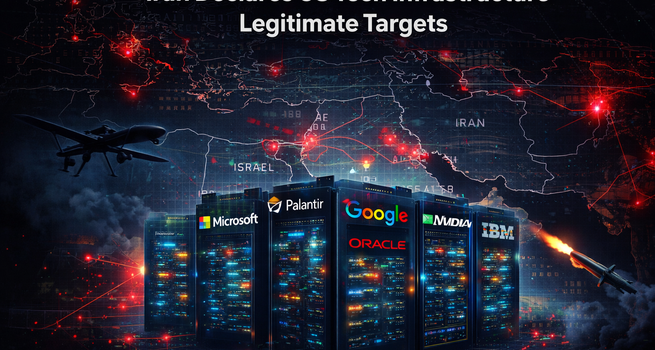
Key Highlights
- Iran has declared infrastructure of major US technology companies in the Middle East as legitimate targets.
- Companies mentioned include Microsoft, Palantir Technologies, Google, Oracle, Nvidia, and IBM.
- Data centers supporting banking, healthcare, and government systems are reportedly part of the target list.
- Gulf technology hubs such as the UAE, Saudi Arabia, and Qatar face elevated geopolitical risk.
- Escalating regional tensions may reshape global cloud infrastructure strategy and technology investment flows.
Middle East Geopolitics and Technology Infrastructure Risk
The Middle East is entering a new phase of geopolitical confrontation where digital infrastructure has become a strategic asset and a potential battlefield.
Iranian messaging through IRGC affiliated media outlets has signaled a shift in targeting doctrine. According to statements circulated by Tasnim News Agency, infrastructure belonging to major American technology firms operating in the Middle East is now considered a legitimate target.
The companies cited include global cloud and artificial intelligence leaders such as Microsoft, Google, Oracle, Nvidia, and IBM. Defense and analytics firm Palantir Technologies was also specifically mentioned.
The declaration comes amid intensifying regional tensions following reported US and Israeli military operations targeting Iranian assets. In response, Tehran appears to be signaling that technological infrastructure supporting Western economic and security systems in the region could become part of the conflict landscape.
For global investors and technology strategists, the message highlights an emerging risk: the physical vulnerability of cloud infrastructure and AI computing hubs that underpin modern economies.
Cloud Infrastructure Expansion in the Gulf Technology Ecosystem
Over the past decade, the Gulf region has become a major destination for global cloud infrastructure investment.
Countries such as the United Arab Emirates, Saudi Arabia, and Qatar have invested heavily in becoming regional digital hubs. Government modernization programs, financial sector digitization, and artificial intelligence initiatives have attracted large scale infrastructure deployments from leading US technology companies.
For example:
- Microsoft operates major Azure cloud regions in the UAE and Qatar.
- Google launched a cloud region in Doha to serve government and financial institutions across the region.
- Oracle has been aggressively expanding cloud regions in Saudi Arabia and the UAE as part of its global infrastructure strategy.
- Nvidia hardware powers many AI data centers supporting regional machine learning and defense applications.
- IBM provides enterprise cloud and hybrid computing services to financial institutions and governments.
These facilities host critical workloads including banking systems, hospital networks, telecommunications platforms, and government databases.
The concentration of these digital assets has created a powerful technology ecosystem. However, it also introduces strategic vulnerability during periods of geopolitical confrontation.
Escalating Conflict and the Targeting of Data Infrastructure
Iranian messaging suggests a broader strategic narrative. Rather than focusing solely on traditional military assets, Tehran is framing Western technology infrastructure as an extension of geopolitical power.
In modern conflicts, cloud computing systems enable intelligence analysis, financial transactions, communications, and logistics coordination.
Companies such as Palantir Technologies have been deeply involved in data analytics platforms used by defense and intelligence agencies. Similarly, AI hardware produced by Nvidia plays a crucial role in advanced computing systems used across military and surveillance applications.
This overlap between commercial technology platforms and national security capabilities creates ambiguity in conflict environments.
According to reports circulating in regional media, some Iranian messaging referenced infrastructure supporting:
- Banking systems
- Healthcare networks
- Government digital services
- Artificial intelligence research facilities
These sectors rely heavily on hyperscale cloud platforms operated by US technology companies.
If infrastructure supporting these services becomes a target, the potential disruption could extend far beyond military objectives and affect civilian economic systems.
Reports of Drone Activity Around Cloud Facilities
Some reports referenced drone strikes targeting cloud infrastructure facilities associated with Amazon Web Services in locations including the UAE and Bahrain.
While independent confirmation remains limited, the emergence of such reports highlights a broader security concern.
Modern data centers are massive physical installations containing tens of thousands of servers, networking systems, and power infrastructure. These facilities require stable electricity supply, cooling systems, and fiber connectivity to operate.
Despite their digital nature, cloud computing ultimately depends on physical infrastructure that can be disrupted.
From a strategic perspective, attacking data centers can have cascading consequences. Banking transactions could halt, hospital systems could lose access to patient data, and government services could experience outages.
This potential vulnerability is forcing both governments and corporations to rethink digital infrastructure resilience.
Market and Investment Implications for the Technology Sector
For investors, the situation introduces a new layer of geopolitical risk surrounding hyperscale infrastructure.
Large technology companies have spent hundreds of billions of dollars building global cloud networks. These facilities form the backbone of artificial intelligence development, digital commerce, and enterprise software platforms.
The companies mentioned in Iran's statement collectively represent trillions of dollars in market value.
These firms include:
- Microsoft
- Oracle
- Nvidia
- IBM
- Palantir Technologies
For these companies, Middle East cloud regions serve as important growth engines. Governments across the region are rapidly digitizing public services, launching sovereign AI programs, and expanding fintech ecosystems.
However, heightened security risks could lead to several shifts:
First, companies may increase investment in hardened infrastructure and physical protection for data centers.
Second, governments may push for sovereign cloud solutions where data remains within national boundaries and infrastructure is operated in partnership with local entities.
Third, cloud providers could diversify infrastructure placement across multiple regions to reduce concentration risk.
These changes could alter capital allocation patterns across the global cloud industry.
Strategic Outlook for Global Technology Infrastructure
The targeting of digital infrastructure reflects a broader transformation in modern geopolitical competition.
Cloud platforms, artificial intelligence clusters, and data centers have become strategic assets comparable to energy infrastructure or transportation networks.
Countries increasingly view control over digital infrastructure as a component of national security.
As a result, several long term developments are likely:
Governments will prioritize sovereign data infrastructure to reduce dependence on foreign platforms.
Cloud providers may accelerate distributed infrastructure models that spread computing resources across multiple smaller facilities.
Defense and cybersecurity spending related to critical digital infrastructure will likely increase.
At the same time, demand for AI computing capacity continues to surge globally. Companies such as Nvidia remain central to this expansion due to their leadership in AI chips and accelerated computing systems.
This dynamic creates a paradox for the technology sector. The same infrastructure powering global innovation also introduces new geopolitical vulnerabilities.
Conclusion
Iran's declaration that US technology infrastructure in the Middle East could be considered legitimate targets represents a significant escalation in geopolitical signaling.
The statement highlights how digital infrastructure has become intertwined with economic power, national security, and geopolitical competition.
Major cloud platforms operated by companies such as Microsoft, Google, Oracle, and IBM now underpin essential services across the Gulf region.
For investors and policymakers, the development underscores a growing reality. The infrastructure powering the global digital economy is no longer insulated from geopolitical conflict.
As artificial intelligence, cloud computing, and digital finance expand across the world, the security of these systems will become an increasingly important strategic priority.
FAQ
Why did Iran declare US tech infrastructure a target?
Iranian messaging suggests the move is a response to US and Israeli military actions. Tehran is signaling that technology systems supporting Western economic and defense operations in the region could be treated as strategic assets within the conflict.
Which companies were mentioned in the statement?
Companies reportedly mentioned include Microsoft, Palantir Technologies, Google, Oracle, Nvidia, and IBM. Some reports also referenced Amazon Web Services infrastructure in the region.
Why are data centers strategically important?
Data centers host cloud computing systems that support banking networks, healthcare platforms, communications infrastructure, and government services. Disrupting these facilities could affect large parts of the digital economy.
Could this impact global technology stocks?
Direct financial impact may be limited in the short term. However, increased geopolitical risk could influence capital spending decisions, security investment, and regional infrastructure expansion strategies.
How might companies respond to these risks?
Technology firms may strengthen physical security, diversify data center locations, and collaborate with governments on sovereign cloud infrastructure to reduce geopolitical vulnerability.


 Jun 16, 2026



 Please wait processing your request...