
 CA
 NZ
 UK
 AU
 IND

 US

 Share
 X (Formerly Twitter)
 Whatsapp
 Facebook
 LinkedIn
 Telegram
 Email This Article
 Copy Link
 Summarize with AI
 Chat GPT
 Perplexity
Key Highlights
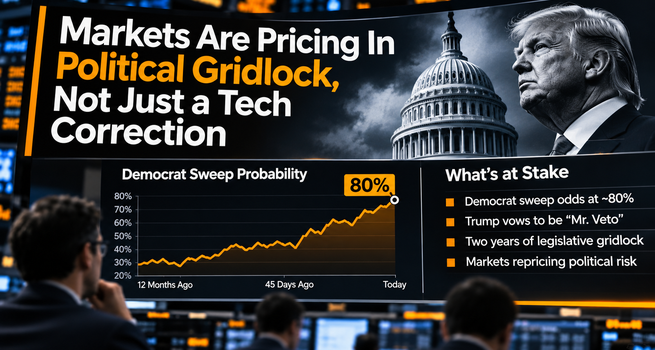
- Prediction markets now put the probability of a Democrat sweep of the US Midterm elections at nearly 80%, up 30 percentage points over the last 45 days and triple the level seen 12 months ago.
- President Trump has publicly vowed to become what he has described as Mr. Veto if Democrats take control of Congress, a stance that would effectively produce two years of legislative deadlock between the executive and the legislature.
- The current Equity market weakness is being driven not only by AI Capital Expenditure concerns but also by the market's systematic repricing of political risk, as a divided government scenario becomes the consensus most-probable outcome.
- Markets price in the most probable outcome, and with Midterm elections taking place today, the result will set the political and legislative backdrop for the next two years of the Trump administration.
Beyond the Tech Correction: What the Market Is Really Pricing
The narrative around the current US equity market weakness has focused heavily on AI capital expenditure concerns: whether Big Tech companies are spending too much, too fast, on infrastructure whose Revenue returns remain uncertain. Those concerns are real and legitimate. Investors are right to scrutinise the profitability timeline of a multi-trillion-dollar Investment cycle.
But the AI capex story does not fully account for what is happening in equity markets. There is a second, larger repricing underway, and it is political in nature. Markets are in the process of adjusting valuations to reflect the most probable outcome of the US Midterm elections, which take place today, and that outcome is increasingly pointing toward a Democrat sweep of Congress.
A change in the political landscape always brings uncertainty. Markets do not dislike any particular political party. What they dislike is uncertainty about the legislative environment, the regulatory direction, the tax framework, and the fiscal trajectory. A divided government, in which the executive and legislature are controlled by opposing parties, introduces all of those uncertainties simultaneously.
The Probability Shift: From Unlikely to Near-Certain in 12 Months
Twelve months ago, prediction market expectations for a Democrat sweep of the US Midterm elections were relatively low. Over the intervening period, those expectations have tripled. In the last 45 days alone, the implied probability has risen by 30 percentage points. As of the time of writing, markets themselves are pricing a nearly 80% probability of a Democrat-controlled Congress following today's vote.
The speed of the move in political probability is itself notable. A 30-percentage-point shift in 45 days is not a gradual repricing. It reflects a rapid reassessment of the political landscape by a large number of Market Participants simultaneously, driven by polling data, candidate performance, fundraising figures, and voter enthusiasm indicators that have collectively shifted the consensus view.
Equity markets do not wait for election results before pricing political risk. They price the probability-weighted outcome in advance. As the probability of a Democrat sweep has risen from a minority scenario to a near-80% consensus, the market has been adjusting valuations accordingly, and that adjustment is visible in the equity price action over the same period.
Trump's Veto Pledge and the Gridlock Scenario
President Trump has stated publicly that he would use his veto power aggressively if Democrats take control of Congress, describing himself as what he has called Mr. Veto. A president who exercises the veto on a consistent basis against a Congress controlled by the opposing party produces legislative gridlock: bills pass one chamber, reach the other, clear both, and then face a veto that requires a two-thirds majority in each chamber to override. That override threshold is rarely met in practice.
For markets, legislative gridlock has two competing implications. On one hand, it means that major policy changes, including tax increases, new regulatory frameworks, and large spending programmes, are unlikely to pass. That can be read as a protective floor against adverse policy shifts. On the other hand, it also means that legislation that markets would welcome, including extensions of existing tax provisions, deregulatory measures, and fiscal reforms, is equally unlikely to advance. Gridlock freezes the policy environment in place, and frozen policy is still uncertainty about what comes next.
The market is currently pricing two years of that environment. Whether it proves correct depends on the result that will emerge from today's vote.
What Happens Next: Outcomes and Market Implications
There are three broad scenarios from today's election. First, a Democrat sweep of both chambers of Congress, which is the scenario currently priced at nearly 80% probability. Under this outcome, the gridlock narrative is confirmed, the market repricing that has already occurred would likely stabilise or continue at a reduced pace, and focus would shift to the specifics of how President Trump exercises his veto and what policy areas become flashpoints.
Second, a split result, in which one chamber flips to Democrat control and the other remains Republican. This scenario is less certain than a full sweep but still produces significant legislative friction, with the degree of gridlock depending on which chamber changes hands and the Margin of control in each.
Third, a Republican hold of both chambers, which would represent a significant departure from what markets are currently pricing. An outcome that contradicts the near-80% consensus would likely produce a sharp market reaction in the opposite direction, as valuations that have been adjusted for the gridlock scenario would need to be unwound rapidly.
Markets price the most probable outcome, and the odds overwhelmingly favour the first scenario as of today. But probability is not certainty, and the gap between what is priced and what actually occurs is where market-moving returns are made. Today's result sets the stage for the next two years.


 Nov 03, 2026





 Please wait processing your request...