
 AU
AU
 UK
UK
 CA
CA
 NZ
NZ
 IND
IND

 US
US

 Share
Share
 X (Formerly Twitter)
 Whatsapp
 Facebook
 LinkedIn
 Telegram
 Email This Article
 Copy Link
 Summarize with AI
 Chat GPT
 Perplexity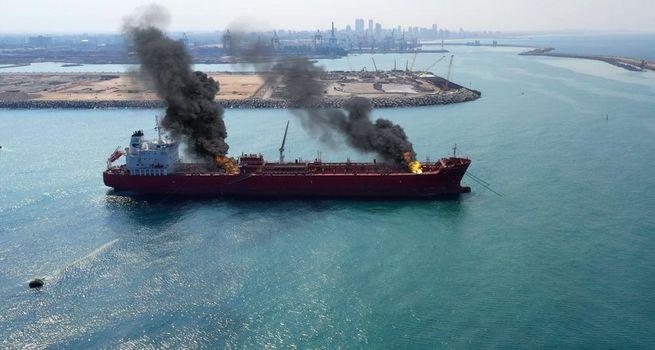
Key Highlights
- Two oil tankers were set ablaze in Iraqi waters near Basra following attacks attributed to Iranian forces.
- Oil prices surged back above $100 per barrel as disruptions threaten global energy supply routes.
- Iran warned the world could face oil prices as high as $200 per barrel amid escalating conflict.
- The Strait of Hormuz remains at the center of the crisis as tanker traffic faces growing security risks.
- Strategic petroleum reserve releases by developed economies may provide only short-term market relief.
Introduction: Escalating Conflict Reshapes Global Energy Market Outlook
The global oil market has entered a new phase of volatility as geopolitical tensions in the Middle East intensify. Attacks on oil tankers near Iraq's southern port of Basra have heightened fears of supply disruptions across one of the world’s most critical energy corridors.
The latest incidents underscore the strategic importance of maritime trade routes in the region. As military confrontations expand across multiple Gulf states, energy markets are once again confronting the possibility of sustained supply shocks like those experienced during past oil crises.
Oil prices quickly reacted to the news, climbing above $100 per barrel after briefly easing earlier in the week. Market participants now face renewed uncertainty about the stability of oil flows through the Persian Gulf and the future direction of global energy prices.
For investors and policymakers alike, the situation represents a critical intersection of geopolitics, commodity markets, and global economic stability.
Global Energy Market Trends and Oil Supply Risks
The Strategic Importance of the Strait of Hormuz
The Strait of Hormuz is widely regarded as the most important oil transit chokepoint in the world. Roughly one fifth of global oil consumption passes through the narrow waterway connecting the Persian Gulf with the Gulf of Oman and the Arabian Sea.
Major oil exporting nations including Saudi Arabia, Iraq, Kuwait, and the United Arab Emirates rely heavily on this corridor to deliver crude to global markets.
Any disruption to tanker traffic in this region can have immediate consequences for energy prices, shipping costs, and global inflation expectations.
Recent attacks on vessels operating in Iraqi territorial waters have reinforced the vulnerability of maritime energy infrastructure.
Oil Market Sensitivity to Geopolitical Risk
Commodity markets are highly responsive to geopolitical shocks, particularly when they involve major energy producing regions.
The Middle East accounts for a significant share of global oil exports, and even small disruptions can lead to rapid price spikes as traders adjust supply expectations.
In recent days, energy markets had briefly stabilized after signals that the conflict might de escalate. However, the latest tanker attacks quickly reversed that sentiment.
Analysts note that the oil market remains structurally tight following several years of underinvestment in upstream energy projects. This means that spare production capacity remains limited relative to historical norms.
As a result, geopolitical disruptions tend to produce larger price swings than in previous decades.
Tanker Attacks and Escalation of Maritime Conflict
Basra Incident Signals Rising Maritime Risk
Two tankers were reported ablaze in Iraqi waters near Basra after overnight attacks involving explosive laden boats.
Images circulating from the Iraqi coastline showed large fireballs engulfing the vessels, illuminating the night sky above the port region.
According to Iraqi port officials, at least one crew member was killed in the attack.
Earlier in the day, three additional vessels had reportedly been struck elsewhere in the Gulf. Among them was a Thai bulk carrier that was set on fire after allegedly ignoring orders from Iranian naval forces.
Another container vessel reported being hit by a projectile near the United Arab Emirates.
These incidents indicate a coordinated escalation targeting commercial shipping routes across the region.
Expanding Regional Impact
Military activity has expanded beyond tanker attacks.
Drone incursions were reported across several Gulf countries including Kuwait, Bahrain, Oman, Iraq, and the United Arab Emirates.
Energy infrastructure has also become a target. Fuel storage facilities in Bahrain were struck, while drones reportedly hit oil storage infrastructure at Oman’s Salalah port.
Saudi Arabia also reported intercepting drones heading toward its Shaybah oil field.
These developments suggest that energy infrastructure across the Gulf could remain vulnerable as the conflict evolves.
Oil Price Reaction and Commodity Market Outlook
Oil Prices Break Above $100
Oil markets responded swiftly to the escalation. Prices climbed above $100 per barrel after falling earlier in the week following political statements suggesting the conflict could soon end.
The renewed surge reflects investor concerns that oil exports from the Gulf region may face prolonged disruption.
Energy traders have increasingly focused on the possibility that Iran could restrict shipping through the Strait of Hormuz until hostilities cease.
Such a scenario would dramatically tighten global oil supply.
Potential Price Shock Scenario
Iranian officials warned that continued instability could push oil prices toward $200 per barrel.
While such projections represent an extreme scenario, the statement highlights the degree of uncertainty surrounding the current conflict.
For comparison, the historical peak oil price occurred in July 2008 when crude reached $147 per barrel shortly before the global financial crisis.
Should supply through the Strait of Hormuz remain constrained for an extended period, analysts believe prices could approach record levels.
Government Intervention and Strategic Reserve Release
Strategic Petroleum Reserve Deployment
In response to rising prices, developed economies announced a coordinated release of 400 million barrels of oil from strategic reserves.
The United States is expected to contribute nearly half of the total volume.
This represents the largest coordinated intervention in oil markets in history.
However, analysts caution that the release may provide only temporary relief.
Executing such a release requires logistical planning and may take months before the full volume reaches global markets.
Limited Impact on Supply Disruption
Even if fully implemented, the reserve release would cover only about three weeks of oil supply normally transported through the Strait of Hormuz.
This highlights the structural importance of the waterway.
Market participants therefore remain focused on whether shipping lanes will reopen safely rather than relying solely on strategic reserves.
Financial and Market Implications
Inflation and Global Growth Risks
A sustained rise in oil prices could have significant macroeconomic consequences.
Higher energy prices typically feed into broader inflation through transportation costs, industrial inputs, and consumer fuel prices.
Central banks worldwide have been attempting to manage inflation following years of monetary tightening. A new oil shock could complicate these efforts.
Higher energy costs may also weigh on global economic growth by reducing household purchasing power and increasing business operating expenses.
Impact on Financial Markets
Energy equities and commodity linked assets often benefit during periods of rising oil prices.
However, the broader equity market can face pressure when energy shocks trigger inflation concerns or reduce consumer spending.
Bond markets may also react as investors reassess inflation expectations and central bank policy trajectories.
Currency markets could see volatility as oil exporting nations experience stronger trade balances while oil importing economies face widening deficits.
Strategic Outlook: Oil Market Volatility Ahead
Geopolitical Risks Remain Elevated
The latest tanker attacks highlight the fragile security environment surrounding global energy infrastructure.
Until maritime routes stabilize and oil flows resume normally, energy markets are likely to remain highly sensitive to new developments.
Analysts emphasize that even limited attacks on commercial shipping can disrupt insurance markets, shipping schedules, and tanker availability.
Long Term Energy Market Implications
Beyond immediate price volatility, the crisis may accelerate structural changes in global energy supply chains.
Countries heavily dependent on Gulf oil exports may seek to diversify supply sources or expand strategic reserves.
Energy importers may also accelerate investment in renewable energy and alternative fuels to reduce geopolitical exposure.
For oil producers outside the Middle East, sustained high prices could encourage increased production investment.
Conclusion
The latest attacks on oil tankers near Iraq represent a significant escalation in the ongoing Middle East conflict and have immediate consequences for global energy markets.
With oil prices already returning above $100 per barrel and geopolitical risks rising, the stability of the Strait of Hormuz has once again become a central issue for the global economy.
While strategic reserve releases may provide temporary relief, the long term trajectory of oil prices will depend largely on whether maritime trade routes remain open.
For investors and policymakers, the situation serves as a reminder that geopolitical events continue to play a decisive role in shaping global commodity markets.
FAQ
Why are oil prices rising after the tanker attacks?
Oil prices increased because attacks on tankers threaten supply routes in the Persian Gulf. Traders fear disruptions to shipments through the Strait of Hormuz, which carries a large share of global oil exports.
Why is the Strait of Hormuz so important to energy markets?
The Strait of Hormuz is a critical shipping corridor connecting Gulf oil producers to global markets. Around one fifth of the world’s oil supply passes through this route each day.
What is the purpose of releasing strategic petroleum reserves?
Strategic petroleum reserves are emergency stockpiles used to stabilize markets during supply disruptions. Governments release oil from these reserves to increase supply and help moderate price spikes.
Could oil reach $200 per barrel?
Some officials have suggested that severe supply disruptions could push prices toward $200 per barrel. While this represents an extreme scenario, prolonged closure of major shipping routes could create significant price pressure.
How could higher oil prices affect the global economy?
Higher oil prices typically increase inflation and raise transportation and manufacturing costs. This can slow economic growth and create challenges for central banks attempting to manage inflation.


 Jun 16, 2026




 Please wait processing your request...