
 AU
AU
 UK
UK
 CA
CA
 NZ
NZ
 IND
IND

 US
US

 Share
Share
 X (Formerly Twitter)
 Whatsapp
 Facebook
 LinkedIn
 Telegram
 Email This Article
 Copy Link
 Summarize with AI
 Chat GPT
 Perplexity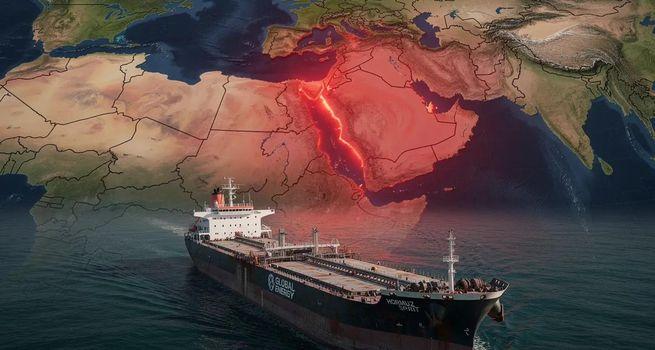
Key Highlights
- The Strait of Hormuz carries roughly 20 percent of the world's daily oil supply, making any disruption an immediate systemic shock to global energy markets.
- Iran's deployment of drone swarms and sea mines in 2026 has exposed a structural weakness in western naval deterrence that carrier groups alone cannot resolve.
- Brent crude surpassed $140 per barrel within ten days of the March 2026 shipping collapse, triggering emergency central bank consultations across the G7.
- Asian importers, led by India, China, and South Korea, face the sharpest near-term exposure, with alternative routing adding 18 to 22 days of voyage time.
- The crisis has structurally repriced geopolitical risk across energy markets, with forward curves suggesting sustained elevated prices through at least mid-2027.
Introduction
Every major oil supply shock of the past five decades has eventually resolved. The 2026 Strait of Hormuz crisis may be the first that cannot be resolved by the tools western powers have historically reached for.
One fifth of the world's oil and a substantial share of its liquefied natural gas transits a 33-kilometre-wide chokepoint between Iran and Oman. What distinguishes 2026 from every prior Hormuz crisis is not the volume at risk but the nature of the threat. Iran has weaponised asymmetric tools, drone swarms, smart mines, and selective enforcement, that are cheap to deploy, slow to counter, and immune to carrier group deterrence. This article traces the timeline that produced this crisis, assesses its market consequences, and examines why the conventional playbook for resolving it may no longer apply.
Strategic Importance
The Strait handles approximately 21 million barrels of oil and petroleum products daily, roughly 20 percent of global supply. Qatar's LNG exports add further systemic weight. Saudi Arabia's Abqaiq-Yanbu pipeline and the Abu Dhabi Crude Oil Pipeline together carry a maximum of roughly five million barrels per day, a fraction of current Strait volumes. Rerouting around the Cape of Good Hope adds weeks to voyage times and raises freight costs sharply. The geography is irreplaceable in the near term, which is precisely what makes it a target.
Timeline of Conflict: Four Decades of Escalation
The Strait's weaponisation did not begin in 2026. During the 1980s Tanker War, both Iran and Iraq attacked neutral vessels to strangle each other's revenues, drawing the United States into active convoy escort by 1987 and establishing a template that Tehran never abandoned. Through 2010 to 2012, Iranian closure threats pushed Brent above $120 per barrel without a single physical action, demonstrating that signalling alone had market impact. In 2019, tanker attacks in the Gulf of Oman marked the shift from rhetoric to operational activity. By 2023 and 2024, Revolutionary Guard vessel seizures had become routine, running in parallel with Houthi attacks on Red Sea shipping. Each episode was absorbed without a decisive western response. Tehran was not merely testing capability. It was calibrating the threshold of western tolerance, and finding it higher than anticipated.
April 2025 — The Architecture Breaks
Direct exchanges of strikes between Israel and Iran beginning in April 2025 shattered the deterrence logic that had contained major confrontation for decades. US forces became operationally involved by mid-2025, striking Iranian facilities after attacks on American naval assets. The conflict was no longer proxy-mediated or deniable. Iranian leadership drew a calculated conclusion: Washington would absorb significant provocation before committing to full-scale war. By December 2025, Omani and Qatari backchannels had closed entirely. The Strait entered 2026 as an active front.
January to February 2026 — The Warning Window
The early weeks of 2026 offered clear signals. Iranian naval exercises intensified, framed explicitly as preparation for full-spectrum maritime operations. Drone surveillance of passing tankers became systematic. War-risk insurance premiums for Hormuz transit tripled within six weeks. Several major shipping companies quietly suspended bookings for vessels above 150,000 deadweight tonnes, covering most large crude carriers. The commercial market was pricing a closure before any shots were fired.
22 February 2026 — The Trigger
A coordinated US and Israeli strike on Revolutionary Guard naval installations on Qeshm Island initiated the active phase. Iran's response was swift, precise, and clearly pre-planned, suggesting the strike was anticipated and the counter-move prepared in advance. Within 48 hours, Iranian forces deployed drone swarms targeting vessel navigation systems, anti-ship missiles, and a substantial seabed mine deployment across the eastern approach to the Strait. Brent, which had closed at $98 on 21 February, opened the following week at $112.
1 to 10 March 2026 — Collapse
The first week of March marked the full breakdown of commercial transit. Three vessels were struck. One, a 280,000-tonne VLCC chartered to a South Korean refiner, sank within twelve hours, the largest vessel lost to hostile action in the Gulf since the Tanker War. Seventeen others turned back without transiting. Saudi Aramco suspended loadings for five consecutive days, the first such suspension in its modern history. Qatar Petroleum halted all LNG shipments with no resumption date. By 10 March, Brent had reached $142. Baltic Exchange dirty tanker rates had more than doubled. Several underwriters withdrew war-risk coverage entirely.
March 2026 Onward — The Stalemate
The Strait has not reopened. US Fifth Fleet mine-clearing operations are being deliberately slowed by Iranian drone harassment of minesweeping vessels, a tactic that imposes cost and delay without requiring Iran to fire a single missile. Tehran has not formally declared a closure, preferring selective enforcement that leaves commercial operators in calculated uncertainty. That uncertainty is itself the weapon. Vessels that might risk a declared blockade will not risk an unpredictable one.
Energy Market and Macro Impact
Brent trading above $140 has passed rapidly into fuel costs, freight rates, and consumer prices. A preliminary World Bank assessment suggests the disruption could add 1.5 to 2.0 percentage points to global headline inflation if sustained through the second quarter. War-risk surcharges have risen to levels not seen since the 1980s Tanker War, with Baltic dirty tanker rates more than doubling since February, adding a second layer of cost pressure beyond the crude price itself. LNG spot prices in Asia have risen even more sharply given the near-total suspension of Qatari shipments. For emerging market economies, the combination of higher import bills and dollar strength is producing a shock more severe than 2022. Central banks across South Asia and Southeast Asia face a near-impossible choice between defending currencies and protecting growth. Two US carrier strike groups are positioned in the region but the carrier group, designed for conflict symmetry, is not the instrument this threat requires. The global response has remained fragmented, with no functioning multilateral framework capable of securing the route.
Strategic Outlook
The stalemate scenario is the base case, and the reasons are structural. De-escalation requires Washington to offer sanctions concessions that face domestic political resistance in a US election cycle, and Tehran to accept an off-ramp that would read domestically as surrender. Neither condition is close to being met, which is why markets attach below 30 percent probability to meaningful progress before the third quarter. This implies sustained oil prices in the $110 to $130 range through 2027. Further escalation represents a tail risk pointing to prices above $150 and potential global recession, but Iran has so far calibrated its actions to avoid the threshold that would compel a full US military campaign. Alternative routing infrastructure is being accelerated but is at minimum 18 to 24 months from meaningful scale.
Conclusion
Iran has spent forty years testing how much the Strait can bear before the world acts decisively. In 2026, it found the answer. The architecture of global energy trade, built on reliable Hormuz access and underwritten by US naval dominance, is under stress it was not designed to absorb. This is not a temporary disruption with a familiar resolution path. It is a structural challenge to the energy order, and the tools historically used to manage it are no longer sufficient.
FAQ
- Why is the Strait of Hormuz important?
The Strait handles approximately 20 percent of global oil supply and significant LNG volumes. No comparable alternative route exists, meaning any closure immediately affects energy pricing and availability across Asia, Europe, and beyond.
- What triggered the 2026 crisis?
The immediate trigger was a US-Israeli strike on Iranian naval installations on 22 February 2026. The underlying cause was the collapse of diplomacy following the 2025 Iran-Israel war and Tehran's strategic decision to weaponise the waterway.
- Is the Strait fully closed?
Not formally. Iran maintains selective enforcement targeting larger vessels. In practice, mines, drone harassment, and suspended insurance have halted most commercial transit.
- What is the impact on oil prices?
Brent surpassed $140 within ten days of the March 2026 collapse. Most analysts project sustained prices in the $110 to $130 range through 2027 under a protracted stalemate.
- Can global forces secure the route?
US Fifth Fleet mine-clearing operations are underway but slow. The absence of a unified coalition and Iran's asymmetric tactics have significantly reduced the effectiveness of conventional naval deterrence.


 Jun 16, 2026




 Please wait processing your request...