
 CA
 NZ
 UK
 AU
 IND

 US

 Share
 X (Formerly Twitter)
 Whatsapp
 Facebook
 LinkedIn
 Telegram
 Email This Article
 Copy Link
 Summarize with AI
 Chat GPT
 Perplexity

Key Highlights
- US midterm elections take place on Tuesday, November 3, 2026, with House control at 220 Republicans to 215 Democrats in Morgan Stanley's August count, so a net gain of 3 seats flips it.
- Since 1922, the sitting president's party has lost an average of 30 House seats and four Senate seats in midterms, according to Morgan Stanley research.
- The S&P 500 has gained an average of 13 percent in the 12 months after midterms, and Deutsche Bank notes it has never posted a Negative return in the nine months after the vote across 20 cycles since World War II.
- Natixis data show the S&P 500 averaged about 10.9 percent to nearly 12 percent under single-party control since 2000 versus 4.8 percent under divided government.
What Is at Stake
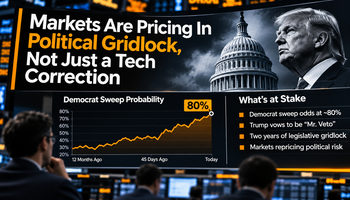
All House seats and part of the Senate are up. A published generic ballot average from FiftyPlusOne shows Democrats ahead by about 6 percentage points, while strategists say Republicans look better placed to hold the Senate. This article makes no prediction. The SPDR S&P 500 ETF Trust (NYSEARCA:SPY) captures the broad effect, because divided government has historically reduced the odds of major legislative change, which can support confidence, though it also raises the odds of budget standoffs. Democrats on the campaign trail have pushed stricter regulation of AI data centers. Morgan Stanley notes wholesale electricity prices near data centers are up 267 percent from 2020 levels versus 30 percent nationally, which keeps power costs politically visible.
Sectors Strategists Are Watching
Morgan Stanley lists defense as often bipartisan, technology tied to AI and chips as potentially helped by policy on infrastructure and competition with China, financial services as possibly gaining from regulatory clarity, and health care exposed to tariffs and drug pricing. The Technology Select Sector SPDR Fund (NYSEARCA:XLK) is the traded proxy for technology. The Financial Select Sector SPDR Fund (NYSEARCA:XLF) covers financials. The Energy Select Sector SPDR Fund (NYSEARCA:XLE) covers energy, where clean energy rules could become more fragmented. Rick Meckler of Cherry Lane Investments said Democratic gains could weigh on AI and technology stocks.
Risks and What to Watch
Disputed or delayed results are a risk, because swing House seats sit in slow-counting states and a final outcome could take weeks, according to TD Securities. The federal Debt limit of USD 41.1 trillion is expected to be reached by mid-2027, so divided government could bring concessions fights. The vote also follows a Nasdaq decline of about 5.3 percent in October, so SPDR S&P 500 ETF Trust (NYSEARCA:SPY) enters the day with technology already under pressure. Apple reports on November 2 and the jobs report follows on November 6 at 8:30 a.m. ET. Historical patterns are not guarantees.
Where Things Stand
Technology, defense, financials, health care and energy are the sectors strategists link most closely to the vote, with AI Data Center rules the sharpest new issue for technology. The balance of evidence favors history over prediction: markets have often rallied after midterms, but with SPDR S&P 500 ETF Trust (NYSEARCA:SPY) near a month of heavy losses and results possibly slow to settle, outcomes are uncertain. Sector moves will depend on who controls the House and what policy follows, so watch the count and the first week of reaction.

 Nov 03, 2026





 Please wait processing your request...