
 CA
 NZ
 UK
 AU
 IND

 US

 Share
 X (Formerly Twitter)
 Whatsapp
 Facebook
 LinkedIn
 Telegram
 Email This Article
 Copy Link
 Summarize with AI
 Chat GPT
 Perplexity
Key Highlights
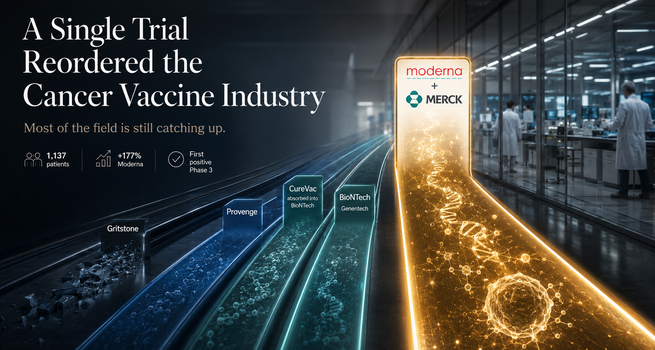
- Moderna and Merck reported the first positive Phase 3 result ever recorded for an mRNA-based cancer therapy or an individualized neoantigen vaccine, sending Moderna shares up as much as 177% in a single session
- BioNTech's comparable personalized mRNA platform has not produced a matching melanoma result; its strongest evidence remains an early-stage pancreatic cancer signal in roughly half of treated patients
- CureVac's oncology pipeline went to BioNTech through a completed acquisition, not to GSK, whose 2024 deal with CureVac covers flu and COVID-19 vaccines rather than cancer programs
- Gritstone Bio filed for Chapter 11 Bankruptcy in October 2024 after its personalized colorectal cancer Vaccine underperformed the control arm on its primary endpoint
- Provenge remains the only cancer vaccine to reach lasting U.S. approval, a reminder that clinical success and commercial viability are separate hurdles in this field
Therapeutic cancer vaccines were, until recently, a loosely bunched field of similarly staged developers running comparable trials on a shared mRNA premise. That is no longer an accurate description. One well-funded developer has been through bankruptcy court. Another has been fully absorbed into a larger rival. And on August 19, 2026, one program did something none of its peers has done: it cleared a Phase 3 trial. Moderna and Merck announced that their personalized mRNA cancer vaccine, developed alongside Merck's checkpoint inhibitor Keytruda, met its primary and a key secondary endpoint in patients with high-risk, surgically resected melanoma. Moderna shares gained as much as 177% intraday on the news, adding roughly $45 billion in Market Value in a single trading day, while Merck rose more than 12%. The scale of that reaction, on a release that did not disclose hazard ratios or detailed efficacy figures, is itself a signal of how much this result matters to the category.
What Counts as a Cancer Vaccine Here
None of the therapies in this landscape prevent cancer. They are therapeutic, administered to patients who already have the disease, typically after surgery, to train the immune system against any tumor cells left behind. Two design philosophies compete within that category. Personalized neoantigen vaccines are sequenced from an individual patient's own tumor and manufactured specifically for that patient, an approach that has produced stronger immune responses but remains costly and slow to scale. Off-the-shelf vaccines use antigens shared across many patients with the same cancer type, which is cheaper to manufacture but has generally produced weaker or less consistent results.
Nearly every leading program pairs its vaccine with a checkpoint inhibitor, a drug class that blocks proteins tumors use to evade immune detection. The vaccine teaches the immune system what to target, and checkpoint inhibition removes the tumor's ability to switch that response off. Neither element alone has matched what the combination has shown in the field's strongest data to date.
The Leader: Moderna and Merck
Moderna (NASDAQ:MRNA) and Merck (NYSE:MRK) now hold the most advanced position in the category. Their personalized mRNA vaccine, intismeran autogene (also known as V940 or mRNA-4157), paired with Keytruda, met its primary endpoint of recurrence-free survival and a key secondary endpoint of distant metastasis-free survival in the Phase 3 INTerpath-001 trial, which enrolled 1,137 patients with completely resected, high-risk cutaneous melanoma. The companies described the improvement over Keytruda alone as statistically significant and clinically meaningful, and said they would present full data at an upcoming medical meeting while engaging with regulators on a filing pathway. No filing date has been set.
The result builds on five-year follow-up data from the earlier Phase 2b KEYNOTE-942 trial, presented at the 2026 ASCO Annual Meeting, in which the same combination cut the risk of recurrence or death by 49% and the risk of distant metastasis or death by 59% compared with Keytruda alone. Development plans extend well beyond melanoma: the INTerpath program spans nine ongoing Phase 2 and Phase 3 trials, including studies in non-small-cell lung cancer, bladder cancer, and renal cell carcinoma. Those programs are earlier in development and have not yet produced comparable results, which is the caveat sitting underneath an otherwise unambiguous headline.
The market reaction has already outpaced the underlying financial picture. Moderna posted a $782 million net loss in the second quarter of 2026 on just $145 million of revenue, and continues to guide toward negative Earnings through at least 2028. Merck's stake is more strategic than speculative: Keytruda faces patent-related pressure beginning in 2028, and a successful vaccine-checkpoint combination gives the company a path to extend its oncology Franchise beyond that cliff.
The Closest Rival: BioNTech, in a Different Cancer
BioNTech (NASDAQ:BNTX) runs the field's other large-scale personalized mRNA oncology platform, developed jointly with Roche's Genentech unit. Its lead candidate, autogene cevumeran, has not replicated Moderna's melanoma result in BioNTech's own trials, which span melanoma, colorectal cancer, and muscle-invasive urothelial cancer. Instead, the company's strongest data sit in pancreatic cancer, a tumor type that has historically responded poorly to immunotherapy. Three-year follow-up from an investigator-initiated Phase 1 study, presented at the 2026 AACR Annual Meeting, showed that 8 of 16 treated patients maintained an active T-cell response, a persistence linked to longer recurrence-free survival in those responders. A larger, randomized Phase 2 trial sponsored by Genentech is now enrolling.
BioNTech has also become a consolidating force in its own right. In June 2025, the company agreed to acquire CureVac, a German mRNA developer, in an all-stock deal valued near $1.25 billion, explicitly to strengthen its oncology pipeline. That announcement followed years of Patent litigation among BioNTech, Pfizer, and CureVac over COVID-19 mRNA technology. In August 2025, the parties reached a settlement: BioNTech and Pfizer agreed to pay GSK, which held a separate licensing stake in CureVac's vaccine technology, $370 million upfront plus ongoing royalties, resolving the U.S. litigation and clearing the way for the acquisition. BioNTech closed the deal on January 6, 2026, and CureVac now operates as a wholly owned subsidiary; its shares were Delisted from Nasdaq later that month.
What Actually Happened to CureVac's Oncology Pipeline
GSK's role in this story is narrower than it looks. It's relationship with CureVac dates to a 2024 restructuring in which GSK took over full development and commercial rights to CureVac's flu and COVID-19 vaccine candidates, in exchange for upfront and milestone payments. CureVac was explicit at the time that the deal freed it to concentrate on oncology rather than dilute it: the company redirected resources toward its cancer vaccine pipeline as part of the same restructuring. The 2025 patent settlement with GSK, BioNTech, and Pfizer addressed infectious-disease mRNA royalties, not cancer assets. CureVac's oncology programs went to BioNTech, in full, through the completed acquisition. GSK's role in this story is a flu and COVID-19 licensing partner, not an inheritor of cancer vaccine rights.
A company that once ran an independent, diversified mRNA pipeline has now been fully absorbed by a single larger acquirer, oncology programs included.
The Warning Signs: Gritstone and Provenge
Gritstone Bio is the field's clearest recent cautionary tale. Its personalized neoantigen program, GRANITE, had generated encouraging early signals across several solid tumors. But in a Phase 2 readout in a metastatic colorectal cancer trial, the vaccine arm underperformed the control arm on the trial's primary endpoint, a ctDNA-based molecular response measure, at 30% versus 41.7%. Gritstone's chief executive, Andrew Allen, attributed the result to an unanticipated, persistent drop in ctDNA among control-arm patients following induction chemotherapy that had been given to both arms. "We simply got it wrong," Allen said in a statement at the time. Progression-free survival data released later in 2024 leaned favorably for GRANITE but remained statistically inconclusive, and with cash running low, Gritstone filed for Chapter 11 bankruptcy on October 10, 2024. Encouraging early signals, in other words, predicted nothing about what a larger, more mature readout would show.
An older precedent points to a different risk entirely. Provenge, a non-mRNA, cell-based therapy, was approved by the FDA in April 2010 for metastatic, castration-resistant prostate cancer, and remains the only cancer vaccine to reach lasting regulatory approval and commercial use in the United States. It demonstrated a genuine survival benefit, yet struggled commercially due to a complex administration process and a modest benefit relative to its cost. Its manufacturer, Dendreon, filed for bankruptcy in November 2014, roughly four and a half years after launch, citing sales far below what its price point required to sustain the business. Scientific success and commercial durability have historically been separate hurdles in this category, not sequential steps that automatically follow one another.
Smaller developers remain active without having reached the scale of the leaders. Transgene is testing a viral-vector-delivered neoantigen vaccine, and various academic and early-stage programs continue in earlier phases, but none currently carries the clinical or commercial weight of the Moderna-Merck or BioNTech-Genentech partnerships.
Where That Leaves the Field
Three patterns define the current landscape. Scale and Partnership now matter as much as the underlying science: every developer with late-stage trial data or a durable Capital position, Moderna with Merck, BioNTech with Genentech, CureVac now absorbed into BioNTech, reached that position alongside a larger, better-capitalized partner. Indication-specific data matters more than platform-wide claims: Moderna and BioNTech use structurally similar personalized mRNA approaches, yet their strongest evidence sits in different cancers entirely, arguing against assuming a result in one tumor type will generalize to others. And the distance between a positive trial and a durable Business remains real, as Gritstone's collapse and Provenge's commercial history each demonstrate in their own way.
The next test for the field is not whether the science can work. Moderna and Merck have shown that it can, in one cancer, in one setting, without yet disclosing the effect size behind that claim. The next test is whether it works again, in lung, pancreatic, or bladder cancer, under different biology and without the benefit of being first.
Conclusion
The INTerpath-001 result is a genuine milestone: the first positive Phase 3 readout anywhere in mRNA oncology, achieved after roughly a decade of joint development between Moderna and Merck. But it arrives alongside a market reaction that has run well ahead of disclosed data, a rival platform whose strongest evidence sits in a different tumor type, and a reminder, from both Gritstone and Provenge, that neither an encouraging early trial nor a full regulatory approval guarantees what comes next. The companies that have reached this point did so with a larger partner and a specific cancer type behind them. Whether that formula extends to the rest of the pipeline, in lung, pancreatic, and bladder cancer, is now the open question the field has to answer.


 Nov 27, 2026





 Please wait processing your request...