
 CA
 NZ
 UK
 AU
 IND

 US

 Share
 X (Formerly Twitter)
 Whatsapp
 Facebook
 LinkedIn
 Telegram
 Email This Article
 Copy Link
 Summarize with AI
 Chat GPT
 Perplexity
Key Highlights
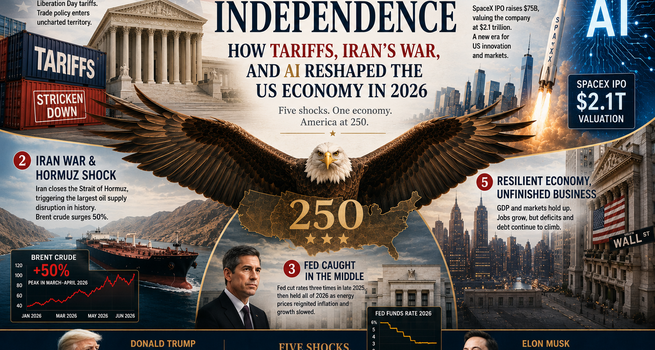
• Liberation Day tariff regime, which drove the effective US tariff rate to its highest level since 1947, was struck down by the Supreme Court in February 2026 and remains legally contested as the 250th anniversary arrives.
• Iran's closure of the Strait of Hormuz from March 2026 triggered the largest oil supply disruption in the history of the global energy market, sending Brent crude up 50% and reigniting US inflation.
• The Federal Reserve cut rates three times in late 2025 then held all of 2026, caught between energy-driven inflation and slowing consumer demand, with new Chair Kevin Warsh now facing the most difficult monetary policy environment since the 2022 tightening cycle.
• SpaceX's June 2026 IPO, the largest in history at $75 billion raised, marked the end of a decade-long anomaly in which the most consequential US companies avoided public markets entirely.
The United States marks 250 years of independence today in the middle of an argument with itself. The argument is about what the American economy is, what it should be, and who gets to decide. Between the 249th and 250th anniversaries, five structural forces arrived simultaneously: a trade architecture built on executive emergency powers and then struck down by the Supreme Court; a geopolitical shock that closed the world's most critical energy chokepoint; a central bank paralysed between competing inflationary pressures under new leadership; a capital markets inflection that ended the private market decade; and a GDP and labour scorecard that showed resilience without resolution.
None of the five is settled. The 250th Independence Day is not a conclusion. It is an audit conducted mid-process.
Thread One: The Tariff War, the Supreme Court, and the Trade Architecture That Was Never Built
On April 2, 2025, President Trump announced what his administration called Liberation Day: sweeping reciprocal tariffs on 90 trading partners, imposed under emergency powers granted by the International Emergency Economic Powers Act. The announcement was the most dramatic restructuring of US trade policy since the post-World War II multilateral order was constructed. The effective US tariff rate hit 21.5% at its peak, against 2.4% in 2024, the highest level since 1947. US-China tariffs escalated to 145% before a May 2025 truce reduced them to 30% on the US side.
The S&P 500 fell more than 21.8% from its February 2025 peak, its largest drawdown since the COVID-19 crash of 2020, before recovering its Liberation Day losses in full by June 27, 2025, and posting a new all-time high. The market recovery masked the legal and structural fragility of the policy itself.
On February 20, 2026, the Supreme Court affirmed, in a 6-3 ruling in Learning Resources v. Trump, that the use of emergency powers under IEEPA to enact tariffs was not legal. The government was required to refund approximately $166 billion collected in IEEPA tariffs from more than 330,000 businesses. Trump replaced the struck-down architecture with a universal 10% tariff under Section 122 of the Trade Act of 1974, valid for 150 days from February 24, 2026. That window expires July 24, 2026, three weeks after this anniversary. New Section 301 investigations across 16 countries were initiated in March 2026 to rebuild the tariff architecture through legally defensible authority.
The Trump tariffs represent the largest US tax increase as a percentage of GDP since 1993, amounting to an average household tax increase of approximately $1,500 in 2026. Customs duties raised $264 billion for the federal government in calendar year 2025. Yet manufacturing employment declined every month following Liberation Day, falling by 89,000 jobs between April 2025 and February 2026, broadly consistent with pre-existing trends rather than any reversal of them. The stated goal of reshoring industrial production has, by the employment data, not yet materialised.
Intel (NASDAQ:INTC), the semiconductor manufacturer in which the US government now holds a direct equity stake, remains the most tangible test case for whether tariff-backed industrial policy can produce domestic production at scale.
Union Pacific (NYSE:UNP), as a proxy for domestic logistics and reshoring demand, has seen freight composition shift but volumes remain below the levels that genuine mass reshoring would require.
Thread Two: The Iran War, the Strait of Hormuz, and the Energy Repricing
The geopolitical shock that defined the first half of 2026 arrived on February 28, when US and Israeli military operations against Iran began. Starting on March 4, 2026, Iranian forces declared the Strait of Hormuz closed, threatening and carrying out attacks on ships attempting to transit. The Strait carries approximately 20% of the world's oil supply and significant volumes of LNG. The International Energy Agency characterised the disruption as the largest supply disruption in the history of the global oil market.
Brent crude surged more than 50% during the peak conflict period, briefly approaching $116 per barrel. The energy shock fed directly into US consumer prices. The PCE price index jumped from 2.9% in February 2026 to 3.8% in April 2026 on a year-ago basis. Energy inflation jumped more than 17 percentage points over the same period.
A ceasefire framework was announced on April 8, 2026. But maritime traffic through the Strait remained far below pre-war levels, with more than 500 vessels estimated to be waiting to transit as mine-clearing operations continued. As of late June 2026, tit-for-tat US and Iranian strikes renewed doubts about the durability of the ceasefire, with Brent crude trading at approximately $73 per barrel, still around $10 above pre-war levels.
The United States is structurally insulated from an energy shock of this nature relative to Asia and Europe. The US is the world's largest producer of petroleum and natural gas and a net exporter of both, cushioning supply shocks and strengthening energy resilience.
ExxonMobil (NYSE:XOM) and Chevron (NYSE:CVX) both recorded elevated export revenues during the conflict. But the insulation is partial: energy inflation still flows directly into CPI and PCE, squeezing consumer purchasing power regardless of domestic production levels. The Iran war repriced the global energy security calculus in a single quarter in a way that will persist regardless of how the MOU negotiations resolve. The conflict has echoed the 1970s energy crisis through acute supply shortages, currency volatility, and heightened risks of stagflation across energy-importing economies globally, even as the US position remains comparatively advantaged.
Thread Three: The Federal Reserve in Paralysis
The Federal Reserve cut interest rates by a cumulative 175 basis points between September 2024 and December 2025, ending the year with the fed funds rate at 3.50% to 3.75%. Coming into 2026, market consensus anticipated further cuts. Instead, the Fed held at every meeting through the first half of the year, caught between the dual mandate in its most difficult configuration since the 2022 tightening cycle: tariff-driven inflation on one side, slowing private payrolls and consumer fatigue on the other.
Jerome Powell's term expired in May 2026. Kevin Warsh, whose appointment represents the most significant Fed leadership change in a decade, presided over his first FOMC meeting in June 2026. The Fed held rates unchanged. Warsh has signalled a desire for regime change at the Fed, but institutional constraints and the existing committee structure limit unilateral shifts in policy direction.
While markets have increasingly priced in the possibility of a 2026 rate hike driven by energy-led inflation, JP Morgan Global Research maintains its view that the Fed will remain on hold through year-end, with the first potential hike not arriving until September 2027.
Goldman Sachs (NYSE:GS) and JPMorgan Chase (NYSE:JPM) have both revised their rate trajectories multiple times across the twelve months, reflecting how dramatically the macroeconomic inputs have shifted. The Fed that entered July 2025 expecting to cut toward 3% by year-end now finds itself debating whether the next move is a cut or a hike. That is not a marginal revision. It is a complete repricing of the monetary policy outlook.
Thread Four: AI, Capital Markets, and the End of the Private Market Decade
Against the macro turbulence of tariff policy and geopolitical shock, the US capital markets in mid-2026 are absorbing the most significant structural shift since the dot-com era: the mass return of the most consequential private companies to public markets.
SpaceX (NASDAQ:SPCX) priced its IPO at $135 per share on June 11, 2026, opening at $150 on its first day of trading and rising to a market valuation exceeding $2.1 trillion, the largest public offering in history at $75 billion raised. The scale of the transaction is best understood against context: the total US IPO market raised $45 billion across all of 2025. SpaceX's single listing exceeded that by two thirds. OpenAI filed confidentially with the SEC in June 2026 for a public debut, with Anthropic targeting a listing later in the year.
The AI infrastructure cycle that underlies these valuations is itself a structural force of unusual magnitude. NVIDIA (NASDAQ:NVDA) is now the world's most valuable company, with a market capitalisation of $4.8 trillion as of June 2026, followed by Apple at $4.3 trillion and Alphabet (NASDAQ:GOOGL) at $4.2 trillion. NVIDIA's fiscal year 2026 data center revenue reached $193.7 billion, accounting for over 89% of total company revenue of $215.9 billion. The concentration of AI infrastructure spend through a single company's product architecture is historically anomalous. Microsoft (NASDAQ:MSFT), at a market cap of $2.8 trillion, and Meta Platforms (NASDAQ:META) at $1.4 trillion, represent the AI deployment layer and the platform economics layer respectively. Amazon (NASDAQ:AMZN) anchors the cloud infrastructure layer that AI workloads increasingly depend upon.
The question that public market discipline will now force is one that a decade of private funding rounds never had to answer: whether the revenue generation of these businesses justifies the capital concentration flowing toward them. The SpaceX listing is the first of what may be a $200 billion-plus public market absorption test across 2026 and 2027. The outcome of that test will determine whether the end of the private market decade produces durable capital formation or the repricing correction that the late 1990s analogy warns against.
Thread Five: The GDP and Labour Scorecard
Real GDP grew at an annualised rate of just 0.5% in the fourth quarter of 2025, a near stall driven by government shutdown disruption, tariff policy uncertainty, and weakening private payrolls. It rebounded to 2.1% annualised growth in the first quarter of 2026, supported by investment, exports, and government spending.
Monthly nonfarm payroll growth averaged a loss of 22,000 in the last five months of 2025. It recovered to an average of 114,000 per month across the first five months of 2026, with hiring broadening beyond healthcare into manufacturing, construction, and leisure. Workers' wages continued to outpace inflation in early 2026, with average hourly earnings up 3.5% year on year through March, even as elevated energy costs eroded real purchasing power at the margins.
The federal deficit stands at $1.9 trillion in fiscal year 2026, representing 5.8% of GDP. Debt held by the public has reached 101% of GDP, a level that exceeds the previous post-World War II peacetime record. Consumer spending, the primary engine of US growth since the pandemic, is showing increasing signs of fatigue as higher inflation and elevated energy costs erode household purchasing power. Real disposable income growth is slowing. The US economy has absorbed an extraordinary compression of shocks across twelve months and remained technically expansionary. That is the resilience story. The fractures in fiscal sustainability, consumer demand, manufacturing employment, and unresolved inflation are the risk story sitting directly alongside it.
The Audit at 250
The pattern of the twelve months is clear in retrospect: five structural forces arrived simultaneously, each one repricing a different layer of the US economy, and none arrived with a clean resolution attached. Trade architecture is legally contested and due for its next iteration within weeks of this anniversary. Energy security has been permanently repriced by the Iran conflict regardless of how the MOU negotiations conclude. The Federal Reserve is paralysed between competing mandates under new leadership at precisely the moment when guidance is most needed. Capital markets are absorbing an unprecedented IPO wave against maximum macroeconomic uncertainty. And the fiscal position is the weakest in modern peacetime history.
The United States has absorbed shocks of comparable weight before, and its institutional capacity to resolve them has, in every prior instance, ultimately proved sufficient. Whether that capacity remains intact at 250, and whether the repricing of 2025 to 2026 proves structural or cyclical, is the question that the next twelve months will begin to answer.
Disclaimer: This article has been produced for informational purposes only and does not constitute financial advice, investment recommendations, or an offer or solicitation to buy or sell any securities. Kalkine Media does not hold positions in any of the securities mentioned. Readers should conduct their own due diligence and consult a licensed financial adviser before making any investment decisions.


 Nov 19, 2026


 Please wait processing your request...