
 CA
 NZ
 UK
 AU
 IND

 US

 Share
 X (Formerly Twitter)
 Whatsapp
 Facebook
 LinkedIn
 Telegram
 Email This Article
 Copy Link
 Summarize with AI
 Chat GPT
 Perplexity
Key Highlights
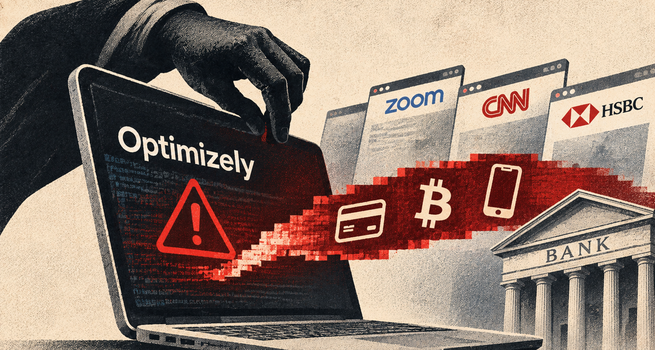
- Hackers hijacked Optimizely to push malicious code onto 178 organisations' websites on Nov 16th.
- Banking and finance was hardest hit, with 32 organisations affected, per Report URI.
- The code targeted crypto, card data and iPhones; about $7,000 in crypto was stolen.
A tool that websites use to test their pages was turned against their own visitors. Banks, news sites and airlines were among the 178 organisations hit
Imagine walking into your bank's website and finding nothing unusual. The page loads, the buttons work, and the login box looks as it always does. Yet a few lines of code, planted by a stranger, are watching what you type and what you copy. On November 16th this was the reality for visitors to some of the busiest websites in the world.
The affected sites include Zoom (NASDAQ:ZM), Salesforce (NYSE:CRM), Equifax (NYSE:EFX), HSBC (NYSE:HSBC), CNN, the BBC, Fox News, IKEA and Air France-KLM. In all, 178 organisations were hit, according to Scott Helme, a security researcher whose firm, Report URI, found the problem. None of them was hacked directly. The attackers went through a supplier they all use.
How it happened
The supplier is Optimizely, whose software lets companies run experiments on their websites, such as checking whether a green button gets more clicks than a blue one. To do this, each customer loads a small piece of Optimizely code into its pages. That code has the same freedom as the company's own, which means it can see what visitors type and copy.
The attackers found a way to write their own code into many customers' Optimizely settings. When a visitor opened an affected page, Optimizely's own servers delivered the booby-trapped code, and browsers trusted it because of where it came from. Optimizely has not yet said how the attackers gained access. It says an outsider exploited a flaw in one of its products, and that the flaw is now fixed.
What the code tried to do
The malicious code was a multi-purpose toolkit that did four things at once.
- Swap crypto addresses. When someone copied a Cryptocurrency address to send money, the code quietly replaced it with the attacker's, so the payment went to the thief.
- Copy card details. If someone typed a card number, expiry date and security code into a form on the site itself, the code sent them to the attackers. Payment boxes run by outside providers were beyond its reach.
- Take cookies and screenshots. The code grabbed screenshots of pages and some of the small files that keep people logged in.
- Attack iPhones. On iPhones and iPads running older software, it tried to load hacking tools that could take over the device. Apple (NASDAQ: AAPL) has fixed the underlying flaws in newer versions.
Who was hit
Banking and finance was the hardest-hit sector, with 32 organisations, according to Report URI. HSBC alone had 11 sites affected, from Hong Kong to Mexico to Egypt. Technology firms came next with 23, followed by retailers with 20, streaming services with 12 and news organisations with ten. Airlines, health firms, telecoms, insurers, gambling sites and charities were also on the list.
Helme's team found the code in 188 of the 1,611 Optimizely files it checked. The true number may be higher, because it could only test the files it could find.
A day-long attack
The attack began in the early hours of November 16th, when the BBC's site was among the first seen carrying the code. The attackers worked through the day, adding the card-copying feature in the afternoon and rebuilding the code 26 times. By evening, Optimizely was cleaning up. By 23:11 GMT, according to a later update from Helme, every infected file was clean. The exposure window was at least 13 hours.
How much was stolen
On the face of it, not much. About $7,000 in cryptocurrency reached the attackers' wallets, and the sum had risen to around $7,150 by the next day. They emptied the wallets in the early hours of November 17th.
But the crypto is only the part that can be seen. Stolen card details, cookies and hacked phones leave no public record, so nobody yet knows how many there were. It is also unclear on how many of the 178 sites the code actually did its work.
What the companies said
Optimizely said it had closed the hole, removed the planted code and notified affected customers. It has not named the flaw or said how many customers were hit. Helme said the company had not replied to his attempts to contact it by the time he published.
Salesforce said it was investigating and had switched off the changed scripts as a precaution. Equifax said it had stopped using Optimizely and found no sign its own systems were compromised. IKEA said it was checking whether its customers were affected. Zoom, HSBC, CNN and Apple did not immediately comment.
Few websites were protected. Of 256 affected organisations that Report URI examined, only 24, or 15%, had a browser safeguard strong enough to block the malicious code. Some 68 had none at all.
Not the first time
Attacks through a trusted supplier are a familiar tactic. In 2018 an accessibility tool was compromised to secretly use government sites' visitors' computers to mine cryptocurrency. In 2024 a widely used service called Polyfill.io began serving malicious code to more than 100,000 websites.
Optimizely was also in the news in February, when it said attackers had reached some of its internal Business systems through a phone-based scam. It said they could not install backdoors. No evidence has linked that episode to this one.
Why it matters
The money stolen this time was small. The reach was not. In a single day, one supplier's weakness exposed a global bank, a Credit bureau, three of the world's biggest news organisations and an airline group.
The wider lesson is that companies can protect their own systems well and still be exposed through a vendor. As Helme puts it, trusted code does not always stay trustworthy.


 Nov 16, 2026





 Please wait processing your request...