
 CA
 NZ
 UK
 AU
 IND

 US

 Share
 X (Formerly Twitter)
 Whatsapp
 Facebook
 LinkedIn
 Telegram
 Email This Article
 Copy Link
 Summarize with AI
 Chat GPT
 Perplexity
Key Highlights
- Forbes' 2026 World's Billionaires list recorded 3,428 billionaires with combined wealth of 20.1 trillion US dollars, up 4 trillion US dollars from 2025.
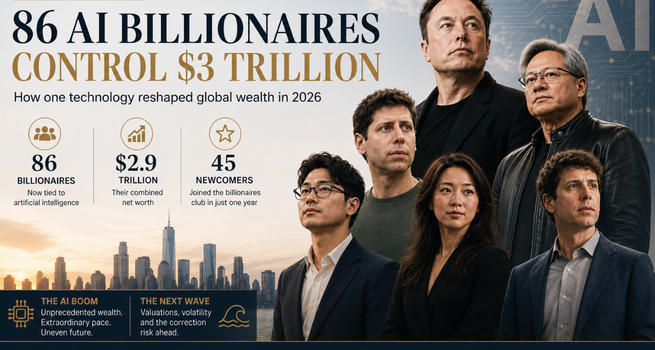
- At least 86 billionaires, worth a collective 2.9 trillion US dollars, now derive their fortunes substantially from artificial intelligence.
- Forty five individuals crossed the billion dollar threshold in the past year alone, led by Surge AI's Edwin Chen at 18 billion US dollars.
- Elon Musk's net worth has moved above and below the trillion dollar mark since June 2026, underscoring volatility embedded in AI linked valuations.
- Private market valuations at OpenAI, Anthropic and SpaceX have outpaced revenue growth at several AI companies, raising questions about capital allocation and correction risk.
A Record Year, Reframed By One Technology
Forbes' 2026 World's Billionaires list, compiled using stock prices and exchange rates as of March 1, 2026, counted a record 3,428 entrepreneurs, investors and heirs, 400 more than the prior year. Combined wealth reached 20.1 trillion US dollars, an increase of 4 trillion US dollars over twelve months. The United States accounted for the largest share of that growth, with a record 989 billionaires and 15 of the world's 20 richest individuals. China, including Hong Kong, followed with 610, while India ranked a distant third with 229.
Within that broader count sits a narrower and faster moving story. Forbes identified at least 86 billionaires whose fortunes are tied in a material way to artificial intelligence, together worth 2.9 trillion US dollars, roughly one seventh of total billionaire wealth on the list. Of those, 45 became billionaires only in the past year, a pace of wealth creation from a single technology category without precedent in the ranking's history.
The World's Richest Person, Still A Legacy Tech Story At The Top
At the March 1 pricing date used for the annual ranking, Elon Musk topped the list at 839 billion US dollars, ahead of Larry Page at 257 billion US dollars, Sergey Brin at 237 billion US dollars and Jeff Bezos at 224 billion US dollars.
Musk is the only name inside the top 10 whose fortune is meaningfully tied to artificial intelligence, through Tesla (NASDAQ:TSLA) and xAI. Page and Brin's wealth traces to Alphabet (NASDAQ:GOOGL), the parent of Google, while Bezos's fortune is tied to Amazon (NASDAQ:AMZN).
The remainder of the top 10, including Mark Zuckerberg of Meta (NASDAQ:META), Larry Ellison of Oracle (NYSE:ORCL) and Bernard Arnault of LVMH, remains anchored in older technology, luxury retail and consumer platform wealth built up over decades. AI dominates the story of new billionaire creation this year, but it has not yet displaced legacy technology and retail fortunes at the very top of the overall ranking.
The Top New AI Billionaires
Edwin Chen: 18 billion US dollars, Surge AI Chen is the wealthiest AI newcomer on this year's list. His company supplies data labeling and human feedback services that large language models depend on for training. By avoiding large venture capital rounds, Chen retained more than 75 percent ownership of Surge AI, an unusually high stake for a company of its scale.
Liu Debing: 9.1 billion US dollars, Z.ai Liu cofounded the Chinese AI firm Z.ai, which builds open models competing directly with OpenAI and other Western developers. His fortune materialised after the company's Hong Kong listing in January 2026, making him evidence that AI linked wealth creation is no longer confined to Silicon Valley.
Daniel Nadler: 7.6 billion US dollars, OpenEvidence Nadler built an AI powered search tool for physicians, positioning his company at the application layer of the AI stack, where healthcare specific tools are beginning to command premium valuations.
Lucy Guo: Scale AI cofounder Guo cofounded Scale AI alongside Alexandr Wang in 2016 to label training data for machine learning systems. Meta's (NASDAQ:META) acquisition of a 49 percent stake in Scale AI for approximately 29 billion US dollars, completed in 2025, cemented Guo's status among the AI economy's data infrastructure billionaires.
Brendan Foody, Adarsh Hiremath and Surya Midha: 2.2 billion US dollars each, Mercor The three cofounders of AI recruiting platform Mercor are each 22 years old and among the youngest self made billionaires on this year's list, having built their fortune in roughly the time it takes most entrepreneurs to raise a first funding round.
The AI Stack, Layer By Layer
Infrastructure: Jensen Huang, 154 billion US dollars Nvidia's (NASDAQ:NVDA) near monopoly position in AI accelerator hardware anchors the base of the AI wealth stack. The company's market capitalisation crossed 5 trillion US dollars in 2026, and Huang's fortune is tied to shipped, revenue generating hardware rather than projected future capability, giving it a more conventional valuation basis than the layers above it. AMD's (NASDAQ:AMD) Lisa Su represents the most credible public market alternative at this layer.
Model builders: Sam Altman, Elon Musk, Dario Amodei OpenAI, xAI and Anthropic sit at the center of the AI wealth story, commanding the largest private valuations in the sector. Their worth rests heavily on future capability and enterprise adoption rather than current earnings, distinguishing this layer from the hardware tier beneath it.
Data and training: Edwin Chen, Lucy Guo, the Mercor trio This is the least visible but increasingly consequential layer of the stack, supplying the human verified data without which large language models cannot be trained.
Applications: Cursor, Lovable, Sierra, Harness, Cognition Ten new billionaires emerged from AI coding assistants and enterprise software tools this year. This layer is the most crowded and most exposed to commoditisation, as improving general purpose model capability compresses the value of thin application wrappers built on top of them.
Musk, Ellison, Huang: Wealth That Moves By The Day
The March 1 pricing date embedded in the Forbes methodology captures a single moment, and AI linked fortunes have continued to move sharply since.
Elon Musk: approximately 997 billion US dollars Musk briefly became the world's first trillionaire on June 12, 2026, when SpaceX (NASDAQ:SPCX) completed a public listing. A subsequent slide in SpaceX shares cut his net worth by an estimated 50 billion US dollars, pulling him back below the threshold before he moved within range of it again by early July.
Jensen Huang: approximately 169 billion US dollars Valued at 154 billion US dollars on the March list, Huang's fortune had moved to roughly 169 billion US dollars by late June, with single day swings in the billions during periods of AI infrastructure repricing.
Larry Ellison: briefly the world's second richest person Ellison overtook Bezos, Brin and Page for a span of days, a shift closely tied to Oracle's (NYSE:ORCL) cloud and AI infrastructure contracts, before slipping back within the same week.
This pattern reflects a structural feature of the current AI wealth cycle rather than a series of isolated events. Fortunes tied to AI infrastructure and model companies are now moving with a speed more typical of daily trading positions than of the annual net worth estimates the Forbes list was originally built to capture.
The Valuation Question Investors Cannot Ignore
The scale of private capital committed to AI companies has continued to expand alongside the billionaire count. SpaceX's acquisition of xAI in January was structured at a valuation of 250 billion US dollars. Anthropic raised capital in the prior month at a valuation of 380 billion US dollars. OpenAI announced 110 billion US dollars in fresh capital commitments in late February, at a valuation of 840 billion US dollars. Several companies with limited revenue and no reported profit, including AI robotics and foundation model startups, are now valued in the tens of billions of dollars.
Forbes' own reporting acknowledges the tension embedded in these numbers, noting that a market correction becomes more plausible should any of the largest private AI companies pursue public listings and face the more rigorous earnings scrutiny that comes with it. Whether the current wave of AI billionaire creation reflects durable value or a valuation cycle still working itself out will likely become clearer as more of these companies test public markets over the next several years.
Disclaimer: This article is for informational purposes only and does not constitute investment advice. Kalkine Media does not recommend any securities or provide buy, sell or hold recommendations. Readers should conduct their own research or consult a licensed financial advisor before making investment decisions. Net worth figures are Forbes estimates and subject to change based on market movements.

 Nov 16, 2026



 Please wait processing your request...