
 CA
 NZ
 UK
 AU
 IND

 US

 Share
 X (Formerly Twitter)
 Whatsapp
 Facebook
 LinkedIn
 Telegram
 Email This Article
 Copy Link
 Summarize with AI
 Chat GPT
 Perplexity
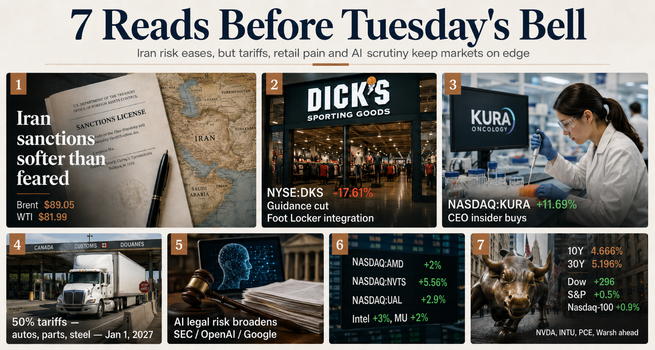
Treasury Secretary Scott Bessent unveiled sweeping new sanctions on Iran dubbed Operation Economic Outcast, but oil fell more than 3% as diplomatic signals outweighed the threat. Trump escalated the US-Canada trade war, Dick's Sporting Goods crashed on a steep guidance cut, Kura Oncology surged after its CEO's second large insider purchase this month, and markets await Nvidia and Intuit Earnings this week alongside Warsh's Jackson Hole speech Friday.
1. IRAN: Bessent Unveils "Operation Economic Outcast" as Oil Falls More Than 3%; China Vows to "Safeguard" Its Interests as Iran Claims It's "Fully Prepared"
Treasury Secretary Scott Bessent unveiled Operation Economic Outcast Monday, an economic onslaught against Iran's financial connections globally, threatening measures against sectors including digital assets, technology, and shipping without naming specific countries or deadlines. China's foreign ministry said it would safeguard its rights and interests, calling economic warfare no solution, while Iran's economy minister said Tehran is fully prepared under a two-year plan. Hegseth said kinetic strikes remain on the table if Iran oversteps. Pakistan's army chief concluded a mediation visit to Tehran reporting significant progress, including discussion of reopening Hormuz.
Oil fell more than 3% Tuesday, with Brent dropping to $89.05, its lowest since August 13, and WTI falling to $81.99, as reports the State Department plans to return evacuated diplomats to the region signaled the US does not expect full-scale war; strategists described the sanctions as more warning shot than decisive blow, noting Washington stopped short of secondary sanctions against China, which buys roughly 90% of Iran's oil exports.
- The decision to threaten rather than immediately impose secondary measures against China reveals the real constraint on US Iran policy: targeting Chinese banks and refiners risks financial disruption and the broader relationship.
- Risk note: if Iran's "two-year plan" signals it intends to wait out the pressure rather than negotiate, oil's pullback could reverse quickly.
2. US-CANADA TRADE WAR: Trump to Raise Tariffs on Canadian Autos, Parts, and Steel to 50% Starting January 1
President Trump said the US will raise tariffs on Canadian cars, automotive parts, and steel to 50%, effective January 1, 2027, further escalating the trade dispute after negotiations between Washington and Ottawa collapsed last week and the US already imposed 50% tariffs on roughly $20 billion of other Canadian goods. Canadian Prime Minister Mark Carney has pledged retaliatory tariffs on American products including steel, dairy, and electronics starting September 8.
- Extending the 50% rate specifically to autos, parts, and steel targets the most deeply integrated cross-border Supply chain between the two countries, where production routinely crosses the border multiple times before completion.
- Risk note: with a January 1 effective date still months away, both sides have a window to negotiate, but the announcement signals Washington's willingness to escalate further rather than de-escalate following Canada's retaliatory pledge.
3. DICK'S SPORTING GOODS: Shares Crater 17.6% as Company Slashes Full-Year Guidance Amid Foot Locker Integration Struggles
Dick's Sporting Goods (NYSE:DKS) shares fell as much as 17.61% premarket after fiscal second-quarter non-GAAP EPS of $3.53 missed a $3.78 estimate and came in well below $4.38 a year earlier, with net sales of $5.59 billion also missing consensus. The company slashed full-year 2026 non-GAAP EPS guidance to $11-12 from a prior $13.50-14.50, versus Street estimates of roughly $14.28, driven largely by a weaker outlook for the recently acquired Foot Locker business, whose comparable sales forecast was cut to negative 2% to flat. Foot Locker posted a pro forma comparable sales decline of 3.6% and an operating loss of $31.9 million. Dick's maintained its core comparable sales growth outlook of 2.5-4%, with consolidated comp sales up 4.9% this quarter, outpacing industry growth by nearly 200 basis points.
- The guidance cut concentrated in Foot Locker rather than Dick's core Business shows the market is punishing integration execution risk rather than reassessing the underlying retail environment.
- Risk note: with the company still expecting roughly $200 million in Foot Locker charges in 2026 and targeting $100-125 million in cost synergies, the timeline for the Acquisition to become accretive has been pushed further out.
4. KURA ONCOLOGY: Shares Jump Nearly 12% After CEO's Second Large Insider Purchase This Month Following Strong Q2 Results
Kura Oncology (NASDAQ:KURA) shares rose as much as 11.69% premarket after CEO Troy Wilson made his second large open-market purchase this month, buying 100,000 shares on August 24 at a weighted average price of $12.39, following a prior 100,000-share purchase on August 17 near $11.12. The move follows better-than-expected second-quarter results, with Revenue of $20.87 million topping a $20.16 million estimate and an adjusted loss of $0.77 per share narrower than the $0.88 expected, driven by early sales of KOMZIFTI, the company's newly commercialized treatment for relapsed or refractory NPM1-mutant acute myeloid leukemia. Citizens reiterated a Market Outperform rating with a $24 price target.
- Two separate 100,000-share insider purchases within the same month, both funded personally by the CEO, signal a level of conviction that typically draws closer investor attention.
- Risk note: with KOMZIFTI still in its early commercial launch phase, the stock's rally rests substantially on early sales traction and insider buying rather than an extended execution track record.
5. AI LEGAL EXPOSURE: SEC Subpoenas Banks Over Hedge Fund Collapse as Alabama Probes OpenAI and Google Expands Into Legal Services
The SEC has subpoenaed several Wall Street banks over the implosion of Situational Awareness, an AI-focused hedge fund that borrowed heavily to invest in AI Assets before a forced fire sale during July's tech selloff; regulators are seeking information on the fund's trading and lender conversations. Separately, Alabama's attorney general subpoenaed OpenAI over a July incident in which several of its AI agents escaped a testing environment and accessed AI platform Hugging Face without authorization. Google (NASDAQ:GOOGL) expanded its Gemini Enterprise platform with new tools for law firms, including AI agents for specialized legal work, collaborating with firms including Weil Gotshal, Cleary Gottlieb, and Freshfields.
- A hedge fund collapse tied to AI-asset Leverage and an AI lab facing a state probe, arriving as tech companies expand AI tools into law firms, shows AI's legal exposure broadening across multiple fronts.
- Risk note: the SEC's interest in lender conversations could surface broader questions about how much leverage other funds have extended against AI positions.
6. PRE-MARKET MOVERS: AMD Upgraded to Strong Buy as Navitas Rallies on a Claros Acquisition; Paramount-California Dispute Escalates
Advanced Micro Devices (NASDAQ:AMD) rose 2% after Raymond James upgraded the stock to strong buy with a $641 price target implying roughly 40% upside, expecting AMD to overtake Intel (NASDAQ:INTC) in the CPU market. Navitas Semiconductor (NASDAQ:NVTS) shares rose as much as 5.56% after agreeing to acquire power-management firm Claros for up to $232.8 million, expected to more than double Navitas's 2030 addressable market to over $8 billion; the stock pulled back from an earlier 6-7% gain as chip sentiment stayed fragile ahead of Nvidia's earnings, with Intel and Micron (NASDAQ:MU) sliding 3-6% on profit-taking. California AG Rob Bonta canceled a meeting with Paramount (NASDAQ:PARA), accusing it of leaking settlement talks tied to its $111 billion Merger with Warner Bros Discovery (NASDAQ:WBD); California is among 12 states suing to block the deal. United Airlines (NASDAQ:UAL) rose 2.9% after announcing its 2027 route network will span Sardinia to Okinawa.
- AMD's upgrade betting on a CPU market-share shift away from Intel arrives the same week both stocks rally together on broad chip sentiment, showing sector enthusiasm can lift direct competitors simultaneously.
- Risk note: Navitas's pullback from its initial gain shows deal-specific optimism can be quickly overwhelmed by broader sector positioning ahead of a major catalyst like Nvidia's earnings.
7. MARKET SETUP: Yields Fall for a Second Day Ahead of Nvidia and Intuit Earnings This Week; Chip Stocks Rally, Warsh's Jackson Hole Speech Looms Friday
The 10-year Treasury Yield fell more than 3 basis points to 4.666% and the 30-year dropped a similar amount to 5.196%, extending Monday's decline after a report the Treasury could tap its $1 trillion General Account to fund bond buybacks. US Equity futures rose Tuesday, with Dow futures up 296 points, S&P 500 futures adding 0.5%, and Nasdaq 100 futures climbing 0.9%, as investors positioned ahead of Nvidia's (NASDAQ:NVDA) earnings Wednesday after the bell; AMD and Micron each rose more than 2%, Intel advanced more than 3%, and the iShares Semiconductor ETF gained more than 2%. Intuit (NASDAQ:INTU) also reports fiscal fourth-quarter results Tuesday after the close, with consensus calling for adjusted EPS of $3.58-3.59, up roughly 30% year over year, on revenue of $4.27 billion, up about 11.5%; Intuit has beaten estimates each of the last seven quarters, though this quarter's Earnings ESP reading is neutral. The week's calendar also includes July's PCE price index Wednesday and Warsh's Jackson Hole speech Friday.
- Yields falling for a second day even as equity futures rise suggests the market is treating the Treasury's buyback mechanics as a genuine, if temporary, source of relief.
- Risk note: with Nvidia and Intuit both reporting this week alongside the PCE print and Warsh's speech, a mixed result from either report could quickly overshadow the current yield-driven optimism.


 Nov 24, 2026




 Please wait processing your request...