
 CA
 NZ
 UK
 AU
 IND

 US

 Share
 X (Formerly Twitter)
 Whatsapp
 Facebook
 LinkedIn
 Telegram
 Email This Article
 Copy Link
 Summarize with AI
 Chat GPT
 Perplexity
Key Highlights
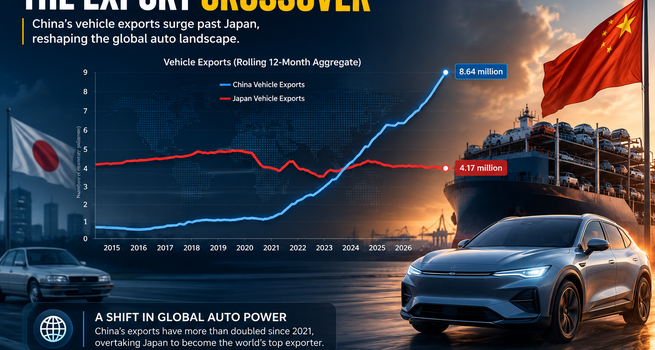
- Export volumes have inverted in seven years: China shipped 8.6 million vehicles in the twelve months to May, more than double Japan's 4.2 million, a complete reversal of the 2019 picture when Japan led 4.8 million to 1.0 million.
- Electric vehicles are driving the surge: EV exports jumped 112.6 per cent year-on-year to 424,000 units in May alone, now accounting for roughly 46 per cent of all Chinese vehicle exports.
- Trade barriers are diverging by region: developed markets such as the EU and Canada have shifted toward price floors and quotas, while emerging markets including Mexico, Brazil, Indonesia and Malaysia are demanding local investment in exchange for market access.
There is a particular kind of chart that makes economists sit up: two lines, once comfortably apart, cross and then pull apart again in the opposite direction. The global car trade has produced exactly that chart over the past seven years, and it describes an industrial reordering that has few parallels since Japan's export rise in the 1970s.
From Detroit to Tokyo: The Old Automotive Order
For decades, the hierarchy of global car exports was settled business. Germany owned the premium segment. Detroit, diminished but still substantial, held North America. Japan, methodical and relentless, exported more finished vehicles than any other country, built on engineering discipline and a dealership network decades in the making. The barriers to entry looked durable: proprietary combustion engineering, brand equity built up over generations, and manufacturing expertise that could not simply be purchased.
That order has now been dismantled, and with unusual speed.
The Numbers Behind China's Export Boom
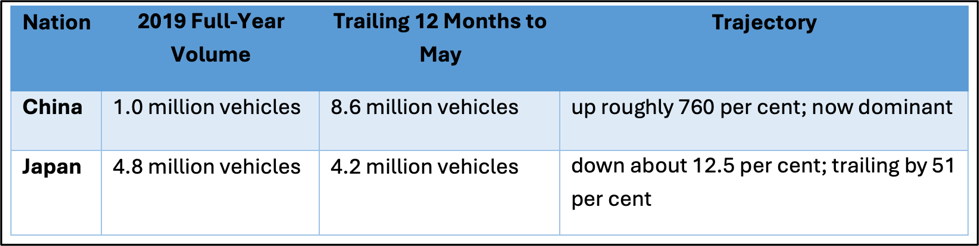
In the twelve months to May, China exported 8.6 million vehicles. Japan, the long-standing export leader, managed 4.2 million over the same period, barely half of China's total. Rewind to 2019 and the picture was almost precisely inverted: Japan shipped 4.8 million vehicles against China's 1.0 million, a lead of nearly 400 per cent. In under a decade, the gap has not just closed. It has reopened in the opposite direction, and grown wider than the original.
The pace of the shift is arguably more striking than its direction. In May alone, Chinese vehicle exports rose 68.7 per cent year-on-year to a monthly run-rate of roughly 930,000 units, a figure some 1,100 per cent above May 2019 levels. Electric vehicles did the heavy lifting: EV exports climbed 112.6 per cent to 424,000 units, or roughly 46 per cent of the total. Two years ago that share would have seemed implausible. Today it looks close to the new normal.
Global Auto Exports: 2019 vs. 2026
Why China's EV Supply Chain Changed the Game
It would be convenient, and largely wrong, to explain this shift as a story of cheap labour and state subsidy alone. Both have played supporting roles. The more durable explanation concerns where profit actually sits inside a modern car.
Boston Consulting Group's 2026 global automotive supplier study frames the shift plainly. Traditional mechanical systems, engines, transmissions, exhaust assemblies, the components Germany and Japan spent a century perfecting, are now in structural decline, with compound annual contraction of 3 to 8 per cent expected to persist into the next decade. Value has migrated instead to three areas: electrical and electronic architecture, battery and powertrain systems, and software-defined driving interfaces. None of these were core strengths of the old guard. All three happen to be areas where Chinese industrial policy placed its bets a decade ago, at a time when doing so still looked uncertain.
The China Association of Automobile Manufacturers describes the result as the world's most complete closed-loop electric vehicle supply chain: lithium extraction and refining, battery cell production through groups such as CATL, electronic control systems, and final assembly, all concentrated within a tight domestic geography. A company such as BYD or Geely can move from raw material to finished vehicle without crossing a border. McKinsey estimates this compresses development cycles by close to 30 per cent relative to Western rivals. In an industry increasingly run on smartphone-like release schedules, that is not a marginal advantage. It is close to decisive.
Domestic Overcapacity Is Fuelling the Export Push
The awkward truth is that this export surge is less a triumph of demand than a symptom of oversupply. The Council on Foreign Relations puts China's total automotive production capacity at a level capable of supplying more than half of global annual demand, which sits at roughly 90 million vehicles. Domestic consumption, meanwhile, has plateaued at around 25 million vehicles a year. The gap between what China can build and what China can sell at home is enormous, and it has produced a brutal domestic price war that no manufacturer particularly wants to keep fighting.
Total Chinese production capacity: approximately 45 million-plus vehicles Domestic absorption: approximately 25 million vehicles Excess capacity seeking a home: 20 million-plus vehicles Result: a record 8.6 million vehicles exported in the trailing twelve months
Faced with a choice between exporting the surplus or watching margins collapse, Chinese manufacturers have chosen the former. Combustion-engine capacity freed up by the domestic shift to EVs is being redirected to markets still reliant on petrol, largely across the developing world, while the newest electric models are steered toward higher-margin territory in Europe and the Middle East. A domestic capacity problem has been converted, with some efficiency, into an international sales campaign.
How Trade Partners Are Responding to Chinese EV Imports
Trading partners have not stood by. The scale and speed of Chinese export growth has prompted a scramble to build new trade defences, though the shape of those defences differs sharply by region, a divergence Deloitte's China research practice has usefully mapped into two broad camps.
Developed markets have generally opted for price management rather than exclusion. The European Union, having earlier imposed anti-subsidy tariffs of up to 45.3 per cent, shifted in early 2026 toward a minimum price commitment arrangement with Beijing, a mechanism that stops short of blocking Chinese brands but prevents them from undercutting European competitors on price while still giving European consumers access to the technology. Canada has taken a similar path, cutting its additional tariff on Chinese EVs from 100 per cent to 6.1 per cent, paired with volume quotas designed to manage rather than eliminate market exposure.
Emerging markets have taken a different approach, one better described as conditional access than protection. Mexico, Brazil, Indonesia and Malaysia have each introduced frameworks that raise the cost of a simple import-and-sell strategy while rewarding manufacturers willing to localise. Knock-down assembly no longer suffices; access increasingly requires local battery production and engineering investment. It amounts to protectionism with an escape hatch, and Chinese manufacturers, flush with capital and eager for volume, are proving willing to use it.
The Software Gap Widening Between Chinese and Legacy Automakers
Underlying all of this is a technology gap that may prove more durable than any tariff schedule. The modern car buyer cares rather less about torque curves than about whether the infotainment system feels a decade behind their phone. Chinese brands, BYD, NIO and XPeng among them, have treated the vehicle as a computing platform from the outset, updating navigation, driver assistance and battery management over the air on close to a monthly cycle. Legacy manufacturers, weighed down by older electronic architectures and fragmented supplier relationships, have struggled to match that pace. When a buyer can acquire a software-rich electric vehicle for the same price as a mechanically competent but digitally basic alternative, the decision tends not to require much deliberation.
What Could Slow China's Automotive Dominance
None of this amounts to a permanent victory, and it would be a mistake to read it as one. Price wars compress margins for winners as well as losers, tariff regimes can tighten as easily as they can loosen, and localisation requirements cut both ways: building a battery plant in Indonesia is a very different commitment from shipping a container of finished cars. Overcapacity, the very force driving the export boom, remains a structural vulnerability rather than a strength, and Beijing's tolerance for loss-making expansion will not last indefinitely.
What is harder to dispute is that the old assumptions no longer hold. A trade hierarchy built on a century of combustion-engine expertise has been overtaken, within a single business cycle, by one built on batteries, software and vertically integrated supply chains. Manufacturers in Wolfsburg, Detroit and Aichi Prefecture are no longer competing to defend market share at the margins. They are competing to establish whether an entirely new set of rules leaves room for them at all.


 Nov 24, 2026





 Please wait processing your request...