
 CA
 NZ
 UK
 AU
 IND

 US

 Share
 X (Formerly Twitter)
 Whatsapp
 Facebook
 LinkedIn
 Telegram
 Email This Article
 Copy Link
 Summarize with AI
 Chat GPT
 Perplexity

A freight bill up almost 40 percent, a luxury builder whose clients all pay cash, and microchips on long order books: the Fed's latest district reports describe an economy moving at several speeds at once.
 One manufacturer in the Richmond district told the Federal Reserve that its freight bills had climbed almost 40 percent as diesel and gasoline prices rose. A luxury homebuilder in Minnesota said every client was paying cash, whatever the price. Around Cleveland, customers were ordering microchips and electrical components far ahead of time simply to secure a place in the queue.
Three snapshots, three different economies. Together they capture the mood of the Federal Reserve's November 2026 Beige Book, released on November 25 and based on information collected on or before November 16. The report is qualitative by design. It draws on conversations with Business owners, bankers, economists and community groups in each of the 12 Federal Reserve Districts, and it does not reflect the views of Fed officials. Its strength is that it can pick up shifts in mood before official statistics catch up.
Eight Districts Grow, Four Stand Still
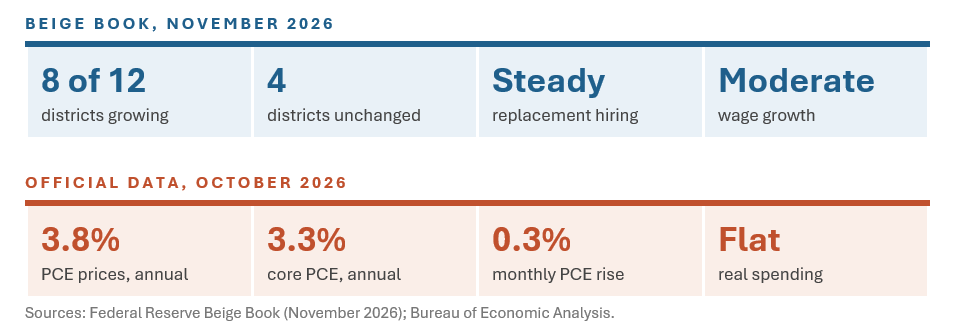
Eight of the twelve districts reported growth in the slight to moderate range, while four reported no change. Cleveland and Richmond described moderate expansion. New York, Philadelphia and Minneapolis reported slight growth, and Atlanta, St. Louis and Dallas reported modest growth. Boston, Chicago, Kansas City and San Francisco saw activity that was roughly unchanged.
The map is neither a boom nor a bust. It shows pockets of strength, mostly in manufacturing, finance and professional services, set against softness in consumer-facing businesses, housing and construction. Most districts still expect slight to moderate growth in the months ahead.
The Cautious Shopper
Consumer spending was little changed nationwide. Households stayed sensitive to prices and grew choosier about discretionary purchases. Travel and tourism were solid, while entertainment and hospitality spending was mixed. Auto sales softened, which contacts blamed on elevated fuel prices and higher interest rates.
The Atlanta district drew the clearest line between income groups. Lower- and middle-income shoppers hunted for promotions and kept trading down, while higher-income households carried on buying premium goods and luxury travel. In San Francisco, retail sales edged down as shoppers moved toward value-oriented stores, though Demand for groceries stayed strong.
Community groups described the strain behind those numbers. High housing and essential costs squeezed household budgets, lifted demand for social services and stretched nonprofit capacity. Atlanta contacts reported more people taking second jobs, more households sharing homes, and some dropping Health Insurance or trimming auto coverage to the state minimum.
Where the Boom Is Hiding
If consumers were cautious, parts of industry were not. Manufacturing grew modestly overall as strong demand in several segments offset weakness in consumer-facing and housing-related goods. Cleveland reported strong orders driven by Data Center buildouts, power generation and defense spending, and that demand stretched supplies of microchips and electrical components and lengthened lead times.
Ports told a similar story. Volumes in the Richmond district dipped slightly because of weather disruptions, yet imports of data center equipment kept rising. Contacts said such goods are a small share of total imports but have grown about 9 percent this year, and shipping rates from Asia to the United States rose close to levels last seen during the pandemic.
Energy activity grew modestly, though Investment stayed restrained by geopolitical, policy and cost uncertainty. Atlanta contacts expected disruptions tied to the Middle East conflict to continue into next year, and Utility contacts said future power demand was hard to judge while data center projects faced rising costs and more complicated planning.
Hiring With the Handbrake On
Employment rose slightly on balance, but the pace was cautious. Many firms held head counts steady and hired mainly to replace people who left, and only a minority reported meaningful increases. Several sectors cited steady or rising labor demand, yet many also described hesitancy to hire amid uncertainty and softer consumer spending.
Skilled and technical roles were the exception. In the Boston district, competition for skilled trades was fierce enough that some manufacturers were hiring traveling machinists at unusually high rates, and others cited shortages tied to immigration enforcement. Wages and benefits rose moderately across the country, a step up from the modest gains of the previous report, driven by hard-to-fill positions, cost-of-living adjustments and rising benefit costs.
Artificial intelligence added a further layer of uncertainty. Boston contacts described effects ranging from limited impact to retraining staff and slower hiring, and some Cleveland firms said they were using AI to limit hiring amid soft demand or high costs. Most Atlanta firms, by contrast, expected the technology to make employees more efficient rather than replace them in the near term.
The Margin Squeeze
Prices rose moderately overall, matching the pace of the prior report, but the more telling detail was who absorbed the increases. Contacts across many sectors cited energy, transportation, healthcare, insurance and tariff-related costs, along with raw materials, metals, freight and specialized imports. Input costs generally rose faster than selling prices, because competition and customer price sensitivity limited how much could be passed on.
New York contacts supplied some vivid examples. A food ingredient wholesaler said consumer product makers had raised prices sharply, and some were now seeing sales fall. An international shipping company said rising costs were eroding the competitiveness of American exports, while buyers of specialized imported equipment with no domestic alternative were absorbing Tariff and currency costs. In Cleveland, nonlabor cost pressures stayed strong for the twelfth straight reporting period, with fuel the most frequently cited driver. Contacts expected costs and prices to keep rising in the coming months.
What the Official Data Adds
The Bureau of Economic Analysis also released its October report on Personal Income and spending on November 25, and it puts numbers on several of these themes. The PCE price index rose 0.3 percent from September and 3.8 percent from a year earlier. The core index, which strips out food and energy, also rose 0.3 percent on the month and 3.3 percent on the year.
Spending followed the Beige Book's script of cautious consumers. Outlays rose 0.3 percent in dollar terms, about $63.8 billion, with services accounting for most of the increase, yet after adjusting for prices real spending slipped by less than 0.1 percent. Personal income rose 0.7 percent, and the saving rate stood at 4.1 percent.
A separate release the same day put third-quarter growth in context. Real gross domestic product, GDP, rose at an annual rate of 4.3 percent, up from 2.2 percent in the second quarter and revised up from the advance estimate, mainly on investment and consumer spending. That covers July to September, so it looks backward, while the Beige Book describes conditions through mid-November.
Property Under Pressure
Residential real estate weakened as affordability challenges suppressed demand, commercial property was mixed, and construction activity declined amid higher borrowing and building costs. Data center projects were the notable exception. In the Philadelphia area, nonresidential construction was falling outside that segment, and a large apartment contractor announced it would wind down projects and cease operations.
Banking conditions were little changed, with Loan demand subdued. Boston bankers said loan demand edged lower on uncertainty ahead of the midterm elections and higher borrowing rates. Credit standards were largely unchanged and most contacts saw stable loan performance, although two worried that delinquencies could rise this winter if households face very large heating bills.
What Comes Next
The outlook was cautiously positive rather than confident. Philadelphia firms still expected growth over the next six months, but optimism had faded across all firms since the prior report. Boston and St. Louis described their outlook as neutral, and Dallas contacts were mostly positive while citing inflation, Supply chain concerns, higher interest rates, and geopolitical and trade policy uncertainty as headwinds.
Several risks run through the report. If cost pressures persist, the squeeze on margins could weigh on hiring and investment. If consumers remain selective, consumer-facing businesses may see softer revenue. One Boston financial services contact also flagged rising uncertainty over the sustainability of AI-related Capital spending, a visible source of demand in several districts.
The Federal Open Market Committee meets next on December 8 and 9, and the Beige Book is one of several inputs policymakers weigh alongside official data. For now, the report describes an economy that is still moving forward, but one in which households and businesses are reading every price tag on the way.


 Nov 26, 2026





 Please wait processing your request...