
 CA
 NZ
 UK
 AU
 IND

 US

 Share
 X (Formerly Twitter)
 Whatsapp
 Facebook
 LinkedIn
 Telegram
 Email This Article
 Copy Link
 Summarize with AI
 Chat GPT
 Perplexity
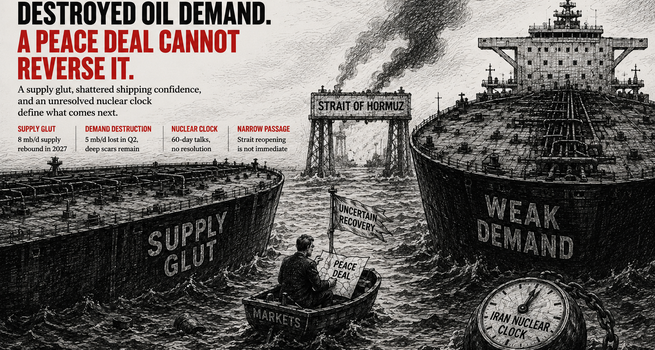
The Iran war ceasefire deal does not undo four months of oil demand destruction. A supply glut, shattered shipping confidence, and an unresolved nuclear clock define what comes next.
Key Highlights
- Global oil demand contracted by 5 mb/d in Q2 2026, the sharpest quarterly decline since the COVID-19 pandemic.
- The US-Iran ceasefire deal reopens the Strait of Hormuz in principle, but demining and infrastructure repair will delay full flow recovery.
- Inventories have shed the equivalent of 3.8 mb/d since late February, pushing global stocks toward historic lows.
- A supply rebound of 8 mb/d is projected for 2027 against only 2 mb/d of demand recovery, signalling a significant surplus.
- Israel remains outside the ceasefire agreement, and the 60-day nuclear negotiation window leaves the core conflict unresolved.
The Ceasefire Does Not Undo the Damage
When the United States and Iran signed their memorandum of understanding in Geneva on Friday, crude markets responded predictably. Brent fell toward $78 per barrel, its lowest in three months, as traders priced in the gradual reopening of the Strait of Hormuz. Three Iranian tankers carrying nearly five million barrels had already passed through the US Navy blockade ahead of the signing ceremony. The optics were of resolution.
They are not. The ceasefire ends the acute phase of a conflict that began on 28 February 2026, but it does not reverse the structural damage that four months of supply shock and demand destruction have inflicted on the global oil market. What the deal actually does is shift the risk from the supply side to a more complex set of questions about recovery speed, political durability, and the market arithmetic that follows. Those questions are harder to answer, and their resolution will determine the trajectory of crude prices, energy sector capital allocation, and the macroeconomic outlook for commodity-dependent economies well into 2027.
Four Months of Damage: The Ledger
The scale of the disruption merits precise accounting before any discussion of recovery. The closure of the Strait of Hormuz, through which approximately 20% of global oil trade transits, produced what the International Energy Agency has characterised as the largest supply disruption in the history of the global oil market. By May 2026, global output had fallen to 94.5 million barrels per day, some 13.6 mb/d below pre-conflict levels. For the full year, supply is projected to average 102.4 mb/d, a contraction of 3.9 mb/d against 2025.
The demand-side response has been equally severe and, crucially, is now self-reinforcing through mechanisms that persist after the supply shock abates. Second-quarter deliveries collapsed by 5 mb/d year-on-year, the deepest quarterly contraction since the pandemic. The full-year demand figure has been revised to a net decline of 1.1 mb/d for 2026, a downgrade of 700,000 b/d from prior estimates. This is not simply a story of missing barrels. Elevated fuel prices have compressed consumer activity, disrupted industrial supply chains, and prompted demand-substitution behaviour that takes time to reverse. The IEA has cut its 2026 global GDP growth assumption to 3%, from 3.4% previously, as the inflationary pass-through of crude prices feeds into broader economic deceleration.
The geographic distribution of that pain matters. Asia and the Middle East absorbed the heaviest demand losses, given their structural dependence on Hormuz transit for both crude imports and LNG supply. Fuel rationing spread across Pakistan, Thailand and parts of Southeast Asia. South Korea restricted naphtha exports for five months. Across the OECD, the damage was more diffuse but real: Americas, Europe, and Asia-Oceania each recorded demand declines of around 80,000 b/d. Product-level data shows gasoil, gasoline, LPG, ethane and naphtha all contracting. Only jet fuel and kerosene are expected to show any annual growth in 2026, and that reflects recovery from disrupted Middle Eastern air traffic rather than underlying demand strength.
The inventory position compounds the picture. Global oil stocks shed 143 million barrels in May alone, accelerating from a 74 million barrel draw in April. Since the conflict began, inventories have eroded at the equivalent of 3.8 mb/d. A coordinated emergency stock release of 400 million barrels has partially offset commercial drawdowns, but it has not arrested them. The cumulative liquids deficit is expected to reach approximately 900 million barrels by September 2026. Rebuilding that deficit to pre-war levels would require approximately 1 mb/d of excess supply sustained for three years, a constraint that will absorb much of the projected surplus before it reaches prices.
Why Recovery Will Not Be Immediate
The ceasefire agreement establishes a framework for reopening the Strait, but the operational reality of doing so is considerably more complex than the diplomatic language suggests. Mines will need to be cleared from the main shipping lanes, a process that carries both logistical and insurance implications. Tanker operators and their underwriters will require demonstrated safety before resuming normal transit patterns. Port and pipeline infrastructure in the Gulf, portions of which sustained damage during the conflict, will need repair and certification. These constraints do not resolve on a political timeline.
The evidence already points to a partial, uneven recovery. Strait shipments fell to a low of 9.6 mb/d in May. By mid-June, flows had recovered toward 12 mb/d, supported by ship-to-ship transfers in the Gulf of Oman rather than direct Hormuz transit. That distinction matters. Ship-to-ship transfers are more expensive, slower, and capacity-constrained relative to standard tanker routing. They reflect workaround logistics, not normalisation. Full restoration of pre-war flow volumes, estimated at approximately 20 mb/d, will require months of operational recovery, not weeks of diplomatic progress.
Supply chain normalisation carries its own lag. Refinery procurement schedules, crude blending arrangements, term contracts and storage logistics were all disrupted during the conflict period. Restoring them requires coordination across hundreds of counterparties operating in multiple jurisdictions. The IEA notes that Iranian oil exports can resume fully once the US blockade is lifted, but the speed of that resumption is constrained by the same infrastructure and confidence factors. Non-OPEC producers that expanded output in response to the crisis, particularly in the Atlantic Basin and US shale, will not immediately curtail production, adding to the supply recovery without a commensurate demand signal.
The Political Clock Is Still Running
The memorandum of understanding is, by the US vice president's own description, a broad framework roughly a page and a half in length, designed to buy time for technical negotiations over the next 60 days. The most difficult questions, specifically Iran's nuclear program, its enrichment levels, sanctions relief, and the status of frozen assets, remain entirely unresolved. Those issues were the original source of the conflict and have not been addressed by the ceasefire. They have been deferred.
Israel, which participated in the February strikes that initiated the war and has continued military operations in southern Lebanon, is not a party to the agreement. Prime Minister Benjamin Netanyahu acknowledged publicly that he and the US president do not always see eye to eye on the terms. Israeli strikes on Hezbollah targets have continued since the ceasefire announcement. If technical nuclear negotiations fail to produce an agreement within the 60-day window, the US president has stated publicly that military options remain on the table. The threat of conflict resumption is not residual. It is structural.
That political uncertainty has a direct market consequence. Energy infrastructure insurance, which collapsed during the conflict period, will not recover fully until the political risk premium associated with Gulf transit is materially reduced. That requires not just a ceasefire but a durable resolution of the nuclear question. Without it, shipping confidence and the pricing of Hormuz risk will remain elevated above pre-war levels, even as crude spot prices decline.
The 2027 Arithmetic: From Scarcity to Surplus
The most significant medium-term risk is not a return to conflict. It is the market imbalance that follows successful normalisation. If the ceasefire holds and Strait traffic recovers through the second half of 2026, global oil supply is projected to rebound by 8 mb/d in 2027 to approximately 110.3 mb/d. Global demand, meanwhile, is expected to recover by only 2 mb/d to 105.3 mb/d. The implied surplus is approximately 5 mb/d, before accounting for the absorptive effect of inventory restocking.
Markets that spent the first half of 2026 pricing acute scarcity will need to reprice structural oversupply before the end of the year. That transition will be neither smooth nor linear. The Brent price trajectory from above $120 per barrel in March to approximately $78 in mid-June already reflects the early stages of that repricing. The downward pressure will intensify as Strait flows recover, Iranian exports resume, and Atlantic Basin production continues to grow. OPEC+ production discipline, already under strain from member compliance variances before the conflict, will face renewed pressure in a surplus environment.
For energy sector capital allocation, the inflection is already visible. US upstream producers, which expanded output during the crisis period without the logistical constraints facing Gulf exporters, are positioned to benefit from the supply recovery lag. Refining margins, which surged as refined product shortages spread across Asia, will compress as product availability normalises. Integrated energy companies with significant Middle Eastern asset exposure face an additional layer of uncertainty tied to demining timelines, insurance market recovery, and the political durability of the MOU itself.
What the Deal Resolves, and What It Does Not
The ceasefire is a genuine diplomatic development. It reduces the immediate probability of further military escalation and creates a window for the most consequential energy market normalisation since the 1970s oil shocks. It does not, however, resolve the demand destruction that has already occurred, accelerate the physical reopening of the Strait, address the nuclear question that produced the conflict, or remove Israel from the regional equation.
The oil market is transitioning from a crisis defined by missing supply to one defined by recovering supply meeting permanently impaired demand, surplus risk in 2027, and a political overhang that makes long-duration capital commitments in the region structurally more expensive than they were before February. That is a different risk environment from what preceded the conflict, and it requires a different analytical framework to navigate.


 Nov 09, 2026





 Please wait processing your request...