
 CA
 NZ
 UK
 AU
 IND

 US

 Share
 X (Formerly Twitter)
 Whatsapp
 Facebook
 LinkedIn
 Telegram
 Email This Article
 Copy Link
 Summarize with AI
 Chat GPT
 Perplexity

Key Highlights
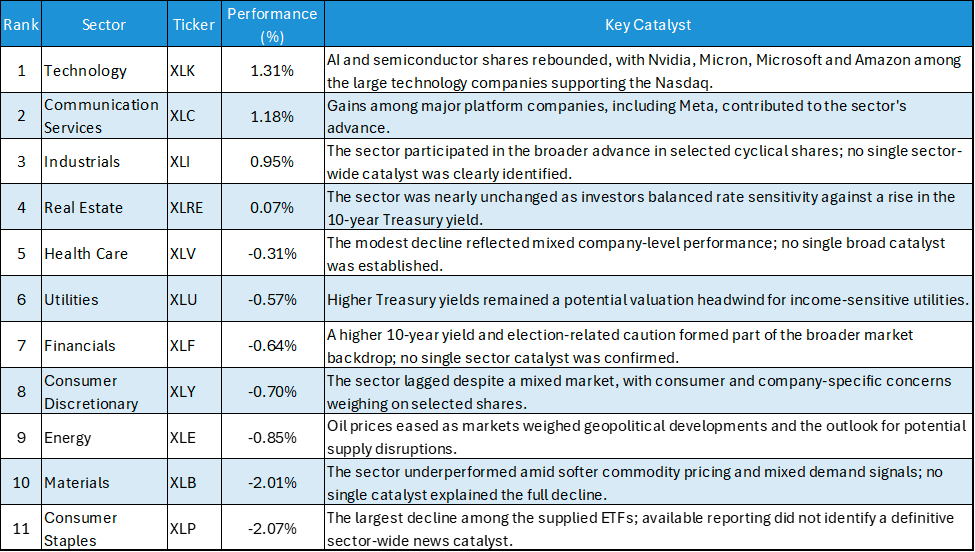
- Technology Leads: XLK gained 1.31%, supported by a rebound in AI-related and semiconductor shares, including Nvidia and Micron.
- Communication Services Advances: XLC rose 1.18%, with gains among major platform companies contributing to the sector's positive performance.
- Industrials Also Move Higher: XLI increased 0.95%, outperforming the broader group of declining sectors.
- Limited Strength in Real Estate: XLRE edged up 0.07%, leaving the sector close to unchanged.
- Consumer Staples and Materials Lag: XLP fell 2.07% and XLB declined 2.01%, recording the largest losses among the supplied ETFs.
- Negative Market Breadth: Four of the eleven supplied sector ETFs advanced, while seven finished lower, indicating that gains were concentrated in selected growth and cyclical areas.
US sector performance on 3 November 2026 showed a selective rebound in growth-oriented shares against a generally weaker market backdrop. Technology (XLK) advanced 1.31%, followed by Communication Services (XLC), which gained 1.18%, and Industrials (XLI), up 0.95%. Real Estate (XLRE) was marginally higher, while the remaining seven sectors declined. The strongest support came from AI and semiconductor-related companies as investors bought back into selected technology leaders ahead of the US midterm election results. However, the gains were not broad-based: Consumer Staples (XLP) and Materials (XLB) recorded the largest declines, highlighting continued uncertainty across defensive and commodity-linked shares.
Performance Breakdown by Sector
Technology and Communication Services Lead the Rebound
Technology (XLK) recorded the strongest performance, rising 1.31%. The advance was supported by renewed buying in major AI and semiconductor companies. Nvidia and Micron gained, while Microsoft and Amazon also moved higher. The rebound helped lift the Nasdaq, even as the broader market remained mixed. The move suggests investors were prepared to return selectively to technology leaders after recent concerns about elevated valuations and the scale of AI infrastructure spending. However, the sector's gains were not universal. Apple declined after warning that higher memory-chip costs could place pressure on margins in the holiday quarter. This divergence illustrates the importance of company-specific Earnings outlooks alongside the broader AI Investment theme.
Communication Services (XLC) advanced 1.18%, supported by strength among large platform businesses. Meta was among the major companies reporting gains, helping the sector outperform most of the market. The result reflects the influence of a relatively small number of large-cap constituents on sector ETF performance. While advertising, digital platforms and online engagement remain important earnings drivers, investors continue to assess regulatory exposure, Capital Expenditure and the sustainability of growth in digital advertising.
Industrials Advance While Real Estate Holds Near Flat
Industrials (XLI) rose 0.95%, making it the third-best performer in the supplied data. The advance indicated that buying extended beyond technology and communication platforms, although no single sector-wide news catalyst was clearly established. Industrial companies remain exposed to Manufacturing activity, infrastructure investment, freight Demand and corporate capital expenditure. Real Estate (XLRE) edged higher by 0.07%, effectively finishing close to unchanged. The sector's rate sensitivity remained relevant as the 10-year Treasury Yield moved higher, limiting the potential benefit of any improvement in risk appetite.
Defensive and Commodity-Linked Sectors Underperform
Consumer Staples (XLP) recorded the largest decline, falling 2.07%, while Materials (XLB) dropped 2.01%. Available market reporting did not identify a definitive sector-wide headline explaining the full weakness in either group. The declines may reflect company-specific earnings and positioning rather than a single common catalyst, so it would be premature to attribute the moves solely to changes in consumer demand or Commodity prices. Energy (XLE) fell 0.85% as oil prices eased amid ongoing geopolitical uncertainty. Utilities (XLU) declined 0.57%, while Financials (XLF) lost 0.64%. Health Care (XLV) and Consumer Discretionary (XLY) also finished lower, showing that weakness extended across several parts of the market.
Market Outlook and Risks
The next phase of sector Leadership will depend on corporate earnings, the direction of Treasury yields, developments in AI investment and the outcome of the US midterm elections. Continued strength in semiconductor and AI-related companies could support Technology, but the market will remain sensitive to the cost of infrastructure investment and the time required to generate adequate returns. Higher memory-chip costs also illustrate how supply-chain pressures can affect margins even when demand remains firm. The rise in Treasury yields may weigh on rate-sensitive sectors, while changes in oil and other commodity prices could influence Energy and Materials. With seven sectors declining, the latest advance in technology should not yet be interpreted as a broad market recovery.
Bottom Line
Technology (XLK) led US sector performance on 3 November 2026 with a 1.31% gain, followed by Communication Services (XLC) at 1.18% and Industrials (XLI) at 0.95%. The rebound in AI and semiconductor shares, including gains in Nvidia and Micron, helped support the technology-heavy Nasdaq, while Apple weakened on concerns about rising memory-chip costs. At the other end of the rankings, Consumer Staples (XLP) declined 2.07% and Materials (XLB) fell 2.01%. Seven of the eleven supplied sector ETFs finished lower, indicating that the advance remained concentrated. Investors will continue to monitor earnings guidance, AI investment returns, Treasury yields and election-related developments to assess whether technology leadership can broaden into a more sustained market recovery.


 Nov 04, 2026





 Please wait processing your request...