
 AU
AU
 UK
UK
 CA
CA
 NZ
NZ
 IND
IND

 US
US

 Share
Share
 X (Formerly Twitter)
 Whatsapp
 Facebook
 LinkedIn
 Telegram
 Email This Article
 Copy Link
 Summarize with AI
 Chat GPT
 Perplexity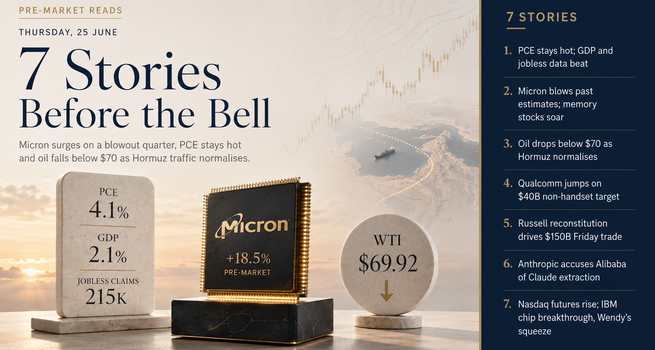
1. PCE/MACRO DATA: PCE Y/Y Holds at 4.1% With Zero Deceleration; GDP Revised Up to 2.1%; Jobless Claims 215K; All Three Hotter Than Forecast
The 8:30 AM data dump delivered a uniformly hawkish set of prints. PCE Price Index Y/Y for May held at 4.1%, matching the prior reading exactly and missing the 3.8% forecast; Core PCE Y/Y also held at 3.4% against a 3.3% forecast. PCE M/M came in at 0.4% and Core PCE M/M at 0.3%, both in line. Personal income rose 0.7% against a 0% forecast, driven by USDA farm disaster relief payments and private wage gains; consumer spending rose 0.7% against a 0.5% forecast; real PCE increased 0.3%.
GDP Q1 third estimate was revised up to 2.1% from the second estimate of 1.6%, with the revision reflecting a downward adjustment to imports. Jobless claims for the week ending June 20 came in at 215,000, down 12,000 from the prior week's revised 227,000, sharply below the 226K forecast. The personal saving rate was 3.0% in May.
- PCE Y/Y holding at 4.1% with no deceleration is the session's most consequential data point for the rate path: it removes the inflation-softening narrative that would have given Warsh cover to hold in July and reinforces the 9 officials who backed a hike at last week's FOMC.
- Jobless claims at 215,000 against a 226K forecast confirms the labour market remains tight; GDP revised to 2.1% means the economy is running hotter than the second estimate suggested across investment, exports, and government spending.
- Risk note: a hot PCE print in a session where Nasdaq futures are elevated on Micron creates a split signal; if bond markets reprice the December hike sharply higher at the open, rate-sensitive equities face pressure even as tech rallies.
2. MICRON/MEMORY: Micron +18.5% as Revenue Quadruples to $41.5B; EPS $25.11 Crushes $20.78 Estimate; Sandisk +15.6%, Western Digital +13%
Micron Technology (NASDAQ: MU) delivered the blowout print that Tuesday's 13% selloff had made the session's defining question. Third-quarter revenue came in at $41.46 billion against the $35.85 billion estimate, quadrupling from $9.3 billion a year prior; adjusted EPS of $25.11 beat the $20.78 consensus; profits surged nearly 15-fold to $28.2 billion. The stock is up 18.5% pre-market, more than recovering Tuesday's rout, and has risen more than 700% in the past year. Tuesday's reversal from an all-time high was a temporary dislocation, not a valuation reset. The memory complex is repricing across every name: Sandisk jumped 15.6%, Western Digital (NASDAQ:WDC) rose 13%, Lam Research (NASDAQ: LRCX) added 6%.
- Revenue quadrupling on a base of $9.3 billion is not a cyclical recovery; it is a structural demand shift driven by AI infrastructure consuming memory at a pace the prior commodity cycle never approached.
- The breadth of the move across Sandisk, Western Digital, and Lam Research confirms the Micron print is being read as a sector-level signal, not a company-specific beat.
- Risk note: the magnitude of the beat sets a new expectation floor; if Q4 guidance implies any deceleration from this trajectory, the post-earnings reaction could reverse despite the headline strength.
3. IRAN/OIL: WTI at $69.92, Fully Erasing All Wartime Gains; Hormuz Tanker Traffic Normalising; White House Seeks $87.6B War Supplemental
WTI crude fell to $69.92, fully erasing every dollar of the wartime premium built since February 28; Brent trades at $73.24. The price mechanism is Hormuz normalisation: tankers are transiting the strait as the MOU's toll-free passage provision takes effect, adding supply the market had priced out during the conflict. The White House asked Congress for an additional $87.6 billion, the bulk covering Iran war costs and munitions replenishment, with smaller allocations for the Ebola outbreak in Central Africa and farmer support. The supplemental faces long odds in the Senate, where Democrats oppose funding the war.
- WTI at $69.92 represents a complete unwind of the war premium; further Hormuz normalisation removes the structural argument for oil above $70 in the near term.
- The $87.6 billion supplemental request puts the fiscal cost of the Iran war on the congressional agenda at the same moment oil prices confirm the military objective has been partially achieved.
- Risk note: Iran's warning that tanker transit without its approval is "unacceptable and dangerous" could escalate into physical interdiction before the 60-day window closes, snapping oil back above $80 in a single session.
4. QUALCOMM: +11% Pre-Market; Nearly Doubles 2029 Non-Handset Revenue Target to $40B; Sets $15B Data Center Goal
Qualcomm (NASDAQ: QCOM) jumped 11% pre-market after nearly doubling its projection for 2029 non-handset revenue to $40 billion, up from a prior forecast of $22 billion, and targeting $15 billion in data center sales by the same year. Doubling a multi-year revenue target in a single disclosure signals the company has concluded its handset-legacy identity is a valuation ceiling and is executing a deliberate pivot toward AI infrastructure. The $15 billion data center target is the most specific AI diversification commitment from a handset-legacy semiconductor company to date, arriving in the same session Micron confirms the scale of AI memory demand.
- Qualcomm's non-handset revenue doubling to $40 billion by 2029 implies a growth rate the handset business alone could never deliver; the market is repricing the multiple accordingly.
- The $15 billion data center target puts Qualcomm in direct competition with Nvidia and AMD for AI inference workloads, a market that did not exist at material scale 3 years ago.
- Risk note: the 2029 targets are forward projections without disclosed quarterly milestones; if near-term non-handset revenue does not track the implied trajectory, the multiple expansion reverses before 2029.
5. RUSSELL RECONSTITUTION: $150B Friday Trade; SpaceX Fast-Tracked Into Russell 1000; Micron and Sandisk Added to Growth Index; Bloom Energy Joins Megacap 200
FTSE Russell executes its June reconstitution after Friday's close, with the total estimated trade of nearly $150 billion making it one of the largest structured liquidity events of the year. For the first time in over 30 years the Russell indexes are reconstituted twice annually, in June and December. SpaceX (NASDAQ: SPCX) is fast-tracked into the Russell 1000 under a rule FTSE Russell announced in late May for qualifying IPOs, classified as 90.4% growth and 9.6% value. Micron (NASDAQ:MU) and Sandisk (NASDAQ:SNDK) are added to the Russell 1000 growth index, creating non-discretionary index-fund buying on top of today's earnings pop. Bloom Energy (NYSE:BE) moves from the Russell 2000 to the Russell 200 megacap index after rising more than 1000% in a year on AI data center power agreements. 62 companies join the Russell 1000, with 43 moving up from the Russell 2000.
- Micron and Sandisk's Russell 1000 growth addition creates structural index-fund buying that arrives on top of today's earnings surge, reinforcing both names into Friday's close.
- Bloom Energy's move from the Russell 2000 to the megacap 200 after a 1000% gain illustrates how AI data center power demand has reshuffled market capitalisation rankings faster than the annual reconstitution cycle was designed to handle.
- Risk note: the $150 billion Friday trade concentrates liquidity demand into a single session; any broad market selloff Thursday would amplify Friday's rebalancing flows in unpredictable directions.
6. ANTHROPIC/ALIBABA: Anthropic Tells Congress Alibaba Ran 29M Exchanges to Copy Claude for China's Military; Alibaba Suing U.S. Over Blacklist
Anthropic testified before Congress that Alibaba was responsible for the "largest campaign to illicitly extract Claude's capabilities" ever recorded, generating approximately 29 million exchanges with the AI model to copy the lab's technology for China's armed forces. Alibaba (NYSE:BABA) is separately suing the U.S. government after being blacklisted and barred from selling products to the Pentagon. The testimony arrives the same week China imposed rare-earth export controls on U.S. firms, adding a direct AI capability theft dimension to the broader U.S.-China technology competition. The 29 million figure is specific enough to be cited in legislation; the congressional context signals a policy response is in motion.
- 29 million model interactions to reverse-engineer a commercial AI system is an industrial-scale extraction operation; the scale implies organisational coordination rather than individual actors.
- Alibaba's simultaneous lawsuit against the U.S. government means both sides are in adversarial legal postures while the extraction testimony is being presented to Congress.
- Risk note: if Congress moves to restrict Chinese firm access to U.S. AI APIs as a direct legislative response, the revenue exposure for U.S. AI labs with Chinese enterprise customers becomes a new regulatory risk category.
7. PRE-MARKET SETUP: DJIA +0.35% Wednesday; Nasdaq Futures Rallying on Micron; IBM +3% on Sub-1nm Chip; Wendy's +13% Extends 32% Weekly Squeeze; Gold Below $4,000
Wednesday closed mixed: DJIA +0.35% at 51,848.90, S&P 500 -0.10% at 7,358.22, NASDAQ -0.43% at 25,476.636. Thursday pre-market: Nasdaq futures are rallying sharply on the Micron print. IBM (NYSE: IBM) gained 3% after unveiling what it describes as the first technology capable of producing chips smaller than 1 nanometer, targeting generative AI and cloud infrastructure. Wendy's (NASDAQ:WEN) surged another 13% pre-market, extending Wednesday's 25%+ gain to a nearly 32% weekly advance on WallStreetBets short squeeze momentum. Gold trades at $3,998.80, below $4,000 for the first time in seven months, on a firm dollar and rising rate-hike bets.
- IBM's sub-1nm chip announcement establishes U.S. leadership at the next process node at a moment Intel's 18A-P recovery and the Apple-Intel partnership have already reframed domestic chip manufacturing.
- Gold breaking below $4,000 is a technically significant level; the metal has shed more than $260 from its recent highs as the Iran peace premium unwinds and Warsh's hawkish stance raises real yields.
- Risk note: Wendy's 32% weekly gain on short squeeze mechanics with no fundamental catalyst is a liquidity concentration risk; any coordinated exit by momentum traders collapses the move in a single session with no fundamental floor.


 Jun 25, 2026




 Please wait processing your request...