
 CA
 NZ
 UK
 AU
 IND

 US

 Share
 X (Formerly Twitter)
 Whatsapp
 Facebook
 LinkedIn
 Telegram
 Email This Article
 Copy Link
 Summarize with AI
 Chat GPT
 Perplexity
Key Highlights
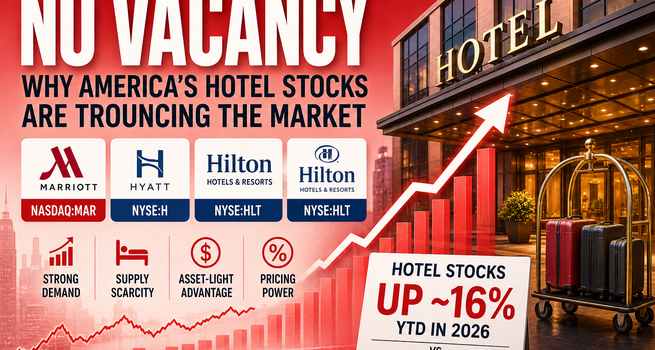
- Beds and Bulls: US (hotel stocks are up roughly 16% year-to-date in 2026, comfortably ahead of the S&P 500's 9-11% gain, with the Baird Hotel Stock Index up 17.6%.
- A Rising Tide: Fourteen of the nineteen major lodging names tracked are sitting on positive YTD returns, with names like NASDAQ:TH, NASDAQ:LIND and NYSE:VIK up more than 40% each.
- Scarcity Value: Net hotel supply growth has been trimmed to just 0.4% for 2026, well below the long-term average of 1.6%, handing operators unusual pricing power.
- Fees, Not Bricks: The rally rests on the high-margin, capital-light franchise economics of operators like NASDAQ:MAR and NYSE:HLT, which collect fees rather than own hotels.
- Not All Rooms Are Equal: Cruise operators NYSE:CCL and NYSE:NCLH, along with Asia-focused names NASDAQ:ATAT and NASDAQ:MLCO, have been left behind, underscoring a sharp bifurcation within the sector.
There is a particular kind of investing mistake that quality-focused investors learn to recognise early: mistaking a cyclical business for a compounding one, and vice versa. Hotels, for most of their history, have belonged firmly in the first camp — capital intensive, leveraged to the economic cycle, and prone to the kind of boom-bust dynamics that make buy-and-hold investors nervous. Yet the numbers coming out of the US lodging sector in 2026 tell a more interesting story, one that rewards a closer look at exactly what has changed in how these businesses are built and why the market is now pricing that change into share prices.
The Numbers: A Sector Re-Rated
Start with the headline number. US hotel stocks are up around 16% on a year-to-date basis in 2026, comfortably ahead of the S&P 500's roughly 9-11% gain over the same period. The Baird Hotel Stock Index, a closely watched barometer for the sector, has climbed 17.6% YTD against the benchmark's 10.7%. Zoom into the data on the 19 hospitality-linked names tracked most closely by the market, and the picture becomes even more textured. Fourteen of the nineteen are sitting on positive year-to-date returns. Target Hospitality Corp (NASDAQ:TH) leads the pack at +123.69%, followed by Lindblad Expeditions Holdings (NASDAQ:LIND) at +83.33% and Viking Holdings (NYSE:VIK) at +39.90%.
Even the more conventional, large-cap franchise operators have delivered returns most equity investors would be pleased with over a full calendar year, let alone six months: Marriott International (NASDAQ:MAR) is up 21.22%, Hyatt Hotels Corporation (NYSE:H) has gained 19.14%, and Hilton Worldwide Holdings (NYSE:HLT) has added 18.04%. This is not a story of a handful of speculative names getting bid up on momentum. It is a broad-based re-rating of an entire sector, and understanding why requires unpacking five distinct but reinforcing forces that have converged in 2026.
Fundamentals Outrunning Forecasts
The first, and arguably most important, force is that operating fundamentals have simply outperformed what the market expected coming into the year. Room demand rose sharply through the first four months of 2026, with more than 8 million additional room nights booked year-over-year. Both the group and transient segments — the two broad pillars of hotel demand, corporate and leisure — performed well simultaneously, a combination that doesn't always occur together and one that operators and analysts alike had not fully priced in. Notably, traditional hotels outperformed short-term rental platforms in demand growth this cycle, a reversal of the narrative that dominated much of the post-pandemic recovery period, when Airbnb-style alternative accommodation was widely seen as structurally taking share from branded hotels.
Domestic leisure travel, in particular, has proven far more resilient than the macro backdrop might suggest, and recent summer data — including the week ending July 4, 2026 — continued to show strong RevPAR (revenue per available room) gains, the single most-watched metric in hotel economics because it captures both occupancy and pricing power in one number.
The Analysts Play Catch-Up
The second force is a straightforward but consequential one: analysts got it wrong, in the right direction, and have had to catch up. CoStar/STR and Tourism Economics, the two research houses whose forecasts the industry treats as closest to gospel, have significantly raised their full-year 2026 outlooks. Full-year RevPAR growth is now projected at +2.8%, sharply revised upward from an earlier estimate of just +0.6%, and this follows a slight RevPAR decline in 2025. That is not a marginal upgrade — it represents more than a four-fold increase in the projected growth rate for the industry's key performance metric within the space of a few months.
Luxury and upper-upscale segments are leading this re-rating, benefiting from stronger average daily rate (ADR) growth as affluent travellers continue to prioritise premium experiences, while broader segments of the market are also expected to participate in the gains, even if less dramatically.
Scarcity Value: The Supply Squeeze
The third force is one that any student of quality investing will recognise instantly: supply discipline. Net hotel supply growth in the US has been trimmed to just 0.4% for 2026, well below the long-term historical average of roughly 1.6%. This is the kind of detail that gets lost in headline share-price commentary but matters enormously to anyone trying to understand durable pricing power. When new room supply is scarce, existing operators don't need to compete as aggressively on price to fill rooms, and they gain the confidence to push through rate increases that stick.
This is precisely the dynamic that separates a business with genuine pricing power from one merely riding a cyclical demand upswing — and it is why occupancy and rate trends in 2026 have been mutually reinforcing rather than working against each other, as often happens when new supply floods in just as demand peaks.
The World Cup Bump (And Why It's Smaller Than You Think)
The fourth force is more event-specific, and inevitably more talked about in the financial press: the 2026 FIFA World Cup, co-hosted by the United States, Canada and Mexico, with matches already underway by July 2026. Major tournaments of this scale are reliably cited as demand catalysts for host-city hospitality markets, and this one is no exception, particularly for premium and full-service hotels positioned to capture corporate hospitality budgets, international visitor spending and the general uplift in event-linked travel.
It's worth being precise about the scale of the effect, however, because the market has occasionally overstated it in the initial excitement. Early booking forecasts for the tournament were tempered as the reality of the impact became clearer, and the effect appears uneven and relatively modest in aggregate — Marriott (NASDAQ:MAR), for instance, has guided to only around a 40 basis point lift to US RevPAR attributable to the tournament. That modesty is itself informative: the World Cup is a genuine tailwind and a useful sentiment booster, but it is not, by itself, the reason hotel stocks have re-rated by mid-teens percentages this year. It is the icing, not the cake.
Layered onto this is a modest expected rebound in international inbound travel to the US, forecast at around 3% growth after a period of prior declines, though arrivals remain below 2019 levels — a reminder that the recovery, while real, is not yet complete.
The Asset-Light Machine
The fifth force is the one that should matter most to anyone thinking about these stocks not as a 2026 trade but as a multi-year holding, and it is where the analysis moves from cyclical tailwinds to structural business quality. Companies like Marriott (NASDAQ:MAR) and Hilton (NYSE:HLT) operate what is, in essence, an asset-light compounding machine. Rather than owning the hotels under their brand names — a capital-intensive, balance-sheet-heavy business with all the cyclicality that comes with owning real estate — these companies have shifted overwhelmingly toward franchising and management contracts.
Under this model, the company collects high-margin fees calculated as a percentage of system-wide RevPAR, while the capital expenditure of building, maintaining and renovating the physical hotel sits with third-party owners and franchisees. This is precisely the kind of business architecture that quality-focused investors look for: high return on capital employed, low incremental capital requirements to grow the topline, and cash flows that convert into free cash flow at a rate most industrial or capital-intensive businesses can only envy.
When system-wide RevPAR grows, as it has been doing at an accelerating pace through 2026, that growth flows through to franchise fee revenue at close to 100% incremental margin, since Marriott (NASDAQ:MAR) and Hilton (NYSE:HLT) aren't paying for the extra housekeeping staff or the extra electricity bill at a hotel they don't own. That operating leverage is a big part of why earnings growth at these companies has consistently outpaced revenue growth, and why the market is willing to pay a premium multiple for that earnings stream.
Reading the Balance Sheet
Look at the underlying financial data across the sector and this business-quality distinction becomes visible in the numbers themselves. Marriott (NASDAQ:MAR) trades at a P/E of 39.48 with EPS growth of 8.54% year-on-year — a premium multiple, but one underpinned by a scaled, capital-light franchise system spanning nearly the entire global upscale and luxury hotel landscape. Hilton (NYSE:HLT) commands an even richer multiple at 51.78 times earnings, alongside EPS growth of 3.19%, reflecting the market's willingness to pay up for the quality and predictability of its fee-based cash flows even when near-term earnings growth is modest.
Choice Hotels International (NYSE:CHH), a franchise-heavy operator focused more on the midscale and economy segments, trades at a more modest 15.01 times earnings but has delivered a robust 12.83% EPS growth, illustrating that the asset-light franchise advantage isn't confined purely to the luxury segment. Vail Resorts (NYSE:MTN), technically a resorts-and-leisure name rather than a pure hotel operator, stands out with a strong 'Strong Buy' technical rating across both technical and moving-average indicators, alongside a striking Relative Strength Index reading of 68.37 — a level that, in most technical frameworks, signals strong bullish momentum without yet tipping into overbought exhaustion.
Not All Rooms Are Equal: The Laggards
It would be intellectually lazy, however, to treat this entire basket of 19 stocks as a single homogenous trade, because the data makes clear that dispersion within the sector is significant and instructive. At the bottom of the table sit the cruise operators — Carnival Corporation (NYSE:CCL) down 12.15% YTD, Norwegian Cruise Line Holdings (NYSE:NCLH) down 12.23%, and the Asia-focused gaming and resorts names Atour Lifestyle Holdings (NASDAQ:ATAT) and Melco Resorts (NASDAQ:MLCO) down 20.28% and 28.69% respectively.
This bifurcation matters. Cruise lines carry a different demand profile, different capital structure — typically far more leveraged given the enormous fixed-asset cost of a cruise ship fleet — and different exposure to fuel costs and international itinerary disruptions than a branded hotel franchise business. Melco (NASDAQ:MLCO) and Atour's (NASDAQ:ATAT) exposure to Asian gaming and travel markets, particularly China-linked demand, has clearly not benefited from the same domestic US leisure resilience that has powered Marriott (NASDAQ:MAR), Hilton (NYSE:HLT) and Hyatt (NYSE:H) higher.
The lesson for anyone building a position in this space is the same lesson that applies across every sector: 'hospitality' as a label captures an enormous diversity of underlying business models, capital structures and demand drivers, and the market has, on the whole, been discerning enough this year to price that diversity correctly rather than treating the entire group as a single undifferentiated basket.
What the Charts Say
The technical picture reinforces this fundamental bifurcation rather nicely. Vail Resorts (NYSE:MTN) and Airbnb (NASDAQ:ABNB) both carry 'Strong Buy' technical and moving-average ratings, with Airbnb's (NASDAQ:ABNB) oscillator rating also flashing an outright 'Buy' — a relatively rare alignment across all three technical dimensions that suggests broad-based, multi-timeframe conviction rather than a single indicator spike. Hilton (NYSE:HLT), Choice Hotels (NYSE:CHH) and Red Rock Resorts (NASDAQ:RRR) also carry 'Strong Buy' moving-average ratings alongside 'Buy' technical ratings, indicating that momentum in the large-cap franchise names remains constructive even after the sizeable YTD gains already recorded.
By contrast, Wyndham Hotels & Resorts (NYSE:WH), Carnival (NYSE:CCL), and Atour Lifestyle Holdings (NASDAQ:ATAT) all carry 'Sell' or 'Strong Sell' technical and moving-average ratings, consistent with their negative or lagging YTD performance and suggesting that near-term momentum has further to unwind before these names stabilise.
The Caveats
None of this is to suggest the sector's tailwinds are risk-free or permanent. The broader macro backdrop remains genuinely uncertain — inflation has not been fully tamed, energy prices remain elevated amid ongoing geopolitical tensions in the Middle East, and international arrivals into the US are still running below pre-pandemic 2019 levels in several key markets. There is also a clear bifurcation within demand itself: luxury and upper-upscale segments are outperforming economy and midscale segments, a pattern consistent with a broader K-shaped consumer economy in which higher-income travellers continue prioritising experiences while more budget-conscious consumers remain more cautious.
Whether domestic leisure demand — the single biggest driver of this year's outperformance — proves durable through a full economic cycle, rather than being a temporary phenomenon driven by pent-up post-pandemic wanderlust and unusually strong labour markets, is a question that deserves genuine scepticism rather than blind extrapolation of the current trend.
The Bottom Line
But here is where the quality-investing lens earns its keep: even acknowledging all of these legitimate near-term risks, the structural argument for the sector's best operators does not depend on any single year's RevPAR number, World Cup bump, or macro forecast being exactly right. It depends on a much simpler and more durable proposition — that constrained new supply, an asset-light franchise model, and powerful brand loyalty programmes that lock in repeat customer spend create a business that compounds free cash flow at an attractive rate across cycles, not just within one favourable year.
The 2026 rally is the market recognising, somewhat belatedly, that this compounding machine had been undervalued relative to its true earnings power. Investors chasing the past six months' returns should be honest with themselves about how much of that recognition has already been priced in at current multiples — Hilton's (NYSE:HLT) 51.78 P/E and Vail Resorts' (NYSE:MTN) RSI north of 68 both suggest a fair amount of good news is now reflected in the share price. The more durable opportunity, as is so often the case in quality investing, likely lies not in chasing the names that have already re-rated the hardest, but in understanding which operators possess the structural, capital-light characteristics that will let them keep compounding long after this year's supply squeeze, World Cup bump and RevPAR upgrade cycle have faded into the rear-view mirror.


 Nov 13, 2026





 Please wait processing your request...