
 CA
 NZ
 UK
 AU
 IND

 US

 Share
 X (Formerly Twitter)
 Whatsapp
 Facebook
 LinkedIn
 Telegram
 Email This Article
 Copy Link
 Summarize with AI
 Chat GPT
 Perplexity
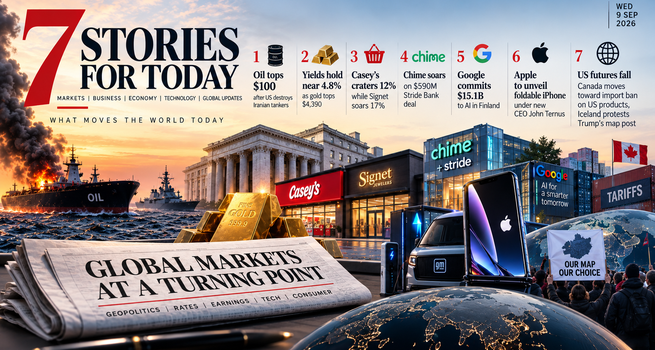
Brent crude topped $100 a barrel for the first time since July after the US destroyed five Iranian oil tankers and Iran claimed retaliatory strikes on American vessels, a claim CENTCOM denied outright. Casey's General Stores tumbled on decelerating same-store sales while Signet Jewelers surged on a big Earnings beat, Chime agreed to buy Stride Bank for $590 million to gain a bank charter, and Apple prepares to unveil its first foldable iPhone under new CEO John Ternus.
1. IRAN/OIL: Brent Tops $100 as US Destroys Five Iranian Tankers; CENTCOM Denies Iran's Claim of Vessel Strikes
Brent crude rose as much as 3% to $100.86 a barrel Wednesday, its first above $100 since July, after the US military destroyed five Iranian Crude Oil tankers Tuesday in retaliation for the IRGC firing ballistic missiles at the USS George H.W. Bush twice over two days; the warship evaded the attack and no Americans were harmed. US forces struck four tankers in the Gulf of Oman and one near Kharg Island, directing crews to abandon ship before rendering the vessels inoperable. Iran's Revolutionary Guard claimed it struck two US vessels and eight oil tankers in retaliation, but CENTCOM said flatly that no US Navy warship has been struck and all IRGC attempted attacks failed, adding that US forces have destroyed 10 Iranian tankers in the past week from a multibillion-dollar shadow network funding the IRGC. WTI crude climbed more than 3% to $95.84. Goldman Sachs' co-head of global commodities research said the escalation raises the risk of oil surging above $120 if attacks on shipping intensify, though the bank's base case remains a gradual export recovery.
- The direct contradiction between Iran's claim of striking US vessels and CENTCOM's flat denial means markets are pricing risk based on unverified claims from both sides.
- Risk note: with the US destroying tankers at a pace of 10 in a week, a shift toward directly targeting commercial shipping could push oil toward Goldman's $120 scenario faster than the base case anticipates.
2. YIELDS/GOLD: Treasury Yields Hold Near 4.8% as Gold Tops $4,390 on Weak Dollar; Mortgage Rates Hit 15-Month High
The 10-year Treasury Yield held near 4.81% Wednesday after briefly topping the closely watched 4.8% level Tuesday, a session in which the Dow fell 1.2%, its worst day in nearly three weeks, as rising oil fed Inflation concerns. The 2-year yield rose more than 2 basis points to about 4.42%, while the 30-year eased slightly to about 5.25%. Gold rose above $4,390 an ounce as the dollar slipped to a four-month low, with investors weighing inflation risk against Thursday's producer price index and Friday's consumer price index, the last major inputs before the Fed's September 16 decision. Mortgage applications fell 2.7% in the first week of September, the sharpest decline in more than a month, as the 30-year fixed rate climbed to a 15-month high of 6.85%, up nearly 80 basis points since US and Israeli strikes on Iran began in late February; refinance applications dropped 6.2% while purchase applications were roughly flat, and adjustable-rate mortgages rose to 8.5% of applications, the highest share since June last year. Markets price roughly a 60% chance of a Fed rate hike next week.
- Gold rising alongside a weakening dollar even as yields hold near multi-year highs shows investors increasingly treating the metal as a hedge against currency Debasement rather than purely a yield-driven safe-haven trade.
- Risk note: with mortgage rates already at a 15-month high and refinancing falling sharply, a further yield increase following this week's data could meaningfully cool housing activity before the Fed has even decided.
3. CONSUMER EARNINGS: Casey's Craters 12% on Sales Deceleration as Signet Soars 17% and Mission Produce Jumps 7.5% on Beats
Casey's General Stores (NASDAQ:CASY) shares fell as much as 12% pre-market after fiscal first-quarter same-store sales growth decelerated to 3.2% from 4.3% a year earlier, missing the Street's 4.1% forecast, even as diluted EPS of $7.37 and Revenue of $5.7 billion both beat estimates; fuel gallons fell 0.3% and operating costs rose 8%, while management left its full-year outlook unchanged, disappointing investors who hoped for an upward revision.
Signet Jewelers (NYSE:SIG) shares jumped as much as 17% after second-quarter adjusted EPS of $2.19 far exceeded a $1.74 estimate, prompting a raise in full-year EPS guidance to $10.45 to $12.15 from $9.20 to $11.00 and an expanded $700 million buyback authorization alongside a new $125 million accelerated repurchase program; the company also signed a seven-year Credit Partnership renewal with Bread Financial expected to generate more than $1 billion in incremental revenue and operating income.
Mission Produce (NASDAQ:AVO) shares rose as much as 7.5% after fiscal third-quarter revenue of $450 million and adjusted EPS of $0.18 both beat every analyst estimate polled by FactSet, with avocado Volume up 38% year over year following the Calavo Growers acquisition; management raised annualized Calavo synergy targets to more than $30 million from at least $25 million.
- Casey's selloff despite beating headline numbers shows investors treating sales deceleration as the more forward-looking signal than trailing earnings.
- Risk note: Signet's guidance raise arrives against broader luxury peers facing Demand headwinds, meaning the rally assumes company-specific execution can keep outperforming a sector where strength has not been universal.
4. CHIME: Shares Surge 10% as Fintech Agrees to Buy Stride Bank for $590 Million to Gain Bank Charter
Chime Financial (NASDAQ:CHYM) shares rose as much as 10% pre-market after agreeing to buy Stride Bank, its nationally chartered banking partner of more than seven years, for $590 million, gaining a bank charter and greater control over its lending expansion. The company also raised its third-quarter and full-year guidance for revenue and core profit growth. Chime said it expects to keep total Assets below $10 billion for the foreseeable future to remain exempt from debit-card fee caps under the 2010 Durbin Amendment, and estimated the deal will generate more than $100 million in net synergies through lower sponsor bank fees, expanded lending products, and lower cost of funds; the Acquisition is expected to close in the first half of 2027. Wall Street reacted positively, with Piper Sandler saying the deal would improve unit Economics and William Blair calling it a bold move with the potential to accelerate Market Share gains.
- Chime pursuing a bank charter while capping its asset base below the Durbin threshold shows it aims to gain a bank's operational control without triggering the regulatory costs of crossing that size threshold.
- Risk note: with a growing number of fintechs simultaneously pursuing bank charters, Chime's advantage from owning Stride could prove temporary if chartered status becomes standard practice rather than a differentiator.
5. AI/TECH: Google Commits $15.1 Billion to Finland AI Buildout as OpenAI and Meta Advance Competing AI Efforts
Google (NASDAQ:GOOGL) said it will invest at least 13 billion euros, or $15.1 billion, into AI infrastructure in Finland through 2028, its largest single Investment in Europe, including a 22-year life extension power purchase agreement with Finnish energy company Fortum. Finland has emerged as a leading European AI Data Center destination, described by one industry lawyer as the "Texas of Europe" given its available land and power, with competing projects announced by Pure DC, Arcem, and Nebius in recent months. Separately, OpenAI said it used an unreleased AI model to make progress on the Navier-Stokes equations, one of seven unsolved Millennium Prize Problems, though the claim was overshadowed by a dispute with a New York University mathematician who said he was preparing to publish a solution with an Anthropic researcher. Meta launched an AI agent called Muse to act as a personal assistant across apps including Instagram and WhatsApp by accessing services such as email, with the company's chief AI officer seeking to downplay concerns about the agent acting autonomously.
- Google's Finland investment arriving alongside competing hyperscaler commitments in the same country suggests European AI infrastructure buildout has reached the same land-and-power-driven dynamic already playing out in Texas.
- Risk note: the OpenAI-Anthropic priority dispute over a mathematical proof signals AI labs are now competing for credibility in pure research, a contest that could shape which lab's models are trusted for high-stakes scientific applications.
6. APPLE: Company to Unveil First Foldable iPhone Under New CEO Ternus, Pricing Expected Above $2,000
Apple (NASDAQ:AAPL) shares traded slightly lower ahead of Wednesday's product launch event, where the company is widely expected to unveil its first foldable iPhone in the most significant overhaul of the product since the physical home button was removed in 2017. The event marks new CEO John Ternus's first extended public keynote since succeeding Tim Cook, with the iPhone having generated $209.6 billion, just over half of Apple's total sales, last fiscal year. Samsung and Huawei have sold folding phones since 2019 without the format reaching mass adoption, but IDC expects Apple to sell every foldable unit it can produce and capture 40% share of the category by the end of next year despite an expected price above $2,000. Analysts expect Apple to update its Watch lineup and iPhone Pro models at the event while holding off on more affordable iPhone updates until spring 2027, a scheduling shift aimed at smoothing the annual sales cycle.
- Apple entering the foldable category years after Samsung suggests the company is betting its typical approach of perfecting engineering execution, rather than being first to market, will translate into pricing power earlier entrants never achieved.
- Risk note: with water and dust resistance cited as a key remaining challenge and Google's Pixel 10 Pro Fold already achieving a superior IP68 rating, any perceived durability shortfall could undermine the premium positioning Apple needs to justify a price above $2,000.
7. MARKET SETUP: US Futures Fall as Canada Import Ban Takes Effect, Iceland Summons US Ambassador Over Trump Map Post
US stock futures fell Wednesday, with Dow futures down 404 points, or 0.8%, S&P 500 futures off 0.5%, and Nasdaq 100 futures down 0.7%, following Tuesday's selloff. Energy stocks rose broadly on oil's surge, with the XLE ETF up about 1% and ExxonMobil (NYSE:XOM) advancing 1%. The US said it will ban imports of several Canadian products, including motorcycles, dairy, and most alcohol, effective in three weeks, an escalation following Canada's tariffs of up to 50% on roughly $20 billion of American goods; both sides say they want a deal, but talks remain at an impasse. In Europe, the Stoxx 600 fell 0.69% and Germany's DAX fell 0.68%; in Asia, Japan's Nikkei 225 fell 0.19% while South Korea's Kospi rose 1.40%. Separately, Iceland summoned the US ambassador after Trump posted a map on Truth Social depicting Iceland, Greenland, Canada, and other nations under the American flag, with Iceland's foreign minister calling the post completely unacceptable.
- The shift from tariffs to outright import bans between the US and Canada is a qualitatively different form of trade restriction, eliminating price-based market access rather than simply raising its cost.
- Risk note: with talks already at an impasse before the ban takes effect, the three-week window offers a narrow negotiating opportunity that, if missed, could harden both sides' positions once the ban becomes reality.

 Nov 03, 2026




 Please wait processing your request...