
 CA
 NZ
 UK
 AU
 IND

 US

 Share
 X (Formerly Twitter)
 Whatsapp
 Facebook
 LinkedIn
 Telegram
 Email This Article
 Copy Link
 Summarize with AI
 Chat GPT
 Perplexity
Key Highlights
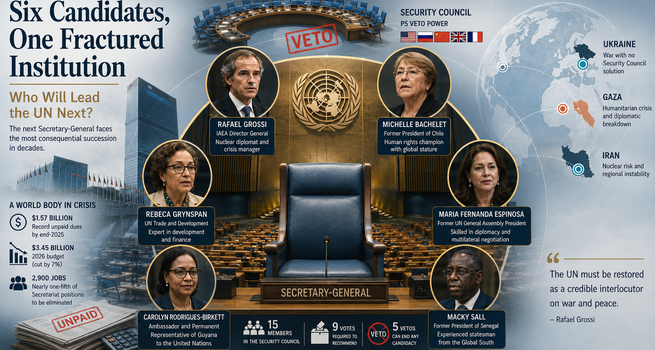
- Six candidates are competing to succeed Antonio Guterres, whose second and final term ends December 31, 2026, with a new Secretary-General expected in office by January 1, 2027.
- The UN faces structural financial strain, with record unpaid dues of $1.57 billion by end-2025 and a 2026 budget cut by 7% to $3.45 billion.
- All five permanent Security Council members hold individual veto power over the selection, making geopolitical acceptability as decisive as institutional competence.
- Conflicts in Ukraine, Gaza, and Iran have exposed the limits of the Secretary-General role and deepened institutional credibility questions the next leader must answer.
A Succession Unlike Any Other
The United Nations is preparing to appoint its tenth Secretary-General under conditions that have no modern precedent. Antonio Guterres departs at year-end after two five-year terms, leaving behind an institution simultaneously managing a financing breakdown, a Security Council in persistent deadlock, and a loss of credibility on the world's most consequential conflicts.
The selection process formally opened in November 2025. A final Security Council recommendation is expected by October 2026, followed by General Assembly confirmation. Six candidates have entered the race. The process is not a democratic election. It is a negotiation among the world's most powerful governments, each of which holds the power to end any candidacy with a single veto.
What the Institution Is Actually Handing Over
Before examining the candidates, the condition of the institution matters. Guterres warned member states in January 2026 of the risk of imminent financial collapse, citing unpaid mandatory contributions and a structural budget rule that forces the UN to return funds it never received. By end-2025, outstanding dues had reached a record $1.57 billion.
The United States, the largest assessed contributor, has withheld mandatory payments, slashed voluntary funding to UN agencies, and attached conditions to any future payment covering staff entitlements, peacekeeping reductions, and budgetary discretion. To manage the shortfall, the 2026 regular budget was cut to $3.45 billion, and the Secretary-General proposed eliminating nearly 2,900 Secretariat positions, close to one-fifth of the total workforce.
The next Secretary-General will need to either reconstruct consensus around funding obligations or pursue structural alternatives. Neither path is straightforward in a political environment where the largest contributor has described the UN as a bloated bureaucracy misaligned with its own foreign policy priorities.
Three Conflicts That Define the Job
The credibility deficit is not abstract. Three ongoing conflicts illustrate precisely what the incoming Secretary-General will face.
In Ukraine, Russia holds a permanent Security Council seat and is simultaneously the primary belligerent in the continent's most serious military conflict in decades. This structural contradiction means the Council cannot pass any binding resolution on the conflict that Russia does not approve. The next Secretary-General inherits a central peace and security institution that is legally incapable of acting on the most prominent conflict currently on its agenda.
In Gaza, Guterres paid a direct diplomatic price for exercising precisely the moral voice the Secretary-General role is designed to embody. His public condemnation of destruction in Gaza City prompted the Israeli government to formally suspend communications with his office. The episode is an instructive case study in the operational cost of independence. A Secretary-General who speaks plainly on conflict risks losing access to one or more parties. One who stays silent risks reducing the role to ceremony.
In Iran, nuclear risk has moved from a background diplomatic concern to an active management challenge. Rafael Grossi, the Argentine candidate, led the International Atomic Energy Agency through Iran's nuclear escalation and oversaw institutional engagement with the security situation at the Zaporizhzhia nuclear plant under Russian occupation. His track record on both fronts partly explains why Western governments have taken his candidacy seriously. It also signals the operating environment the next Secretary-General will face from day one.
The Six Candidates
Rafael Grossi, 65, is an Argentine career diplomat who has led the IAEA since 2019. His sustained engagement on nuclear risk and hard security issues places him among the more frequently cited front-runners. At the July 23 town hall in the General Assembly chamber, he argued that the UN must be restored as a credible interlocutor on war and peace, and that restoring that credibility requires concrete action rather than diplomatic language alone. He has declined to resign from the IAEA to campaign, citing his ongoing institutional responsibilities.
Michelle Bachelet, 74, served two terms as President of Chile and as UN High Commissioner for Human Rights from 2018 to 2022. She brings the widest international profile in the field. Her rights tenure drew sustained opposition from China following her reporting on alleged abuses of the Uyghur minority in Xinjiang, which complicates her candidacy given Beijing's veto. Chile subsequently withdrew its co-nomination after a domestic political transition. She has argued the Secretary-General must exercise a moral voice even under sustained pressure from major powers, and that field presence and direct engagement with conflict parties are non-negotiable requirements of the role.
Rebeca Grynspan, 70, is Costa Rica's former vice president and currently leads UNCTAD. In 2022, she brokered the Black Sea Grain Initiative, securing a temporary channel for Ukrainian grain exports under wartime conditions. She has called for the UN to be brought back to the table on active conflict scenarios and has been critical of what she describes as an overly risk-averse institutional culture that prioritises process over outcome.
Maria Fernanda Espinosa, 61, is Ecuador's former foreign minister and a past president of the UN General Assembly. She has called for structural reform including an early warning mechanism for emerging conflicts, and has argued that the institution must become more disciplined about distinguishing genuine impact from institutional activity. Her own government has not backed her candidacy.
Carolyn Rodrigues-Birkett, 52, is Guyana's current ambassador to the UN and a former foreign minister. She has pushed back against the tendency to evaluate the UN exclusively through its peace and security failures, arguing that the organisation's development and humanitarian record is substantial and consistently underreported. She also carries significance as a representative of indigenous communities in Guyana.
Macky Sall, 64, is the former president of Senegal and the only candidate from outside Latin America. By informal convention, which has guided UN leadership selection since the 1950s though it is not codified in the Charter, the role should now rotate to Latin America, where it has not been held since 1991. Sall was nominated by Burundi as chair of the African Union and has built his platform around the relationship between peace and sustainable development. His candidacy carries the complication of allegations that his government used lethal force against political demonstrators between 2021 and 2024.
The Veto Arithmetic
No candidate can succeed without clearing the veto hurdle from all five permanent members simultaneously. A candidate acceptable to Washington may be vetoed by Beijing or Moscow. A candidate with strong Global South support may face resistance from the United States. The result is a selection process conducted under near-total opacity, through secret straw polls in closed Council sessions, with candidates visibly campaigning with caution to avoid provoking any single permanent member.
Washington has explicitly linked the release of more than four billion dollars in outstanding arrears to a series of structural conditions covering staffing, peacekeeping, and Secretariat governance. The incoming Secretary-General will face that negotiation from their first day in office, before any longer-term reform agenda can be addressed. That financial leverage gives the United States substantial influence over the selection outcome even before the formal straw poll process begins.
The ten elected Council members matter too. While permanent members can veto, a candidate needs nine of fifteen votes total. Building that majority requires the support of elected members drawn from across the Global South, Europe, and the Asia-Pacific region. The straw polls, which begin in late July, will reveal where that support actually sits.
Conclusion
The UN Secretary-General race is, in structural terms, a referendum on what multilateralism can deliver under conditions of great power fragmentation. The next occupant of the role inherits a financing model under severe strain, a Security Council paralysed on the conflicts that matter most, and an institution whose moral authority is under pressure from multiple directions simultaneously.
The informal rotation convention points toward Latin America. The veto calculus points toward a candidate who can be accepted simultaneously by Washington, Beijing, and Moscow. Whether any individual in this field can satisfy both conditions at once is the central question the Security Council straw polls will begin to answer before October.


 Nov 10, 2026





 Please wait processing your request...