
 CA
 NZ
 UK
 AU
 IND

 US

 Share
 X (Formerly Twitter)
 Whatsapp
 Facebook
 LinkedIn
 Telegram
 Email This Article
 Copy Link
 Summarize with AI
 Chat GPT
 Perplexity
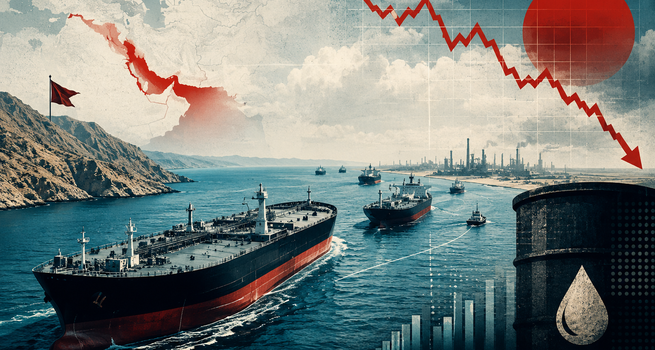
Key Highlights
- Commercial shipping through the Strait of Hormuz has recovered to roughly 10 million barrels per day.
- Oil flows remain around 50% below pre-conflict levels despite the rebound.
- A 60-day Memorandum of Understanding has temporarily reduced security concerns.
- Brent and WTI crude prices have retreated sharply as immediate supply fears ease.
- Markets remain focused on what happens when the agreement expires.
Calm Has Returned to the Strait of Hormuz—For Now
Commodity markets possess a curious habit. They rarely wait for events to unfold before pricing them. Instead, they trade probabilities, exaggerating risks during moments of uncertainty before rapidly reversing course when catastrophe fails to materialise.
The Strait of Hormuz offers the latest illustration.
According to Bloomberg, commercial crude shipments through the world's most strategically important energy corridor have climbed back to approximately 10 million barrels per day following the signing of a 60-day Memorandum of Understanding (MoU) that temporarily eased regional tensions.
That recovery marks a meaningful improvement after weeks in which military confrontation threatened one of the world's most critical maritime chokepoints. Yet it also conceals an uncomfortable truth: flows remain roughly 50% below pre-war levels, suggesting that confidence has returned only partially.
Markets may have stepped back from the edge. They have not walked away from it.
Why Hormuz Matters More Than Almost Anywhere Else
Few waterways exert as much influence over the global economy as the Strait of Hormuz.
Barely 33 kilometres wide at its narrowest point, the passage links the Persian Gulf to international markets. It serves as the export route for crude produced by Saudi Arabia, Iraq, Kuwait, the United Arab Emirates, Qatar and Iran.
Under normal conditions, roughly one-fifth of globally traded petroleum passes through these waters.
The world's dependence on Hormuz is not merely a function of geography but of limited alternatives. While pipelines can bypass portions of Gulf exports, their capacity remains insufficient to replace maritime transport on a meaningful scale.
Whenever tensions rise in the region, shipping insurers increase premiums, tanker operators alter routes, charter costs rise and energy traders begin pricing the possibility—not necessarily the certainty—of supply disruptions.
The fear itself often becomes economically consequential.
The Market Has Repriced Risk with Remarkable Speed
Oil prices have reflected precisely that pattern.
As conflict intensified, crude surged on expectations that shipping could face prolonged disruption or even temporary closure. Yet once diplomatic efforts produced the 60-day agreement and vessels began moving again, markets unwound much of the geopolitical premium.
US benchmark crude has now fallen more than 40% from its recent highs.
Such declines underline an enduring characteristic of commodity markets: they are often driven less by realised shortages than by changing perceptions of future risk.
In recent weeks, traders have concluded that the probability of a sustained interruption has diminished.
That is not the same as concluding the danger has disappeared.
Recovery Does Not Mean Normalisation
The headline figure—10 million barrels per day—appears reassuring until placed in context.
Traffic remains roughly half its normal level.
Shipping companies continue to assess security risks before committing vessels. Marine insurers remain cautious. Energy companies are balancing commercial necessity against operational uncertainty.
In effect, Hormuz has reopened without fully regaining trust.
That distinction matters.
Physical infrastructure can resume functioning quickly after a ceasefire. Commercial confidence generally takes longer to recover.
The gap between capacity and utilisation illustrates how businesses respond to geopolitical shocks. They rarely return immediately to pre-crisis behaviour simply because hostilities pause.
Instead, they seek confirmation that peace is durable.
The current agreement provides only temporary reassurance.
Sixty Days Is Not a Long Time in Energy Markets
Perhaps the most important feature of the current arrangement is its limited duration.
The Memorandum of Understanding extends for only 60 days.
That leaves traders confronting an uncomfortable question: what happens next?
If negotiations produce a broader diplomatic settlement, tanker traffic could gradually return to historical levels. Freight costs may ease further, insurance premiums could decline, and oil markets would likely continue removing residual geopolitical risk from prices.
But if negotiations stall—or worse, if military tensions resume—the market could rapidly reverse course.
Oil has repeatedly demonstrated its ability to respond violently to unexpected geopolitical developments.
In that sense, today's lower prices reflect confidence in diplomacy rather than certainty about its success.
Supply Has Been More Resilient Than Expected
Another reason oil prices have retreated lies outside the Gulf itself.
Global energy markets entered this crisis in stronger condition than many previous geopolitical episodes.
Non-OPEC production, particularly from North America, has remained relatively robust. Strategic petroleum reserves continue to offer emergency buffers in several major consuming nations. Demand growth, while positive, has moderated amid slower economic expansion across parts of Europe and China.
These factors have collectively reduced the market's vulnerability to temporary disruptions.
Unlike the oil crises of the 1970s, today's energy system is more geographically diversified.
That diversification does not eliminate Hormuz's strategic importance.
It simply makes the consequences of disruption somewhat less catastrophic than they might once have been.
Shipping Is Recovering, but Insurance Markets Remain Cautious
Energy markets often focus on barrels.
Shipping companies focus on probabilities.
Even if crude producers are willing to export, tanker operators must determine whether crews, vessels and cargoes can safely transit contested waters.
War-risk insurance premiums remain significantly higher than before the conflict.
Shipping schedules continue to reflect operational caution.
These frictions raise transportation costs even when physical exports resume.
Such costs ultimately filter through supply chains, influencing refining margins, fuel prices and corporate profitability.
The economic effects of geopolitical uncertainty therefore extend beyond headline oil prices.
Investors May Be Underestimating Political Risk
Financial markets frequently oscillate between excessive optimism and excessive pessimism.
The recent collapse in oil prices suggests investors increasingly expect the temporary agreement to evolve into something more permanent.
That assumption may prove correct.
It may also prove premature.
The Middle East has rarely rewarded linear forecasts.
Political agreements can stabilise situations surprisingly quickly, but they can also unravel with little warning.
For portfolio managers, this presents a familiar dilemma.
Energy prices now incorporate considerably less geopolitical risk than they did only weeks ago. Yet the underlying political uncertainty has not disappeared.
Rather, it has been deferred.
The Next Test Will Come When the Agreement Nears Expiry
The coming weeks may prove more important than the recent rebound itself.
If shipping volumes continue increasing beyond 10 million barrels per day, confidence in regional stability is likely to strengthen. Refiners, traders and tanker operators would gradually resume normal commercial activity.
Conversely, if negotiations falter before the memorandum expires, oil markets may once again confront the prospect of interrupted supply through one of the world's most critical energy arteries.
Much will depend less on the current level of exports than on expectations regarding future security.
Markets rarely wait for conflict to resume before reacting.
They price anticipation.
A Fragile Recovery
The recovery in shipping through the Strait of Hormuz represents genuine progress. Commercial traffic has returned more quickly than many feared, and oil markets have responded by removing much of the geopolitical premium that drove prices sharply higher during the conflict.
Yet this remains an incomplete recovery.
Exports are still substantially below historical norms. The temporary nature of the diplomatic agreement leaves businesses cautious, insurers vigilant and investors uncertain.
The broader lesson is that resilience should not be mistaken for permanence.
The global energy system has shown an impressive capacity to absorb geopolitical shocks, but it has not become immune to them. As the expiration of the 60-day memorandum approaches, markets will once again confront the uncomfortable reality that the world's most important oil corridor remains dependent not on engineering or economics, but on diplomacy.
For now, the Strait of Hormuz is flowing again. Whether that flow becomes the new normal—or merely an intermission—will shape oil markets long after today's headlines fade.


 Nov 20, 2026



 Please wait processing your request...