
 CA
 NZ
 UK
 AU
 IND

 US

 Share
 X (Formerly Twitter)
 Whatsapp
 Facebook
 LinkedIn
 Telegram
 Email This Article
 Copy Link
 Summarize with AI
 Chat GPT
 Perplexity
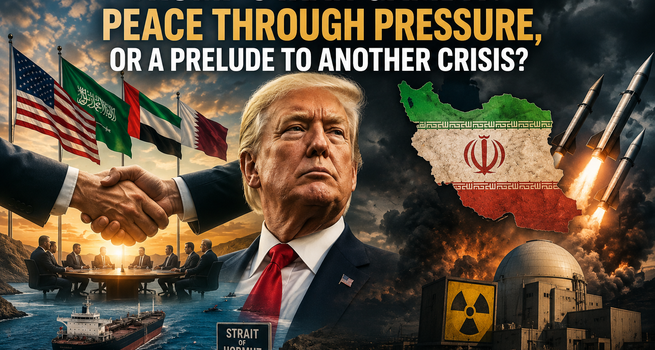
Donald Trump's month-long campaign on Iran reveals a foreign-policy doctrine built on simultaneous diplomacy and coercion. From reopening the Strait of Hormuz to nuclear inspections and threats of military action, the strategy carries profound implications for global energy markets, Middle East stability, and America's role in the region.
Key Highlights
- Trump spent the past month promoting a prospective Iran agreement while maintaining threats of military escalation.
- The Strait of Hormuz emerged as the central economic and geopolitical battleground.
- Nuclear inspections became a cornerstone of the proposed settlement framework.
- Oil markets responded positively to expectations of de-escalation.
- The contradiction between diplomacy and coercion remains the defining feature of Trump's Iran strategy.
The Return of Maximum Pressure Diplomacy
For much of the past month, President Donald Trump's social-media commentary on Iran has resembled a hybrid of a diplomatic communiqué and a military ultimatum.
One day brought declarations that a historic agreement was nearing completion. Another featured warnings that military action would resume on an unprecedented scale if Tehran failed to comply. References to peace agreements appeared alongside discussions of blockades, inspections, sanctions, and military readiness.
The resulting picture is neither traditional diplomacy nor outright confrontation.
Instead, it reflects a familiar Trump doctrine: negotiate from a position of overwhelming pressure while publicly emphasizing the possibility of peace.
Whether that approach delivers a durable settlement—or merely postpones another crisis—may prove one of the defining geopolitical questions of 2026.
Why the Strait of Hormuz Matters More Than Ever
At the centre of the negotiations lies a narrow stretch of water that remains one of the world's most important economic chokepoints.
The Strait of Hormuz handles roughly a fifth of global oil consumption and serves as the primary export route for Gulf energy producers.
Any disruption immediately reverberates through:
- Global oil markets
- Shipping costs
- Inflation expectations
- Energy security planning
- Financial markets
Trump repeatedly highlighted the reopening of the Strait as a major achievement.
This emphasis is understandable.
The economic stakes extend far beyond the Middle East.
Following years of inflation shocks triggered by supply-chain disruptions, energy markets have become particularly sensitive to geopolitical risk.
The mere prospect of uninterrupted oil flows can reduce volatility across global commodity markets.
For investors, the Strait of Hormuz is no longer simply a regional issue. It is a macroeconomic variable influencing everything from central-bank policy to corporate earnings forecasts.
A Nuclear Deal Reimagined
The most striking feature of Trump's recent messaging concerns nuclear inspections.
Rather than focusing solely on uranium enrichment levels or technical compliance metrics, the rhetoric has increasingly centered on what Trump described as "nuclear honesty."
While the phrase lacks formal diplomatic meaning, it captures a broader objective: establishing long-term verification mechanisms that prevent future disputes over Iran's nuclear ambitions.
This reflects a lesson learned from previous agreements.
The original Joint Comprehensive Plan of Action succeeded in limiting aspects of Iran's nuclear programme but failed to generate lasting political consensus in either Washington or Tehran.
Trump appears to be pursuing a framework designed to be more visibly enforceable.
The emphasis on extensive inspections serves two audiences simultaneously.
International observers receive assurances regarding non-proliferation.
Domestic political audiences receive evidence that verification, rather than trust, remains the foundation of the arrangement.
Whether Tehran ultimately accepts such intrusive monitoring remains uncertain.
Historically, inspection regimes have often become the most contentious element of nuclear negotiations.
The Economics Behind Sanctions Relief
Another notable aspect of the proposed framework involves sanctions relief.
Trump suggested that any financial benefits flowing to Iran could potentially be routed through mechanisms controlled or supervised by the United States, particularly for food and medicine purchases.
On the surface, the proposal appears humanitarian.
Yet its strategic significance is larger.
Sanctions have always faced a fundamental dilemma.
Excessive restrictions risk worsening humanitarian conditions while strengthening hardliners who argue that negotiations bring few practical benefits.
Insufficient restrictions weaken leverage.
By linking relief directly to essential goods, negotiators may be attempting to strike a balance between economic pressure and humanitarian considerations.
Whether such arrangements prove politically acceptable in Tehran is another matter.
Iranian officials have historically resisted measures perceived as limiting economic sovereignty.
Peace Through Strength—or Peace Through Uncertainty?
Perhaps the most revealing element of Trump's messaging is the coexistence of optimism and threats.
The President repeatedly described agreements as nearly complete, ceasefires as imminent, and peace as achievable.
At the same time, he warned that military action could resume if compliance faltered.
This duality reflects the central tension in his foreign-policy philosophy.
Supporters argue that credible military pressure strengthens diplomatic outcomes.
Critics contend that constant threats undermine trust and increase the risk of miscalculation.
Both perspectives contain elements of truth.
History offers examples where coercive diplomacy produced meaningful concessions.
It also offers numerous examples where escalating rhetoric contributed to unintended conflicts.
The challenge is determining where the current situation falls along that spectrum.
Markets Have Already Cast Their Vote
Financial markets appear cautiously optimistic.
Oil prices have generally reflected expectations that major disruptions to Gulf energy exports can be avoided.
Shipping markets have similarly responded positively to signs of de-escalation.
Equity investors, meanwhile, have largely treated the developments as reducing geopolitical risk rather than increasing it.
That reaction reveals an important reality.
Markets care less about diplomatic language than outcomes.
The reopening of trade routes, the reduction of military tensions, and the stabilization of energy supplies matter more than the precise wording of any social-media post.
For now, investors seem willing to assume that negotiations are progressing in a constructive direction.
That assumption remains vulnerable to reversal.
Middle Eastern diplomacy has repeatedly demonstrated how quickly optimism can evaporate.
Regional Powers Are Watching Closely
The negotiations extend beyond Washington and Tehran.
Saudi Arabia, the United Arab Emirates, Qatar, Turkey, Egypt, Jordan, Bahrain, and Israel all possess significant interests in the outcome.
Each government views Iran through a different strategic lens.
For Gulf states, stability supports economic diversification and investment ambitions.
For Israel, nuclear constraints remain the overriding concern.
For energy exporters, uninterrupted maritime trade is paramount.
The complexity of these overlapping interests helps explain why regional diplomacy has become increasingly multilateral.
No sustainable agreement can ignore the broader regional balance of power.
The Biggest Risk: Expectations
Ironically, the greatest danger may not be military escalation but inflated expectations.
Trump's public statements frequently suggest that agreements are close, comprehensive, and transformative.
History suggests that Middle Eastern diplomacy rarely progresses in a straight line.
Negotiations can stall.
Implementation can falter.
Verification disputes can emerge.
Political transitions can alter priorities.
By presenting progress as nearly complete, leaders risk creating disappointment if talks encounter predictable obstacles.
Financial markets, regional governments, and domestic constituencies may all react negatively if anticipated breakthroughs fail to materialize.
Managing expectations may therefore prove as important as managing the negotiations themselves.
What Comes Next?
Several developments will determine whether the current momentum produces a lasting agreement.
Investors and policymakers should monitor:
- Formal verification mechanisms for nuclear inspections.
- The long-term status of the Strait of Hormuz.
- The structure of sanctions relief.
- Regional security guarantees.
- Compliance enforcement procedures.
- Responses from Israel and Gulf states.
- Iranian domestic political reactions.
The answers to these questions will ultimately matter more than any individual social-media post.
Conclusion
Donald Trump's recent Iran messaging reveals a strategy built on simultaneous engagement and coercion. The administration appears determined to secure a diplomatic breakthrough while maintaining the threat of overwhelming military pressure. That approach has generated optimism in energy markets and reduced immediate fears of regional escalation.
Yet the durability of any agreement remains uncertain. The core challenges—nuclear verification, sanctions relief, regional security, and mutual distrust—have not disappeared. They have merely entered a new phase of negotiation.
The coming months will determine whether Trump's approach represents a genuine diplomatic achievement or simply another temporary pause in one of the world's most enduring geopolitical rivalries. For global markets, energy producers, and regional powers, the outcome will matter far beyond Washington and Tehran.

 Nov 10, 2026





 Please wait processing your request...