
 CA
 NZ
 UK
 AU
 IND

 US

 Share
 X (Formerly Twitter)
 Whatsapp
 Facebook
 LinkedIn
 Telegram
 Email This Article
 Copy Link
 Summarize with AI
 Chat GPT
 Perplexity

Key Highlights
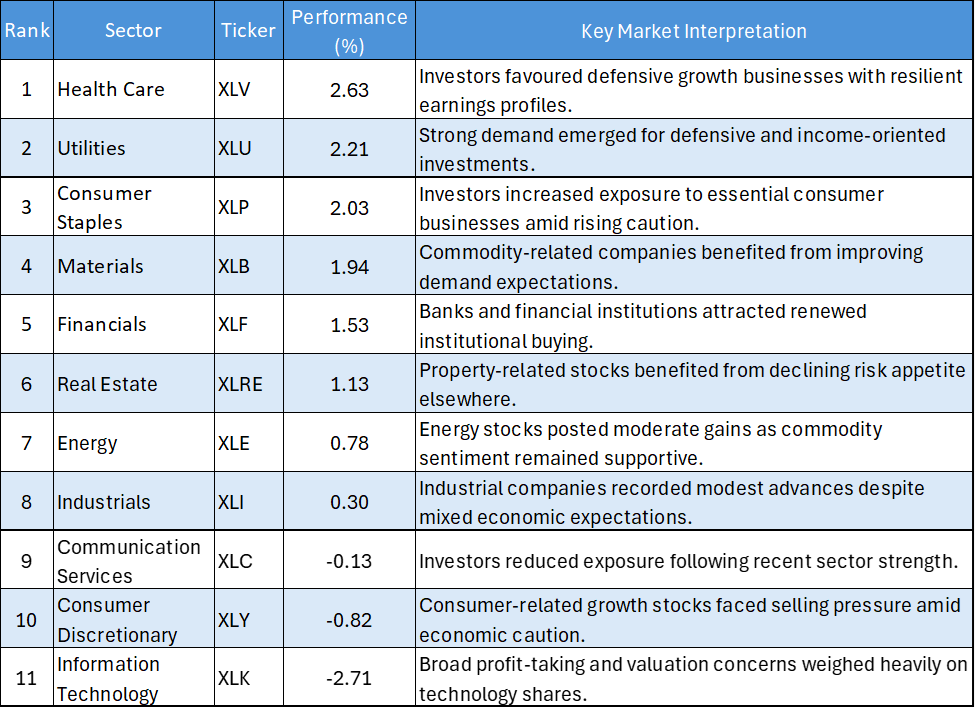
- Health Care Leads the Market: Health Care (XLV) surged 2.63%, emerging as the strongest-performing sector as investors rotated aggressively into defensive growth opportunities.
- Utilities and Consumer Staples Gain Strong Momentum: Utilities (XLU) advanced 2.21% while Consumer Staples (XLP) climbed 2.03%, reflecting a clear shift toward defensive positioning.
- Materials and Financials Show Broad Strength: Materials (XLB) gained 1.94% and Financials (XLF) rose 1.53%, indicating selective participation beyond traditional defensive sectors.
- Technology Suffers Significant Selling Pressure: Information Technology (XLK) fell 2.71%, making it the weakest-performing sector as investors continued to take profits following an extended period of leadership.
- Consumer Discretionary Underperforms: Consumer Discretionary (XLY) declined 0.82%, suggesting growing caution toward economically sensitive consumer-related businesses.
The US equity market experienced a notable defensive rotation on July 2, 2026, as investors shifted capital away from growth-oriented sectors and into traditionally defensive areas of the market. Health Care, Utilities, Consumer Staples, and Real Estate all posted solid gains, while Technology suffered a sharp decline. The session reflected a more cautious investment environment, with market participants favouring earnings stability and lower-volatility sectors amid growing uncertainty surrounding valuations in high-growth areas. This article follows the structure and analysis style of the attached report.
Daily US Sector Performance Summary
Key Market Themes
Health Care Emerges as Market Leader
- Health Care (XLV) delivered the strongest performance of the session, rising 2.63%. The sector benefited from increased demand for companies offering stable earnings growth, defensive characteristics, and lower sensitivity to economic cycles.
- The strong performance suggests investors are seeking greater portfolio resilience while maintaining exposure to long-term growth opportunities, particularly in pharmaceuticals, biotechnology, and healthcare services.
Defensive Sectors Take Control
- Utilities (XLU) gained 2.21%, while Consumer Staples (XLP) advanced 2.03%, making them two of the strongest-performing sectors of the day. Both sectors typically outperform during periods when investors become more risk-averse.
- The simultaneous strength across Utilities, Consumer Staples, Health Care, and Real Estate indicates a broad move toward defensive positioning rather than isolated sector-specific buying.
Materials and Financials Participate in the Rally
- Materials (XLB) climbed 1.94%, supported by optimism surrounding industrial demand and commodity-related businesses. The sector's strength suggests investors remain constructive on parts of the economic outlook despite the broader defensive tone.
- Financials (XLF) rose 1.53%, benefiting from continued institutional interest in banks, insurance companies, and diversified financial firms. The positive performance indicates confidence in credit conditions and financial sector profitability.
Technology Experiences Heavy Profit-Taking
- Information Technology (XLK) suffered the largest decline of the session, falling 2.71%. After leading market performance for much of the year, technology stocks experienced significant selling pressure as investors locked in gains and reallocated capital toward undervalued sectors.
- The weakness extended across many growth-oriented companies, particularly those with elevated valuations that had benefited from the ongoing artificial intelligence investment theme.
- While the decline may represent a healthy consolidation within a longer-term uptrend, the magnitude of the move highlights growing investor sensitivity to valuation risks.
Consumer Discretionary Weakens
- Consumer Discretionary (XLY) declined 0.82%, making it the second-weakest sector of the session. The weakness suggests investors are becoming more selective toward companies dependent on discretionary consumer spending.
- The divergence between Consumer Staples and Consumer Discretionary reflects a preference for essential spending categories over more cyclical consumer businesses.
Bottom Line
The July 2 session was characterised by a decisive shift toward defensive leadership. Health Care, Utilities, Consumer Staples, and Real Estate emerged as clear winners, while Technology experienced substantial profit-taking following an extended period of outperformance.
The strong performance across multiple defensive sectors suggests investors are prioritising stability and earnings visibility while reducing exposure to higher-risk growth areas. Although Technology remains a critical long-term driver of market performance, the current rotation indicates that market leadership may broaden in the near term as capital flows into Health Care, Financials, Materials, and other sectors offering attractive valuations and more balanced risk-reward opportunities.
If this defensive rotation continues, investors may increasingly favour diversified sector exposure rather than relying predominantly on Technology to drive portfolio returns.

 Nov 06, 2026



 Please wait processing your request...