
 CA
 NZ
 UK
 AU
 IND

 US

 Share
 X (Formerly Twitter)
 Whatsapp
 Facebook
 LinkedIn
 Telegram
 Email This Article
 Copy Link
 Summarize with AI
 Chat GPT
 Perplexity

Key Highlights
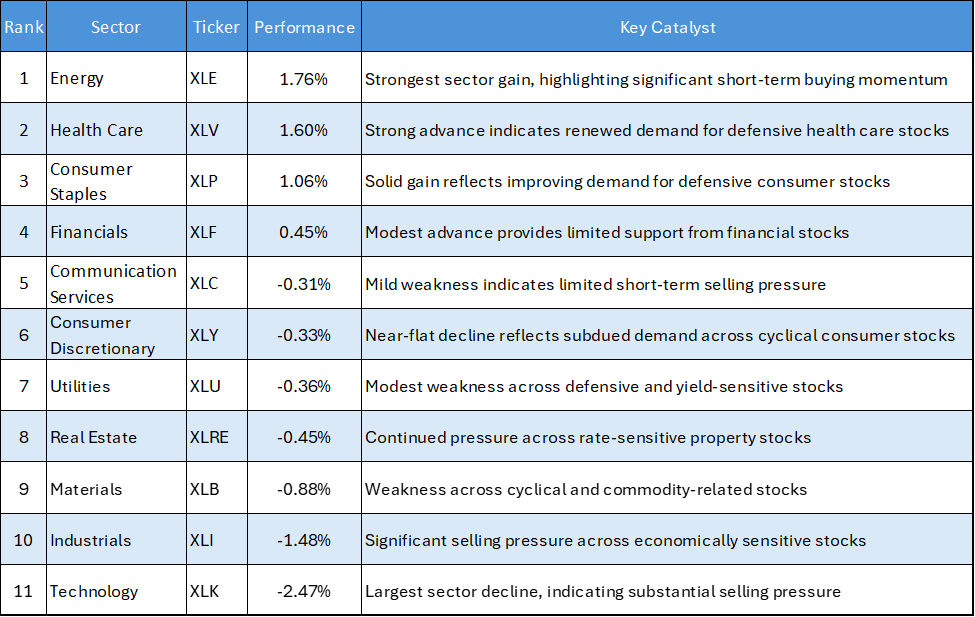
- Energy (XLE) gained 1.76%, ranking first among all eleven sectors and emerging as the strongest source of short-term momentum.
- Health Care (XLV) advanced 1.60%, providing significant additional support alongside Energy.
- Four of the eleven sectors advanced, while seven declined, indicating that Market Breadth remained weak despite strong gains in Energy and Health Care.
- Technology (XLK) fell 2.47%, recording the largest sector decline and facing significant selling pressure.
- Industrials (XLI) and Materials (XLB) also declined sharply, falling 1.48% and 0.88%, respectively.
The latest US sector performance data for 18 August 2026 shows a highly selective market environment. Energy (XLE) led the eleven sectors with a 1.76% gain, followed closely by Health Care (XLV), which advanced 1.60%. Consumer Staples (XLP) and Financials (XLF) also recorded modest gains, while the remaining seven sectors declined.
The performance highlights a continued divergence across the US market. Strong buying interest was concentrated in Energy and Health Care, while Technology experienced substantial selling pressure. The limited number of advancing sectors indicates that the market's positive momentum remains narrow.
Momentum Breakdown by Sector
Energy
Energy (XLE) was the strongest-performing sector, gaining 1.76% during the latest session. The advance placed Energy clearly at the forefront of short-term market momentum, with the sector outperforming every other segment by a wide margin.
The strength in Energy indicates concentrated buying interest, particularly as most other sectors failed to participate. Sustained outperformance would reinforce Energy's position as the dominant sector within the current market rotation.
Health Care
Health Care (XLV) advanced 1.60%, ranking second among all eleven sectors. The strong gain provides important support to the market alongside Energy and suggests renewed Demand for defensive and relatively stable areas.
Health Care's performance was substantially stronger than the sectors positioned below it. Continued gains would strengthen its momentum profile and potentially establish the sector as a secondary Leadership area.
Consumer Staples and Financials
Consumer Staples (XLP) gained 1.06%, while Financials (XLF) advanced 0.45%. The positive performance in Consumer Staples adds another defensive component to the market's leadership profile.
Financials recorded a smaller gain, suggesting more limited buying conviction. Nevertheless, its positive performance contrasts with the weakness seen across several cyclical sectors and provides some support to overall market breadth.
Communication Services, Consumer Discretionary, Utilities and Real Estate
Communication Services (XLC) declined 0.31%, while Consumer Discretionary (XLY) fell 0.33%. Utilities (XLU) and Real Estate (XLRE) recorded slightly larger declines of 0.36% and 0.45%, respectively.
The relatively modest losses across these four sectors suggest that selling pressure was contained. However, their inability to participate in the gains led by Energy and Health Care highlights the narrow nature of the market's positive momentum.
Materials, Industrials and Technology
Materials (XLB) declined 0.88%, while Industrials (XLI) fell 1.48%. The weakness across these cyclical sectors indicates reduced short-term demand for economically sensitive areas.
Technology (XLK) was the weakest-performing sector, declining 2.47%. The magnitude of the decline stands out significantly compared with the rest of the market and indicates substantial selling pressure across growth-oriented stocks.
Technology's sharp underperformance is particularly important because the sector is a major contributor to broader US Equity market momentum. Continued weakness in XLK could weigh on overall market sentiment unless leadership broadens across other sectors.
Strategic Summary
The latest US sector performance data points to a highly selective market environment, with only four of the eleven sectors recording gains. Energy clearly led with a 1.76% advance, followed by Health Care at 1.60% and Consumer Staples at 1.06%.
The leadership profile therefore shifted toward Energy and defensive sectors, while Technology experienced the strongest selling pressure. Industrials and Materials also declined significantly, reinforcing the uneven nature of current sector momentum.
Market breadth remains an important consideration. Although several sectors posted strong gains, seven of eleven sectors still declined. A broader recovery across Technology, Industrials, Materials and consumer sectors would provide stronger evidence of improving market momentum. Conversely, continued weakness in Technology combined with narrow leadership could leave the broader market vulnerable to further deterioration in breadth.

 Nov 13, 2026




 Please wait processing your request...