
 CA
 NZ
 UK
 AU
 IND

 US

 Share
 X (Formerly Twitter)
 Whatsapp
 Facebook
 LinkedIn
 Telegram
 Email This Article
 Copy Link
 Summarize with AI
 Chat GPT
 Perplexity

Key Highlights
- Energy Maintains Leadership: Energy (XLE) climbed 1.76%, extending its recent strength and emerging as the best-performing sector of the session.
- Technology Rebounds: Information Technology (XLK) gained 1.24%, making it the only other sector to finish firmly in positive territory.
- Defensive Sectors Lose Momentum: Consumer Staples (XLP) and Utilities (XLU) slipped 0.55% and 0.74%, respectively, indicating reduced demand for traditional defensive assets.
- Financials and Consumer Discretionary Under Pressure: Financials (XLF) fell 1.93%, while Consumer Discretionary (XLY) declined 1.78%, reflecting ongoing caution toward economically sensitive sectors.
- Materials Record Sharpest Decline: Materials (XLB) dropped 2.62%, making it the weakest-performing sector as investors reduced exposure to cyclical industries.
The US equity market remained highly selective on July 8, 2026, with investors concentrating capital in Energy and Technology while most other sectors finished lower. The session highlighted a narrow leadership structure, where gains in a limited number of sectors contrasted with widespread weakness elsewhere. This divergence suggests investors remain cautious about the broader economic outlook while continuing to favour sectors supported by strong earnings prospects and favourable industry-specific trends.
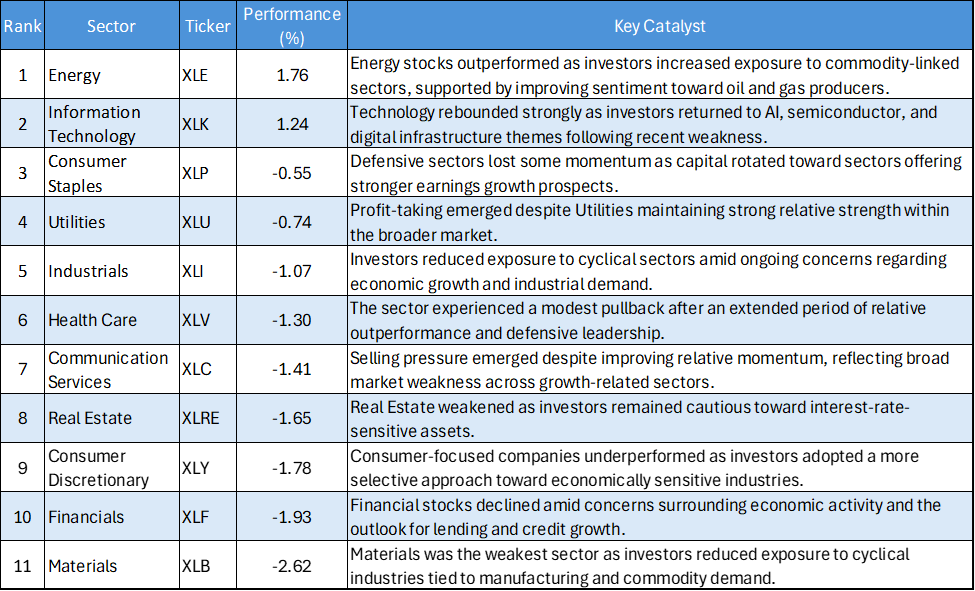
Daily US Sector Performance Summary
Energy Continues to Outperform
- Energy (XLE) led the market with a gain of 1.76%, extending its recent period of strong relative performance. Investor interest remained focused on energy producers and related businesses, supported by resilient commodity prices and attractive valuation levels. The sector's continued leadership demonstrates confidence in companies capable of generating robust cash flows even amid broader market uncertainty. As a result, Energy remained a key source of strength within the market.
Technology Shows Renewed Strength
- Information Technology (XLK) advanced 1.24%, recovering from the previous session's weakness and providing meaningful support to overall market sentiment. Investors returned to technology stocks amid optimism surrounding long-term growth opportunities, particularly in areas linked to artificial intelligence, cloud computing, and digital infrastructure. The sector's rebound highlights its continued importance as a market leader despite recent volatility.
Defensive Sectors Lose Investor Support
- Traditionally defensive sectors experienced modest selling pressure during the session. Consumer Staples (XLP) declined 0.55%, while Utilities (XLU) fell 0.74%. Health Care (XLV) also retreated 1.30%. The weakness across these sectors suggests that investors were less focused on defensive positioning compared with the previous session, instead concentrating capital in sectors perceived to offer stronger growth or earnings potential.
Communication Services and Real Estate Weaken
- Communication Services (XLC) fell 1.41%, while Real Estate (XLRE) lost 1.65%. The pullback indicates that investors became more selective within sectors that had previously demonstrated resilience. Although these industries continue to benefit from long-term structural trends, the session's performance suggests market participants were willing to reduce exposure to areas lacking immediate catalysts.
Consumer Discretionary and Financials Face Selling Pressure
- Consumer Discretionary (XLY) declined 1.78%, reflecting a cautious outlook toward consumer spending and economically sensitive businesses. Financials (XLF) performed even worse, dropping 1.93% as banks and financial institutions came under pressure. The weakness in these sectors indicates lingering concerns regarding economic growth and the broader operating environment for cyclical businesses.
Materials and Industrials Lag the Market
- Materials (XLB) recorded the largest decline of the session, falling 2.62%, while Industrials (XLI) lost 1.07%. The broad weakness across cyclical sectors suggests investors remain cautious about industries closely tied to economic expansion and manufacturing activity. The sharp decline in Materials, in particular, highlights a reduction in risk appetite outside the market's leading sectors.
Bottom Line
The July 8 session reflected a highly concentrated market environment, with Energy and Technology standing out as the only sectors to generate meaningful gains. Their outperformance suggests investors continue to favour industries supported by strong earnings momentum and structural growth themes.
Meanwhile, widespread weakness across Financials, Consumer Discretionary, Real Estate, Communication Services, and Materials indicates that broader risk appetite remains subdued. The sharp decline in cyclical sectors suggests investors are maintaining a selective approach to capital allocation rather than embracing a broad-based market rally.
If current trends persist, Energy and Technology may continue to attract investor attention in the near term, while economically sensitive sectors could remain under pressure until confidence in the broader growth outlook improves.

 Nov 06, 2026



 Please wait processing your request...