
 CA
 NZ
 UK
 AU
 IND

 US

 Share
 X (Formerly Twitter)
 Whatsapp
 Facebook
 LinkedIn
 Telegram
 Email This Article
 Copy Link
 Summarize with AI
 Chat GPT
 Perplexity

Key Highlights
- Energy Dominates Market Performance: Energy (XLE) surged 2.84%, making it the strongest-performing sector as investors increased exposure to commodity-related industries.
- Defensive Sectors Gain Ground: Health Care (XLV), Real Estate (XLRE), Consumer Staples (XLP), and Utilities (XLU) all posted solid gains, highlighting a shift toward defensive positioning.
- Communication Services Remains Resilient: Communication Services (XLC) advanced 0.73%, providing additional support to the broader market.
- Growth Sectors Under Pressure: Information Technology (XLK) declined 2.39%, while Industrials (XLI) fell 1.71%, making them the weakest performers of the session.
- Market Sentiment Turns More Cautious: The sector rotation suggests investors are reducing exposure to higher-growth areas and favouring sectors that may offer greater stability amid market uncertainty.
The US equity market displayed a noticeable defensive tilt on July 7, 2026, as investors rotated away from growth-oriented sectors and toward Energy and traditionally defensive industries. Strong gains across Energy, Health Care, Consumer Staples, Utilities, and Real Estate contrasted sharply with weakness in Technology and Industrials, indicating a more cautious approach to risk-taking. The session's performance profile suggests investors are seeking balance between income-generating sectors and areas that may benefit from resilient economic conditions.
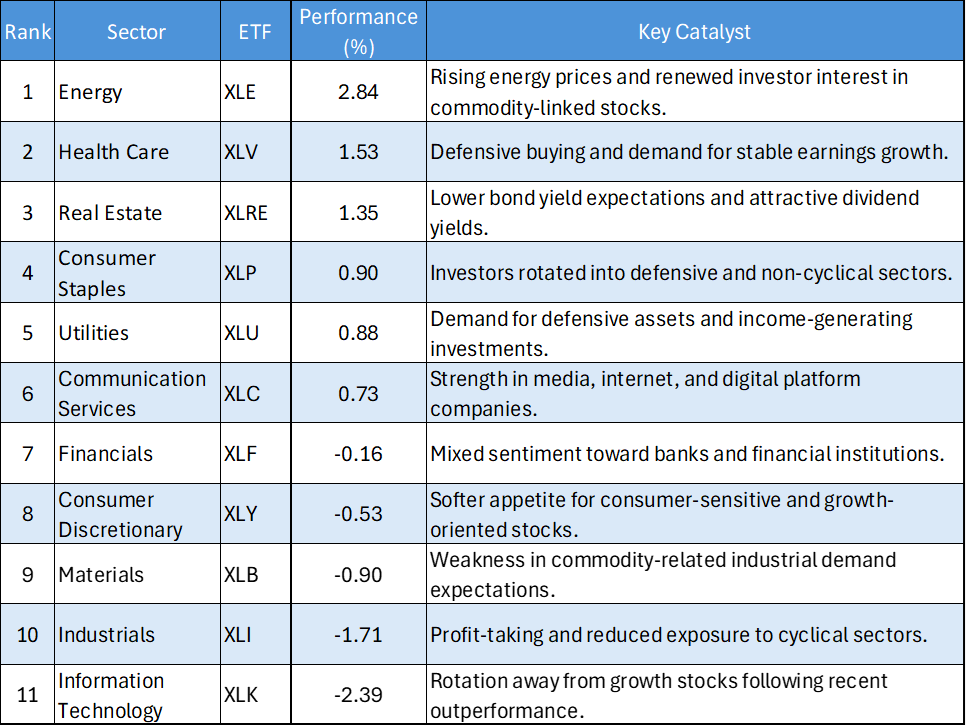
Daily US Sector Performance Summary
Energy Leads the Market Higher
- Energy (XLE) delivered the strongest performance of the session, advancing 2.84% and comfortably outperforming all other sectors. The strong gain was supported by renewed strength in commodity-related stocks and growing investor interest in companies linked to oil and gas production. The sector's leadership reflects increasing confidence in businesses that can benefit from higher energy prices while offering attractive cash flow and valuation characteristics. As a result, Energy emerged as the primary driver of market performance during the session.
Defensive Sectors Attract Investor Capital
- Defensive sectors experienced broad-based buying interest throughout the trading session. Health Care (XLV) rose 1.53%, while Real Estate (XLRE) gained 1.35%. Consumer Staples (XLP) and Utilities (XLU) also posted solid advances of 0.90% and 0.88%, respectively. The collective strength across these traditionally defensive industries suggests that investors are increasingly prioritising stability and predictable earnings streams. Such behaviour is often observed when market participants become more selective about risk exposure and seek sectors that can perform relatively well across varying economic conditions.
Communication Services Provides Additional Support
- Communication Services (XLC) added 0.73%, providing further support to the broader market. The sector benefited from continued investor confidence in digital media, telecommunications, and online platform businesses. Despite weakness elsewhere among growth-oriented sectors, Communication Services demonstrated resilience, indicating that investors continue to favour companies with strong earnings visibility and structural growth opportunities.
Financials and Consumer Discretionary Show Mixed Results
- Financials (XLF) finished relatively unchanged, slipping only 0.16%, suggesting that sentiment toward banks and financial institutions remains broadly stable. Meanwhile, Consumer Discretionary (XLY) declined 0.53%, reflecting a slightly more cautious outlook toward consumer-sensitive businesses. While the losses were modest, the sector's underperformance relative to defensive areas indicates that investors are becoming more selective when allocating capital to economically sensitive industries.
Technology and Industrials Face Selling Pressure
- Information Technology (XLK) was the weakest-performing sector of the day, falling 2.39%, while Industrials (XLI) declined 1.71%. Materials (XLB) also experienced weakness, losing 0.90%. The sharp pullback in Technology represents a notable reversal from its recent leadership role and likely reflects a combination of profit-taking and sector rotation. At the same time, weakness across Industrials and Materials points to a reduction in cyclical exposure as investors shifted capital toward more defensive segments of the market. This rotation highlights a more cautious market tone despite continued strength in selected sectors.
Bottom Line
The July 7 session reflected a meaningful shift in market leadership as investors favoured Energy and defensive sectors while reducing exposure to Technology and other growth-sensitive areas. The strong gains in Health Care, Real Estate, Consumer Staples, and Utilities indicate a more cautious investment environment, while Energy's outperformance highlights continued confidence in commodity-related opportunities.
Although the broader market remains supported by pockets of strength, the sharp decline in Technology and Industrials suggests investors are becoming more selective and risk-aware. If this rotation continues, Energy and defensive sectors may remain relative leaders in the near term, while growth-oriented sectors could face additional consolidation until investor confidence strengthens once again.


 Nov 10, 2026




 Please wait processing your request...