
 CA
 NZ
 UK
 AU
 IND

 US

 Share
 X (Formerly Twitter)
 Whatsapp
 Facebook
 LinkedIn
 Telegram
 Email This Article
 Copy Link
 Summarize with AI
 Chat GPT
 Perplexity
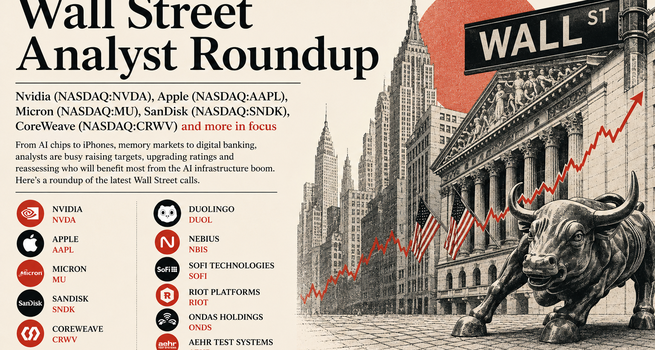
Key Highlights
- BofA Securities calls Nvidia Corporation (NASDAQ:NVDA) valuation "compelling" even after factoring in vendor-financing risk, reiterating a Buy rating and $350 price target.
- DA Davidson upgraded Duolingo, Inc. (NASDAQ:DUOL) to Buy from Neutral, lifting its target to $160 from $130 on underappreciated monetization changes.
- JPMorgan raised its Riot Platforms, Inc. (NASDAQ:RIOT) price target to $22 from $20, citing a newly signed Anthropic data-center lease.
- Rothschild & Co Redburn upgraded Apple Inc. (NASDAQ:AAPL) to Buy from Neutral, setting a $400 target on expectations for an iPhone Ultra foldable launch.
- JPMorgan resumed coverage of SanDisk Corporation (NASDAQ:SNDK) with an Overweight rating and $2,250 target, moving off a prior Neutral stance held during a research restriction period.
Several Wall Street brokerages issued fresh research notes this week, adjusting ratings and price targets across a range of technology, semiconductor, Fintech and industrial names. The commentary spans artificial intelligence infrastructure, memory chips, consumer hardware, digital banking and crypto-mining infrastructure, reflecting how differently analysts are reading the same broad AI capital-expenditure cycle depending on where a company sits in the value chain. Some notes focus on balance-sheet structure and financing risk, others on product cycles and monetization, and still others on Backlog visibility tied to data-center buildouts. Below is a summary of what each firm told investors, based strictly on the commentary attributed to each note. This article reports third-party analyst opinions for informational purposes and does not constitute Investment advice or a recommendation to buy or sell any security. Readers are encouraged to review the original research notes and other credible, verifiable sources before drawing any conclusions.
AI & Semiconductor Infrastructure
Nvidia Corporation (NASDAQ:NVDA)
BofA Securities analyst Vivek Arya described Nvidia's valuation at current levels as "compelling," even after accounting for the risks tied to the company's rising vendor financing arrangements. Vendor financing, broadly, refers to arrangements in which a supplier helps fund a customer's purchases of its own products, a structure that has drawn increased investor scrutiny across the AI hardware ecosystem as Capital commitments have grown. In a note to investors, Arya said Nvidia shares are trading at a 34%-50% discount to free Cash Flow when the vendor-financing risk is included in the analysis. BofA acknowledged that the "off-balance-sheet risk matters but resists easy valuation," adding that current share levels "could be overstating the risks and creating a compelling opportunity." The firm said it expects Nvidia to provide additional disclosure around its off-balance-sheet commitments at its August 26 Earnings report, which the note suggested could be a key event for narrowing the valuation debate one way or another. BofA reiterated a Buy rating on Nvidia with a $350 price target.
Micron Technology, Inc. (NASDAQ:MU)
BofA said Micron remains a top pick at the firm, pointing to SanDisk's durable growth outlook as a signal that the broader memory industry may be entering a "structurally stronger phase." The read-through logic in the note ties memory pricing power and Demand durability across NAND and DRAM producers together, given how closely the two sub-segments move with data-center and AI inference build-outs. According to BofA, this dynamic could potentially lift Micron's fiscal 2030 Earnings Per Share to a range of $200-$250, compared with consensus peak estimates of $160-$170 — a gap the firm frames as evidence that consensus has not yet fully absorbed the read-through from SanDisk's commentary. BofA reiterated its Buy rating on Micron along with a $1,550 price target. Given the size of this target relative to Micron's recent trading range, readers should cross-check the figure directly against BofA's original note or another primary source before citing it further.
SanDisk Corporation (NASDAQ:SNDK)
JPMorgan analyst Harlan Sur resumed coverage of SanDisk with an Overweight rating and a $2,250 price target, following a period of research restriction that had temporarily prevented the firm from publishing on the name. JPMorgan's rating on the stock prior to the restriction had been Neutral, making this resumption effectively an upgrade in stance. The analyst described SanDisk as "uniquely positioned" to benefit from a structural inflection in NAND demand driven by rapid growth in AI inference workloads, which increasingly rely on high-capacity flash storage alongside compute. JPMorgan added that the new Business model framework announced at SanDisk's investor day has "structurally reset" the company's Margin profile higher and "materially reduced cyclicality," a combination the firm frames as a re-rating catalyst. As with Micron's target above, the $2,250 figure is notably large relative to SanDisk's recent share price and should be independently verified against JPMorgan's original note before being repeated elsewhere.
CoreWeave, Inc. (NASDAQ:CRWV)
Citi raised its price target on CoreWeave to $159 from $142 while maintaining a Buy rating. The firm increased its estimates for the company following its latest earnings report, a common pattern among AI infrastructure names that have posted results this earnings season. Citi's analyst noted that amid robust AI demand, CoreWeave is seeing backlog strength that supports its ongoing capacity buildouts, which the note frames as a leading indicator of future Revenue visibility rather than a reflection of near-term results alone.
Nebius Group N.V. (NASDAQ:NBIS)
Citi analyst Tyler Radke raised the firm's price target on Nebius to $324 from $278, keeping a Buy rating on the shares. As with CoreWeave, Citi upped its estimates for Nebius following the company's earnings report, citing robust AI demand and backlog strength supporting capacity buildouts. The parallel language used across both notes suggests Citi is applying a consistent framework for valuing AI-focused infrastructure and cloud-compute providers based on order backlog rather than trailing financials alone.
Aehr Test Systems (NASDAQ:AEHR)
Jefferies analyst Kevin Garrigan initiated coverage of Aehr Test Systems with a Buy rating and a $175 price target. Garrigan described Aehr as the only vendor offering both wafer-level and package-level burn-in testing qualified into AI production environments, a niche positioning the firm views as a differentiator versus peers focused on a single test format. The firm said the stock's valuation multiple is sustainable as the broader market shifts toward AI reliability testing, noting that the market is still pricing Aehr shares against its fiscal 2024 silicon carbide (SiC) profile, even though AI, silicon photonics (SiPho) and networking end-markets are now driving the company's revenue and backlog. Jefferies' framing implies a potential disconnect between how the stock is currently valued and where its revenue mix is actually headed.
Consumer Tech & Fintech
Apple Inc. (NASDAQ:AAPL)
Rothschild & Co Redburn analyst Timm Schulze-Melander upgraded Apple to Buy from Neutral, raising the firm's price target to $400 from $260 — one of the larger single-note target increases in this roundup. The firm forecasts iPhone unit sales growing at 12% annually, or as much as 14% above current consensus expectations, through fiscal 2030, led by Apple's expected entry into the premium foldable category with an iPhone Ultra launch. Rothschild said stronger-than-consensus iPhone earnings, combined with what it called a "strategic reset" of Apple Intelligence, leave its estimates 18% above fiscal 2030 consensus. The firm expressed confidence that Apple's relative valuation multiple is "well supported," and said Apple may be able to position itself as "the gatekeeper of consumer AI," directing AI workloads to a "subservient fleet of open-source models" monetized through Apple Pay and other payment platforms. This framing positions Apple's AI strategy less around building foundation models in-house and more around owning the distribution and monetization layer that sits on top of them.
Duolingo, Inc. (NASDAQ:DUOL)
DA Davidson analyst Wyatt Swanson upgraded Duolingo to Buy from Neutral, raising the firm's price target to $160 from $130. Swanson said the company's Marketing and core monetization changes are underappreciated at current share levels, suggesting the market has not yet given the company Credit for changes already underway in its business. The firm said it sees a "long runway for growth" for Duolingo over the coming years, and believes the company's daily active user growth can continue to accelerate, with bookings growth converging toward that pace over time. DA Davidson said Duolingo "is nearing a turning point," language that suggests the firm views the upgrade as timed around an inflection rather than a call on long-run fundamentals alone.
SoFi Technologies, Inc. (NASDAQ:SOFI)
Piper Sandler analyst Patrick Moley initiated coverage of SoFi Technologies with an Overweight rating and a $22 price target. Piper described SoFi as a "high-growth Personal Finance story," characterizing it as a vertically integrated digital financial services company that offers loans and personal finance products, including checking, savings and investing accounts, under a single membership-style platform. The firm said SoFi gives investors exposure to a large and growing total addressable market in lending and Debt consolidation aimed at a younger, creditworthy demographic — a customer cohort the firm views as underserved by traditional banks. Piper also pointed to what it called a "powerful product flywheel" that is accelerating adoption across both new and existing members, with cross-selling between banking, lending and investing products cited as a structural advantage.
Crypto Mining & Industrial Technology
Riot Platforms, Inc. (NASDAQ:RIOT)
JPMorgan raised its price target on Riot Platforms to $22 from $20 while maintaining an Overweight rating. The analyst said the company is "building momentum," pointing to a data-center Lease signed with Anthropic at what the firm described as "attractive economics." The note frames the lease as part of a broader shift among crypto-mining infrastructure operators toward diversifying their facilities for AI and high-performance-compute hosting, rather than relying solely on digital-asset mining economics. JPMorgan added that execution of Riot's separate lease agreement with AMD remains on track, which the firm appears to view as a second, complementary proof point for this Diversification strategy.
Ondas Holdings Inc. (NASDAQ:ONDS)
Ladenburg Thalmann analyst Jon Hickman raised the firm's price target on Ondas Holdings to $22.75 from $21.50, maintaining a Buy rating on the shares. The firm cited the company's accelerating revenue outlook as the reason for the target increase, though the note as summarized did not detail the specific business lines or contracts driving that acceleration.
A Note on Sourcing
The ratings, price targets, and quoted language in this roundup are drawn directly from statements attributed to each research firm and analyst in their respective notes to investors. No additional price targets, ratings, or projections have been added beyond what was stated in the source commentary. Where a figure appears unusually large relative to a stock's typical trading range, that has been flagged above so readers can cross-check it against the original note or another primary source rather than taking the number at face value. As with any analyst commentary, ratings and targets represent the house view of the issuing firm at a point in time and are routinely revised as new information, including quarterly earnings and management guidance, becomes available.
Conclusion
Taken together, the latest round of analyst notes reflects continued Wall Street focus on artificial intelligence infrastructure buildout, memory-chip demand tied to AI inference, and company-specific catalysts ranging from product cycles to new leasing agreements. Several themes recur across the notes: backlog visibility as a valuation anchor for AI infrastructure names, structural (rather than purely cyclical) arguments for memory pricing power, and product-cycle or monetization inflections at the consumer and fintech names. Ratings, price targets, and the rationale behind them vary by firm and are based solely on each analyst's independent research and assumptions, and different firms covering the same stock can and do reach different conclusions. Figures such as price targets and projected earnings can change quickly as new company disclosures, earnings reports, and macroeconomic data become available, underscoring the importance of treating any single note as one input among many rather than a final word on a stock's prospects.
Q1: Why did BofA call Nvidia's valuation "compelling" despite vendor-financing risk?
A1: BofA said Nvidia shares trade at a 34%-50% discount to free cash flow even after including vendor-financing risk, and expects more disclosure at the August 26 earnings report.
Q2: What is driving JPMorgan's more positive view on SanDisk?
A2: JPMorgan pointed to a structural inflection in NAND demand from AI inference and a reset margin profile following SanDisk's investor day.
Q3: Why did Rothschild & Co Redburn upgrade Apple?
A3: The firm cited an expected iPhone Ultra foldable launch, stronger iPhone unit growth forecasts, and a "strategic reset" to Apple Intelligence.
Disclaimer
This article summarizes opinions and estimates published by third-party research firms and does not represent the views, analysis, or recommendations of the author or publisher. Ratings, price targets, and figures cited are as stated in the respective analyst notes and are subject to change without notice. This content is for informational purposes only, does not constitute investment advice, and should not be relied upon as the basis for any investment decision. Readers should verify all figures against the original research notes and consult a licensed Financial Advisor before making investment decisions.

 Nov 20, 2026




 Please wait processing your request...