
 CA
 NZ
 UK
 AU
 IND

 US

 Share
 X (Formerly Twitter)
 Whatsapp
 Facebook
 LinkedIn
 Telegram
 Email This Article
 Copy Link
 Summarize with AI
 Chat GPT
 Perplexity
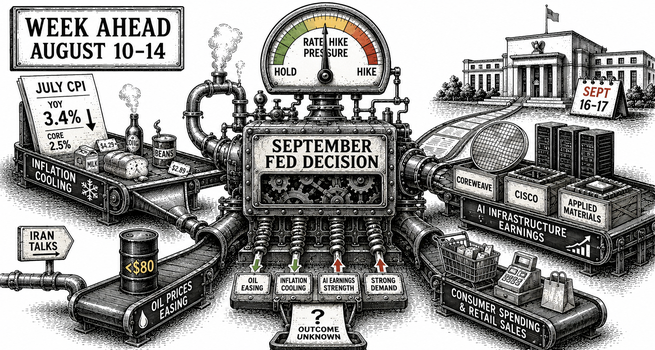
The S&P 500 posted its first all-time closing high in two months this week, propelled by a 5.75% four-session surge, its biggest four-day gain since April 2025, as calming US-Iran tensions pulled oil below $80 a barrel and relieved some of the inflation anxiety that had defined July's volatile trading. The benchmark index is now up more than 12% year-to-date, with corporate profits surpassing lofty expectations for a second consecutive quarter.
But the rally faces its next immediate test on Wednesday, when July CPI arrives as the most consequential inflation datapoint ahead of the Fed's September meeting. Economists expect headline CPI to rise 3.4% year-on-year with core CPI at 2.5%, suggesting that Iran-driven price pressures are receding. Whether that deceleration holds will determine whether the nearly 60% probability of a September rate hike embedded in futures contracts is confirmed or reduced. AI semiconductor shares, which drove the market's recent surge but remain more than 17% below their late-June high, face their own test with earnings from Applied Materials, Cisco, and CoreWeave.
Monday, August 10
Market
No economic data or earnings are scheduled. Markets open on the back of the S&P 500's record close, with attention focused immediately on Tuesday's housing and sentiment data and the critical CPI release on Wednesday. The Philadelphia SE Semiconductor Index, up 70% in 2026 but still deep in a drawdown from its late-June peak, remains one of the most sensitive barometer of how the week's inflation data is received.
Tuesday, August 11
Earnings
CoreWeave (NASDAQ:CRWV) reports Tuesday as the week's first AI infrastructure read. As a cloud infrastructure company purpose-built for AI workloads and one of the highest-profile names to join the Nasdaq following its IPO, its revenue trajectory and data centre capacity commentary will be read as a direct signal of whether enterprise AI demand is sustaining the capital expenditure commitments that have underpinned the semiconductor sector's 2026 rally. Cardinal Health (NYSE:CAH) reports before the open, providing a pharmaceutical distribution and healthcare supply chain read.
Economic Data
The NFIB Small Business Optimism Index for July, prior at 97.4, opens Tuesday's data calendar. The index has been under pressure from elevated borrowing costs and energy price uncertainty, and any deterioration would add to the evidence that the rate hike environment is beginning to affect small business confidence. Existing home sales for July, prior at 4.1 million and forecast to edge down to 4.07 million, provide a housing demand read under sustained affordability pressure. The Federal Reserve Bank of New York Q2 Household Debt and Credit Report is also published Tuesday, offering a structural read on consumer balance sheet health under elevated interest rates.
Wednesday, August 12
Earnings
Cisco Systems (NASDAQ:CSCO) reports in the afternoon as the week's primary enterprise technology earnings event. Its enterprise networking, cybersecurity, and AI infrastructure hardware commentary will be parsed for evidence of whether corporate IT spending is sustaining momentum as borrowing costs remain elevated. Cisco's results sit in direct dialogue with Applied Materials' Thursday print, together providing a comprehensive read on the technology hardware investment cycle from networking through semiconductor manufacturing equipment.
Economic Data
July CPI is the week's defining release, landing at 8:30 am ET. Headline CPI is forecast at 0.1% month-on-month and 3.4% year-on-year, following June's -0.4% monthly decline and 3.5% annual reading. Core CPI is forecast at 0.2% month-on-month and 2.5% year-on-year, flat against June's 0% monthly reading. If confirmed, the annual deceleration in both headline and core would represent the second consecutive month of easing and would suggest that Iran-driven energy price pressures are receding through the inflation data pipeline. A reading above forecast on either the headline or core measure would almost certainly cement a September rate hike and trigger a significant equity sell-off given current positioning. The monthly Treasury balance for July, prior at -$120 billion, also releases Wednesday.
Thursday, August 13
Earnings
Applied Materials (NASDAQ:AMAT) reports in the afternoon as the week's most consequential AI semiconductor earnings event. Its wafer fabrication equipment demand and guidance will be read as a primary signal of whether the semiconductor investment cycle is recovering from July's sharp pullback or whether demand is beginning to moderate at elevated capital expenditure levels. Given that the Philadelphia SE Semiconductor Index remains more than 17% below its late-June high, Applied Materials' forward commentary will carry outsized weight for sector sentiment.
Economic Data
PPI for July lands at 8:30 am ET, prior at -0.3% month-on-month and forecast to rebound to 0.1%. Core ex-food and energy PPI is forecast at 0.2%, matching June's pace. The PPI sequence will be read as a leading indicator for future CPI trajectory, and any upside surprise would complicate the relief narrative that a soft CPI print on Wednesday would have established. Weekly jobless claims for the week ending August 8, prior at 199,000, provide the most current labour market read of the week. Fed President Beth Hammack speaks before the open at the Dayton Area Chamber of Commerce Government Affairs Breakfast, in the first Fed communication since the July meeting and the first following Wednesday's CPI release.
Friday, August 14
Economic Data
Retail sales for July, prior at 0.2% and forecast at 0.2%, land at 8:30 am ET alongside manufacturing and trade inventories for June, prior at 0.3%. Retail sales will provide a view into consumer spending strength at a moment when easing gasoline prices from the Iran tension de-escalation should theoretically be freeing up household discretionary budgets. A reading at or above forecast would reinforce the resilient consumer narrative and add to the soft-landing case, but also introduce the risk of being read as inflationary by a Fed already at a 60% probability of hiking in September. The preliminary University of Michigan Consumer Sentiment Index for August, prior at 64.4, closes the week. Sentiment has been tracking near multi-year lows, and any meaningful recovery here would be the clearest evidence yet that easing energy costs are translating into improved household confidence.
Geopolitical Backdrop
Negotiations between the US, Iran, and GCC states on access to the Strait of Hormuz continue to be the primary variable shaping energy prices and the inflation outlook. The calming of tensions this week pulled US crude below $80 a barrel from near $100, directly alleviating the inflation anxiety that had driven the Fed's hawkish July hold and pushed the 10-year Treasury yield to its highest level since January 2025. The yield has since pulled back to 4.67%, providing some relief to equity valuations. However, any resumption of strikes or naval blockades against maritime chokepoints would rapidly reverse the energy price decline and reignite rate hike fears, making the week's diplomatic developments as consequential as the inflation data itself. Oil price volatility remains the market's most sensitive external variable, functioning simultaneously as an inflation input, a yield driver, and a consumer confidence determinant.
The Week in Context
Wednesday's CPI print will either validate the market's record-high optimism or test whether the recent rally has run ahead of the fundamental reality. A soft reading, confirming the 3.4% headline and 2.5% core forecast, would represent the most powerful case for the Fed to pause in September and would remove the primary headwind that has kept the Philadelphia SE Semiconductor Index more than 17% below its peak despite the S&P 500 reaching a new all-time high. Applied Materials' Thursday guidance will then determine whether the semiconductor recovery is structural or fragile.
Together, CPI and Applied Materials will answer the question that has defined the second half of 2026: whether the AI trade and the inflation shock are now moving in opposite directions, or whether they remain on a collision course heading into the September 16-17 Fed meeting.


 Nov 20, 2026





 Please wait processing your request...