
 CA
 NZ
 UK
 AU
 IND

 US

 Share
 X (Formerly Twitter)
 Whatsapp
 Facebook
 LinkedIn
 Telegram
 Email This Article
 Copy Link
 Summarize with AI
 Chat GPT
 Perplexity
Key Highlights
- Minutes released August 19 show hawkish sentiment extended well beyond the three officials who formally dissented at the July meeting
- Many participants said policy tightening would likely become necessary if Inflation failed to decline, a stronger signal than the 9-3 vote alone conveyed
- Chairman Kevin Warsh proposed cutting the annual meeting count from eight to six, a structural change the Committee discussed but did not adopt
- Financial stability language flagged elevated Equity valuations and AI infrastructure financing as areas of growing concern
- Balance sheet policy emerged as a live discussion topic, with a dedicated task force expected to inform future Committee deliberations
A Vote Count That Understated the Debate
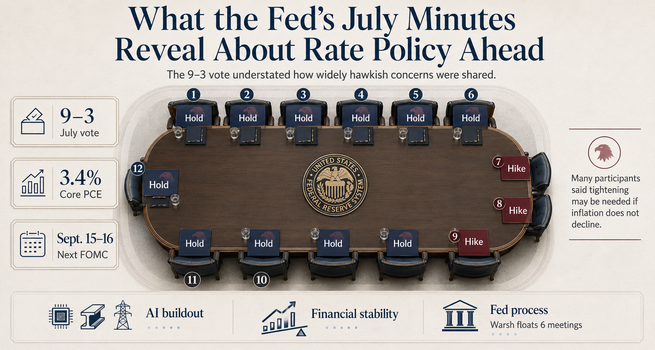
When the Federal Open Market Committee held its benchmark rate at 3½ to 3¾ percent on July 29, the outcome looked settled: nine members in favor, three dissenting in favor of a hike. Minutes released August 19 complicate that picture. Hawkish sentiment inside the room was not confined to the three regional presidents who voted against the majority. Many participants said tightening would likely be necessary if inflation failed to decline, and some questioned whether current financial conditions were restrictive enough to bring inflation back to target at all.
That gap between the vote count and the sentiment recorded in the minutes is the story. A 9-3 result reads as disagreement at the margin. A minutes release showing the hawkish case circulated more broadly reads as a Committee whose next move remains genuinely open.
What the Three Dissenters Argued, and Who Agreed With Them
Beth Hammack, Neel Kashkari, and Lorie Logan cast the three dissenting votes, each preferring a 25 basis point increase. Their positions were already public in the days following the July decision. What the minutes added was evidence that officials who ultimately voted to hold shared much of the same reasoning. Several participants who favored raising the target range argued that broad-based price pressures warranted a more restrictive stance to meet the Committee's price stability mandate, and a few suggested that moving sooner could forestall a steeper, more costly tightening sequence later in the cycle.
Beyond the formal dissent, many participants more broadly assessed that policy tightening would likely be necessary if inflation did not decline, and some argued that financial conditions may not currently be tight enough to support a return to the 2 percent target. That language, absent from the July statement itself, is what shifts the read on the Committee's underlying posture.
Warsh Floats a Leaner Meeting Calendar
One structural detail stood apart from the inflation debate. Chairman Warsh raised the idea of reducing the FOMC's schedule from eight meetings a year to six, spaced roughly every two months. His reasoning, as recorded in the minutes, was that a longer interval between meetings would allow more economic data to accumulate and give policymakers and staff additional time to weigh strategic policy questions.
The Committee discussed the proposal but reached no decision, and Warsh confirmed the remaining 2026 meetings would proceed on the existing schedule regardless of any future change. The discussion signals that governance and process questions are under active review at the Committee level, separate from the rate path itself.
The Inflation and Growth Backdrop
Core PCE inflation stood at 3.4 percent in May, with staff estimates showing only a modest step down to 3.3 percent in June. Total PCE inflation eased to an estimated 3.7 percent in June, aided by falling consumer energy prices, even as the conflict in the Middle East continued to add upward pressure on oil and broader input costs. Participants noted that price pressures remained broad based, with some pointing specifically to Data Center materials, including chips and steel, alongside consumer categories like smartphones and electricity, as areas where AI-related Demand was contributing to elevated prices.
Labor market conditions were described as stable, with Unemployment at 4.2 percent and wage growth moderating to 3.5 percent year over year. Growth was supported by continued AI-related capital investment, though staff and participants alike flagged considerable uncertainty over how AI adoption would ultimately affect productivity, output, and prices over the medium term.
Financial Stability Attention Centers on AI Financing
The minutes devoted particular attention to vulnerabilities tied to the AI infrastructure buildout. Staff characterized asset valuation pressures as elevated, noting that the forward Earnings to price ratio, adjusted for long-term interest rates, has only been lower during the dot-com Bubble in recent history. Several participants raised concerns that high valuations for AI-linked firms rest on optimistic long-term earnings assumptions, and that a downward revision to those assumptions could trigger a broader repricing of Assets and tighter financial conditions.
A few participants also highlighted the growing share of AI capital spending financed through borrowing, including Credit extended by nonbank investors and regional banks. Hedge fund Leverage was described as near all-time highs and concentrated among the largest funds, while the private credit sector saw continued increases in Redemption requests to Business development companies through the second quarter.
What This Means Heading Into September
Most participants viewed the interval between the June and July meetings as too short to materially shift their economic assessments, and expected that data accumulated before the September 15 to 16 meeting would carry more weight in shaping the next decision. The Board of Governors separately confirmed a unanimous vote to hold the Interest Rate on reserve balances at 3.65 percent and the primary credit rate at 3.75 percent, both effective July 30.
Conclusion
The August 19 release did not change the outcome of the July meeting, but it changed how that outcome should be read. A 9-3 vote understated the breadth of hawkish sentiment in the room, and the minutes make clear that a meaningful share of participants view the current policy stance as provisional rather than settled. With inflation still running well above target, geopolitical risk unresolved, and AI-related financial stability concerns drawing increased scrutiny, the Committee heads into September with more open questions than the July vote alone suggested.

 Nov 13, 2026



 Please wait processing your request...