
 CA
 NZ
 UK
 AU
 IND

 US

 Share
 X (Formerly Twitter)
 Whatsapp
 Facebook
 LinkedIn
 Telegram
 Email This Article
 Copy Link
 Summarize with AI
 Chat GPT
 Perplexity
Key Highlights
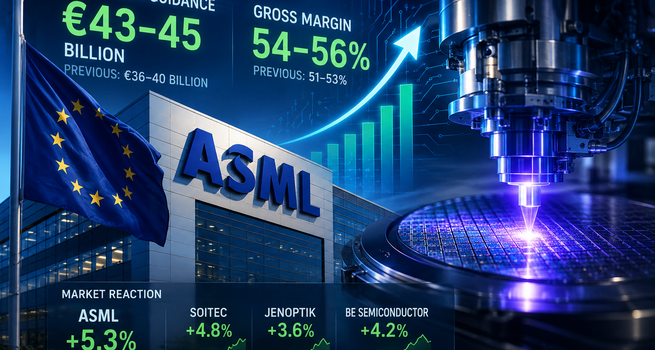
- ASML raised full-year 2026 sales guidance to €43–45 billion (from €36–40 billion) and gross margin guidance to 54–56% (from 51–53%) — its second upgrade of the year.
- Q3 guidance of €11.5 billion sales came in ~11% above consensus, with margin guidance of 56% well ahead of the 52.1% analysts expected.
- Bank of America now models Q4 revenue of €14.41 billion and gross profit of €8.08 billion at 56% margin, versus prior Street estimates of €11.62 billion and 53%.
- Memory revenue is set to grow 75% this year, signaling HBM manufacturing capacity — not chip design — is becoming the binding constraint on AI accelerator supply.
- ASML is near fully booked on 2026 EUV orders and is weighing ~30% EUV output increases in both 2027 and 2028, with customers already placing volume orders for 2028.
- European supply-chain plays reacted unevenly: ASML (AMS: ASML) +3.03%, Jenoptik (FRA: JEN) +5.5%, Soitec (EPA: SOIT) +3.6%, BE Semiconductor (AMS: BESI) +1.12%/-0.32% — a sign markets are discriminating between pure-EUV exposure and broader semiconductor capex plays rather than buying the sector blindly.
- The order visibility stretching to 2028 is one of the strongest data points yet that the AI capex buildout is structural rather than a short-term overshoot — though it also means capital commitments are stacking multiple layers deep across the supply chain.
ASML (AMS: ASML / NASDAQ: ASML) just did something it almost never does: raised full-year guidance for the second time in a single year, pushing 2026 sales to €43–45 billion from €36–40 billion, with gross margin climbing to 54–56% from 51–53%. The headline reaction — a 5.3% pop in Amsterdam, green across Soitec (EPA: SOIT), Jenoptik (FRA: JEN), and BE Semiconductor (AMS: BESI) — is the obvious read. The more interesting read is what a second upgrade, arriving mid-cycle rather than at a single beat-and-raise moment, actually tells you about where we are in the AI infrastructure buildout.
The signal inside the signal
Single guidance raises happen for lots of reasons — a big order pulled forward, a currency tailwind, a one-off margin mix shift. A second raise in the same fiscal year is a different animal. It means the company's own visibility — its backlog, its bookings pipeline, its conversations with TSMC (NYSE: TSM), Samsung Electronics (KRX: 005930), SK Hynix (KRX: 000660), Micron (NASDAQ: MU), and Intel (NASDAQ: INTC) about 2027 and 2028 capacity — has itself moved up twice, in the same direction, within months. That's not noise correcting itself; that's a trend accelerating faster than even the people closest to it expected.
The number to actually sit with isn't €44 billion. It's the fact that Fouquet says ASML is "close to securing all the orders it needs" for next year's EUV systems, while simultaneously discussing a ~30% EUV output increase for 2027 and another 30% for 2028 — with customers already placing volume orders for the latter. That is a company being told by its own customer base, nearly two years out, to build meaningfully more capacity than it currently has. EUV tools take on the order of 18-24 months lead time to build and ship; a decision to expand capacity now is a bet that isn't really ASML's bet — it's TSMC's (NYSE: TSM), Samsung's (KRX: 005930), and the hyperscalers' bet, expressed through ASML's order book because ASML is the only company on earth that makes the machine.
Memory is the tell, not logic
The most underappreciated line in this release is the 75% memory revenue growth ASML is guiding to this year. Logic demand — the chips inside GPUs and AI accelerators — has been the consensus AI-capex story for two years now. Memory has been the quieter half of the trade. But HBM (high-bandwidth memory) is the binding constraint on how many AI accelerators the world can actually build, because you can't ship a GPU without enough memory bandwidth to feed it, and HBM yields have been persistently tight. When ASML says memory tool demand is up 75%, it's confirming that the bottleneck has moved from "can we design faster chips" to "can we physically manufacture enough memory to pair with them." That's a maturation signal for the AI buildout — the constraint is shifting from architecture to atoms.
This also explains why gross margin, not just revenue, moved so much. A 300 basis point-plus upgrade to margin guidance in a hardware business with enormous fixed R&D costs means ASML is getting pricing power and mix improvement simultaneously — more of the highest-margin EUV and installed-base service revenue, less discounting pressure, because there simply isn't enough supply of these tools for customers to negotiate hard. Bank of America's read — that Q4 gross profit could hit €8.08 billion at 56% margin versus a Street consensus of €6.11 billion at 53% — is really a statement that analysts have been underestimating pricing power, not just volume, for two consecutive quarters.
What this does — and doesn't — tell you about a bubble
The AI-capex-bubble debate has been running hot for over a year, and this print will get read by both sides as confirmation. The bull case: real, physical, multi-year capacity commitments from the most sophisticated buyers in the industry (TSMC (NYSE: TSM), Samsung (KRX: 005930), SK Hynix (KRX: 000660) don't order EUV tools speculatively — the capital intensity is too brutal) is about as hard a data point as exists that AI infrastructure demand is not vaporware. Software company revenue guidance can be goosed by channel stuffing or aggressive recognition; you cannot fake an order for a €400 million lithography machine that takes two years to deliver.
The bear case, though, is embedded in the same data: this is now a very long capital commitment chain. ASML is expanding EUV output based on 2027-2028 orders. Those orders exist because TSMC (NYSE: TSM) and Samsung (KRX: 005930) are expanding fab capacity based on their own multi-year forecasts of AI accelerator and HBM demand from Nvidia (NASDAQ: NVDA), AMD (NASDAQ: AMD), and the hyperscalers. Each layer of that chain is making a bet on the layer above it continuing to spend at the current trajectory. The system has no natural brake until someone actually cancels an order — and semiconductor capex cycles have historically corrected hard and fast once they turn, precisely because everyone commits capital on the same optimistic assumption at the same time. ASML's own history — the 2022-2023 order softness, the WFE (wafer fab equipment) downcycle — is proof the pattern repeats.
The second-order winners are more interesting than ASML itself
ASML rising 5.3% on this news is almost mechanical. The more informative moves are Jenoptik (FRA: JEN) (+5.5%, outpacing ASML itself) and Soitec (EPA: SOIT) (+3.6%) — suppliers deeper in ASML's own supply chain, making optical components and specialty substrates. When suppliers-to-the-supplier rally harder than the prime contractor, it suggests the market isn't just repricing ASML's earnings — it's repricing the entire EUV and advanced-lithography ecosystem's forward capacity utilization. BE Semiconductor's (AMS: BESI) modest 0.8% gain, by contrast (and its slight red print in the ticker data at -0.32%), is a useful data point too: BESI is more levered to advanced packaging and hybrid bonding, adjacent to but distinct from EUV lithography demand, and its muted reaction suggests the market is discriminating between "pure EUV supply chain" and "broader semiconductor capex" rather than buying the whole sector indiscriminately. That's a healthier, more analytically grounded rally than a blanket sector pop would be.
The number that actually matters for 2027 estimates
Buried in the release is arguably the most forward-looking data point of all: customers have "already placed large volumes of orders" for 2028 EUV capacity. In an industry that has spent the last three years anxious about demand visibility beyond 12 months, a credible two-and-a-half-year order book is the single strongest argument that this AI capex cycle is structural rather than a 2024-2025 overshoot. Whether that turns out to be right will be determined less by ASML's next print than by whether Nvidia's (NASDAQ: NVDA) and the hyperscalers' own capex guidance over the next two quarters continues to validate the assumption sitting underneath every layer of this chain.
Q. Why did ASML raise guidance twice in one year?
A. Its own order book visibility from customers like TSMC (NYSE: TSM), Samsung (KRX: 005930), and SK Hynix (KRX: 000660) moved up twice in the same direction within months, pointing to accelerating rather than one-off demand.
Q. Why does the 75% memory revenue growth matter?
A. It shows the AI supply bottleneck has shifted from chip design to HBM manufacturing capacity — the industry can design faster chips but can't yet make enough memory to pair with them.
Q. Does the 2028 EUV order book prove the AI capex cycle isn't a bubble?
A. It's strong evidence demand is structural, since multi-year hardware orders are hard to fake — but it also stacks several layers of capital commitment that could unwind together if spending assumptions change.
Q. Why did Jenoptik (FRA: JEN) and Soitec (EPA: SOIT) rally harder than ASML itself?
A. Both sit deeper in ASML's supply chain, so their outperformance suggests investors are repricing capacity utilization across the whole EUV ecosystem, not just ASML's earnings.


 Nov 09, 2026





 Please wait processing your request...