
 AU
AU
 UK
UK
 CA
CA
 NZ
NZ
 IND
IND

 US
US

 Share
Share
 X (Formerly Twitter)
 Whatsapp
 Facebook
 LinkedIn
 Telegram
 Email This Article
 Copy Link
 Summarize with AI
 Chat GPT
 Perplexity
_06_10_2026_23_58_15_597808.jpg)
Key Highlights
- FORM reached an all-time high near $75–$78 in early 2026 before pulling back to retest prior breakout levels — a classic post-ATH consolidation that is now being monitored as a potential secondary entry zone for investors who missed the initial advance
- The EMA-21 and EMA-50 are both below the recent peak but rising, providing dynamic support to any near-term weakness and confirming the medium-term trend remains constructive
- RSI pulled back from overbought extremes near 75 to approximately 50 — a healthy mid-range reset that creates the momentum headroom necessary for the next leg of the advance once the HBM4 ramp accelerates
- Expected revenue growth of 17.4% and earnings growth of 38.5% for the current year — a significant positive operating leverage dynamic where earnings grow more than twice as fast as revenue — reflect the margin expansion embedded in the HBM4 upgrade cycle
- Earnings estimate revisions improved 11.8% over the past 30 days — one of the most reliable leading indicators of institutional consensus upgrades and the associated stock price re-rating that typically follows
- The acquisition of FICT Limited and partnership with Advantest extend FormFactor's advanced packaging testing capabilities into the next generation of AI chip architectures, creating competitive advantages that are difficult to replicate
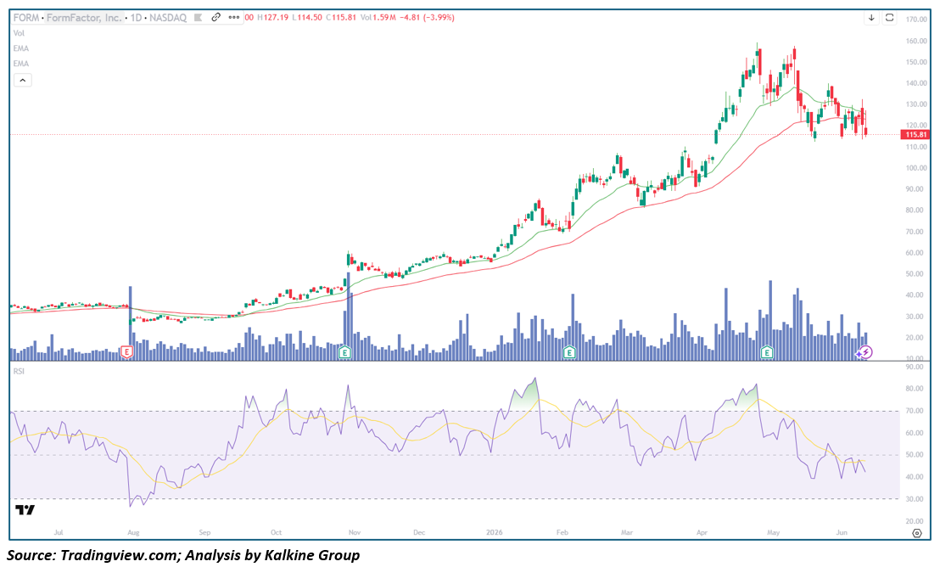
Trend Structure: Multi-Year Recovery and New All-Time High Breakout
Phase 1 — The Deep Trough and Patient Accumulation (2022 – Mid 2024)
FormFactor spent the 2022–2024 period recovering from the $18 cycle low in a slow, grinding advance that reflected patient institutional accumulation ahead of the AI semiconductor cycle. Volume was subdued, moving averages were flat, and the stock's action was consistent with quiet professional buying rather than momentum-driven speculation.
Phase 2 — AI Semiconductor Tailwind and Breakout (Late 2024 – Early 2026)
The acceleration of HBM demand driven by the generative AI chip cycle transformed FormFactor's financial profile and ignited a breakout through the prior all-time high near $62. The advance from $23 to $75 was supported throughout by fundamentally justified earnings estimate revisions, rising institutional ownership, and increasing analyst coverage — all hallmarks of a secular breakout rather than a cyclical bounce.
Phase 3 — Post-ATH Consolidation and HBM4 Ramp Setup (2026)
The pullback from the $75–$78 ATH range is modest in magnitude and constructive in character — contracting volume on down days, RSI reset to neutral, moving averages continuing to rise. This is digestion, not distribution, and the HBM4 ramp represents the catalyst that transforms the current consolidation into the next breakout.
Fundamental Foundation: The Picks-and-Shovels Winner of the GPU Supercycle
FormFactor occupies a unique position in the AI semiconductor ecosystem — it does not design chips, but every chip that gets designed requires its probe cards to be tested before leaving the fabrication line. In a world where AI chip complexity is increasing with every generation, FormFactor's revenue per chip tested increases proportionally. HBM4 requires more precise, more intensive testing than HBM3 — and FormFactor is the dominant provider of HBM probe cards globally.
The Farmers Branch facility expansion adds capacity at structurally lower cost, supporting simultaneous top-line growth and gross margin expansion — a combination that typically generates significant positive earnings surprise relative to conservative consensus estimates.
The HBM4 Catalyst
The ramp of HBM4 across the 2026–2028 period is FormFactor's most powerful multi-year catalyst. Every leading AI accelerator — from NVIDIA's next-generation GPU architectures to AMD's competing platforms to custom silicon from hyperscalers — will require HBM4 stacks tested to specifications that only FormFactor and a small number of peers can reliably deliver. As production volumes scale, FormFactor's revenue scales proportionally — and because test intensity per unit increases with each HBM generation, the revenue per wafer tested is a rising rather than flat metric.
Key Technical Levels
Resistance: $72–$75 — prior ATH and immediate overhead resistance | $78 — all-time high; ultimate bull target
Support: $62–$65 — prior breakout zone and 38.2% Fibonacci retracement | $55–$58 — EMA-50 confluence and 50% Fibonacci retracement | $46–$50 — 61.8% golden ratio retracement; deepest constructive support | $22–$25 — cycle low; structural failure scenario
Scenario Analysis
- Bullish Continuation: EMA-21 holds, RSI reclaims 60 → weekly close above $75 confirms the ATH breakout → targets $85–$90 as HBM4 ramp accelerates through Q3 2026
- Deeper Consolidation: Price tests the $62–$65 prior breakout zone → RSI reaches 40–45 → demand re-emerges at a historically significant horizontal support level
- Bearish Breakdown: Close below $55 questions the AI chip cycle thesis → downside toward $46–$50 golden ratio support
Conclusion
FormFactor is the cleanest picks-and-shovels expression of the AI semiconductor testing cycle available in the mid-cap universe. With HBM4 ramp beginning and earnings growing 38.5% on 17.4% revenue growth, the operating leverage embedded in the business model is exceptional. The current post-ATH consolidation is constructive. Above $75 a new all-time high is confirmed and the next leg of the advance begins.


 Jun 10, 2026
_06_11_2026_00_01_09_368404.jpg)


_06_10_2026_23_59_01_962593.jpg)

 Please wait processing your request...