
 CA
 NZ
 UK
 AU
 IND

 US

 Share
 X (Formerly Twitter)
 Whatsapp
 Facebook
 LinkedIn
 Telegram
 Email This Article
 Copy Link
 Summarize with AI
 Chat GPT
 Perplexity
Key Highlights
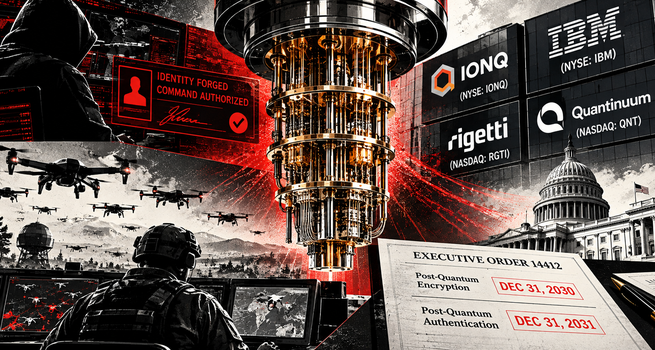
- Naoris CEO David Carvalho warns a quantum computer could forge a commander’s digital identity and turn a military’s own drones against it.
- No machine capable of breaking today’s public-key encryption exists as of 2026, but estimates of the qubits needed have fallen from about 20 million to under 1 million.
- A June 22 executive order sets Dec. 31, 2030, for post-quantum encryption and Dec. 31, 2031, for post-quantum authentication on the most sensitive federal systems.
- Carvalho’s company is pre-commercial and plans a Nasdaq listing, a conflict readers should weigh.
- Listed names in the race include IonQ (NYSE: IONQ), IBM (NYSE: IBM), Rigetti (NASDAQ: RGTI) and Quantinuum (NASDAQ: QNT).
A sufficiently powerful quantum computer could forge a commander’s digital identity and issue orders that a military’s own drone swarm would accept as genuine, according to David Carvalho, chief executive officer of Naoris Quantum Protocol. The orders, he says, would look completely legitimate.
The scenario points to the less-discussed half of the quantum threat. Most attention has gone to stolen secrets. Carvalho’s warning is about forged proof of who is speaking. He includes banks, power grids, military command systems and Bitcoin among the systems that rely on mathematics a quantum machine could break. Add a self-improving artificial intelligence on top, he says, and the risk grows darker. “We’re basically creating a god,” he said.
Readers should weigh the source. Carvalho founded Naoris, which sells post-quantum security. According to its filings with the U.S. Securities and Exchange Commission, the company is pre-commercial and is offering shares at $4 each under Regulation A, with a planned listing on the Nasdaq Capital Market under the symbol QDY, subject to completing the offering. His warning is also his sales pitch. That does not make it wrong, but it does mean the claims deserve independent checking.
How a Forgery Would Work
Digital signatures built on RSA and elliptic-curve cryptography prove that a message came from a particular sender. Shor’s algorithm, run on a large, error-corrected quantum computer, can in principle derive a private key from its public counterpart. With the private key, an attacker can sign anything as that sender: a command, a software update, a transaction. Unlike a stolen secret, a forged signature leaves no obvious trace.
The drone swarm is a hypothetical. The research reviewed does not identify any fielded military system as vulnerable, and what protects a given system depends on its design. Cryptographers also generally regard symmetric encryption, such as AES with 256-bit keys, as far less exposed than public-key schemes. The vulnerable layer is the one that establishes identity and trust.
The Timeline Is Contested
No quantum computer capable of this exists. But the bar is dropping. In May 2025, Craig Gidney of Google Quantum AI estimated that RSA-2048 could be broken with fewer than 1 million noisy qubits in under a week, down from about 20 million qubits in a 2019 estimate. In February 2026, Iceberg Quantum proposed an architecture that on paper needs fewer than 100,000 physical qubits. Today’s best error-corrected demonstrations are still orders of magnitude smaller, according to one recent review.
Forecasts diverge. The Global Risk Institute’s central estimate, as summarized by one security analyst, is 2033 to 2037. Google and Cloudflare Inc. (NYSE: NET) have both set 2029 as internal deadlines to finish their own post-quantum migrations, which are company targets rather than predictions. Adam Back, chief executive of Blockstream, has said quantum threats to Bitcoin are unlikely within the next decade, while Cointelegraph reports that roughly a quarter of Bitcoin sits in older address formats that are more exposed.
Washington Sets Staggered Deadlines
The National Institute of Standards and Technology finalized its first post-quantum standards in August 2024. On June 22, President Donald Trump signed Executive Order 14412, which requires federal agencies to move their most sensitive systems to post-quantum encryption by Dec. 31, 2030, and to post-quantum authentication by Dec. 31, 2031, according to Cloudflare’s analysis of the order.
The one-year gap reflects a quirk. Encrypted data can be harvested now and decrypted later, so encryption has to move first. Forged signatures only become possible once a capable machine exists, so authentication can follow. Carvalho’s scenario is the second kind, the one that cannot be exploited until the hardware arrives but that takes years to fix once it does. A tracker of the deadlines lists Oct. 22 as the date federal agencies are due to submit migration plans to the Office of Management and Budget, a date worth confirming against the primary memo.
The Listed Players
The companies building the machines are mostly unprofitable. Quantinuum Inc. (NASDAQ: QNT), which went public on June 5 at $60 a share, had 2025 Revenue of $30.9 million and a net loss of $192.6 million, according to the Motley Fool. IonQ Inc. (NYSE: IONQ), Rigetti Computing Inc. (NASDAQ: RGTI) and their peers are also pre-profit. The U.S. Department of Commerce has agreed to take minority stakes in several, including Rigetti and Quantinuum, U.S. News reported.
The sector is volatile. Quantum shares fell in a dilution-driven selloff earlier this month, according to 24/7 Wall St., and IonQ has priced a $2 billion Equity offering, a separate development. On Oct. 7, the Defense Advanced Research Projects Agency advanced six companies to Stage 3 of its Quantum Benchmarking Initiative: IonQ, International Business Machines Corp. (NYSE: IBM), Microsoft Corp. (NASDAQ: MSFT), Atom Computing, Diraq and PsiQuantum. Alphabet Inc. (NASDAQ: GOOGL), Google’s parent, sits on both sides of the story, as the source of the resource estimates and as a company racing to migrate its own systems.
What to Watch
The measurable markers are narrower than the rhetoric. Watch for further drops in published qubit estimates, error-corrected hardware that scales beyond today’s demonstrations, and whether agencies meet the 2030 and 2031 deadlines. The self-improving AI element of Carvalho’s warning is a prediction, not a measurement; none of the quantum resource research cited here addresses it. For now the clearest fact is the simplest one: the cryptography is being replaced because its owners think the window to do it quietly is finite.
Disclaimer: This content is for informational purposes only and does not constitute financial advice or a recommendation to buy, sell, or hold any security. Quantum Computing and related securities are speculative and volatile. Investors should conduct their own research and consult a licensed financial adviser before making Investment decisions.


 Nov 18, 2026





 Please wait processing your request...