
 CA
 NZ
 UK
 AU
 IND

 US

 Share
 X (Formerly Twitter)
 Whatsapp
 Facebook
 LinkedIn
 Telegram
 Email This Article
 Copy Link
 Summarize with AI
 Chat GPT
 Perplexity
Key Highlights
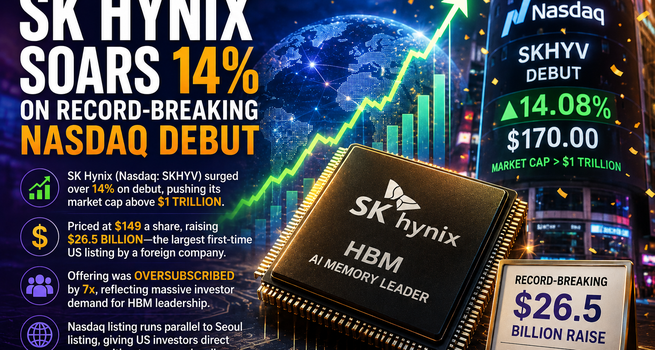
- SK Hynix (Nasdaq: SKHYV) surged over 14% intraday on its Nasdaq debut, pushing its market capitalization above $1 trillion.
- The company's ADRs were priced at $149 a share, raising $26.5 billion — the largest first-time US listing by a foreign company, surpassing Alibaba's record.
- The offering was reportedly oversubscribed by 7x, reflecting intense investor demand for exposure to SK Hynix's dominant position in High-Bandwidth Memory.
- The Nasdaq listing does not alter SK Hynix's primary Seoul listing or share structure, but gives US investors direct access without currency or brokerage hurdles.
SK Hynix, South Korea's second most valuable company, made its trading debut on the Nasdaq on July 10, 2026, and wasted no time making history. The company's American Depositary Receipts opened sharply higher and surged more than 14% intraday to around $170, propelling its market capitalization above $1 trillion and cementing the listing as one of the most consequential cross-border stock market events in recent memory.
The ADRs were priced at $149 a share ahead of the debut, raising $26.5 billion in the process — the largest first-time share sale by a foreign company in US history, surpassing the record previously held by Alibaba. The offering was reportedly oversubscribed by a factor of seven, a level of demand that underscores just how aggressively global investors are positioning for continued exposure to the artificial intelligence infrastructure buildout, and specifically to the memory chip makers supplying its physical backbone.
Trading under the temporary ticker SKHYV, with regular trading under SKHY expected to follow shortly, the listing does not alter SK Hynix's primary listing in Seoul or its overall share structure. Instead, it functions as a parallel access point, allowing US-based retail investors, mutual funds, and institutional managers to buy into the company directly on American exchanges rather than navigating the currency conversions, brokerage restrictions, and settlement timelines that have historically made the Korean exchange a less convenient venue for many international investors.
That accessibility question sits at the heart of why this listing has generated such outsized attention. SK Hynix has, for years, been one of the most important yet under-owned names among US investors relative to its centrality to the AI trade. The company is the world's leading producer of High-Bandwidth Memory, the specialized, high-performance memory architecture that has become an essential component in advanced AI accelerators, most notably the GPU systems built by Nvidia. Demand for HBM has climbed in near lockstep with the broader AI infrastructure buildout, and SK Hynix has consistently held a dominant position in the segment, with market share often estimated at 50% to 60% or higher across recent generations of the technology.
That dominance has translated into extraordinary operating momentum. Capacity for several HBM product lines is reportedly sold out into 2026 and, in some segments, as far out as 2028, a level of forward demand visibility that is rare even among the most sought-after AI-exposed companies. For investors, that sold-out capacity has functioned as a form of validation: a signal that the AI capital expenditure cycle driving demand for high-performance memory is not a speculative bubble but a sustained, contracted commitment from the world's largest technology companies and cloud infrastructure providers.
The scale of today's market reaction reflects that conviction. A 14% single-day surge is a substantial move for any large-cap listing, let alone one already priced to raise $26.5 billion, and the fact that it pushed SK Hynix's valuation past the trillion-dollar threshold places the company in a small and elite group of technology businesses to have crossed that mark. For a company whose shares had already appreciated by hundreds of percent over the prior year on the Korean exchange, today's Nasdaq debut represents both a culmination of that run and, based on the market's reaction, a signal that investors see room for the story to continue.
The listing also arrives at a moment when the broader memory chip sector — SK Hynix alongside Samsung and Micron — has been navigating a period of acute, AI-driven shortages. Where memory chips were once viewed as a highly cyclical, commoditized corner of the semiconductor industry prone to boom-and-bust pricing swings, the emergence of HBM as a critical, high-margin, capacity-constrained product category has reshaped how investors value the space. SK Hynix's Nasdaq debut can be read as a direct consequence of that repricing: a company that might once have been considered a niche international holding is now viewed as core infrastructure for the AI economy, deserving of the broadest possible investor access.
For SK Hynix itself, the decision to pursue a US listing carries strategic significance beyond the immediate capital raised. Dual-market access typically expands a company's investor base, can improve trading liquidity, and often supports a more diversified shareholder register less concentrated among domestic Korean institutions. It also raises the company's profile among the largest US index funds and actively managed technology and AI-focused portfolios, some of which may have faced structural or mandate-related constraints on holding foreign-listed shares directly on the Korean exchange.
Still, investors weighing the ADRs will need to consider some of the same dynamics that apply to any dual-listed foreign company: currency exposure to the Korean won, the relationship between ADR pricing and the underlying Seoul-listed shares, and the broader cyclicality that has historically characterized the memory chip industry, even if the current HBM-driven supercycle looks structurally different from past cycles. Whether SK Hynix can sustain its currently sold-out capacity position — and the pricing power that comes with it — over the multi-year horizon implied by today's valuation will be the central question determining whether the stock's debut-day enthusiasm proves durable.
For now, though, the market's verdict has been unambiguous. A seven-times oversubscribed order book, a record-setting $26.5 billion raise, and a 14% opening-day surge that pushed the company past a trillion dollars in market value all point to the same conclusion: SK Hynix has arrived on Wall Street not as a niche international curiosity, but as one of the most closely watched names in the entire AI infrastructure trade, and investors are moving quickly to make sure they have a seat at the table.

 Oct 28, 2026





 Please wait processing your request...