
 CA
 NZ
 UK
 AU
 IND

 US

 Share
 X (Formerly Twitter)
 Whatsapp
 Facebook
 LinkedIn
 Telegram
 Email This Article
 Copy Link
 Summarize with AI
 Chat GPT
 Perplexity
Key Highlights
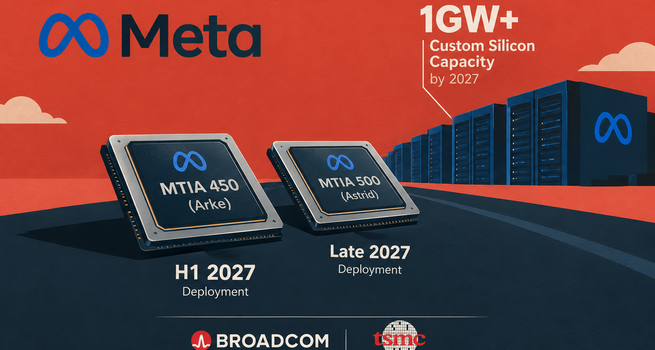
- Meta Platforms (NASDAQ:META) will begin deploying its MTIA 450 chip, code-named Arke, across data centers in the first half of 2027 to cut AI inference costs and power use.
- The next-generation MTIA 500 (Astrid) is expected to finish design within roughly a month and enter data centers by late 2027, with a broader rollout planned than Arke.
- Meta has committed to more than 1 gigawatt of custom-silicon capacity over 12 months, developed with Broadcom (NASDAQ:AVGO) on design and TSMC (NYSE:TSM) on manufacturing.
- Meta scrapped its planned Olympus chip, which combined Training and inference, after estimating it would cost roughly 30% more, sharpening its focus on low-cost inference at scale.
Meta's Custom Silicon Push Moves Into Its Next Phase
Meta Platforms (NASDAQ:META) is advancing its in-house chip program with two new additions to its Meta Training and Inference Accelerator (MTIA) family, according to a Bloomberg report. The rollout marks a shift toward deploying custom silicon at gigawatt scale as the company looks to lower the cost and energy intensity of running its AI workloads across its Data Center network.
The first chip, MTIA 450, code-named Arke, is scheduled for deployment across Meta's data centers starting in the first half of 2027. Meta received its first batch of 12 Arke units from TSMC (NYSE:TSM) on September 1, with early testing showing performance within 2% to 3% of pre-production simulations. On day one, the chips were reported to run models from Meta, DeepSeek, and Alibaba, an early signal of the hardware's compatibility across model architectures beyond Meta's own.
Astrid Follows With Broader Deployment Plans
Meta's next chip, MTIA 500, code-named Astrid, is expected to complete design work within about a month and begin entering data centers by the end of 2027. The company anticipates Astrid will see even wider deployment than Arke, positioning it as the more central chip in Meta's inference infrastructure going into 2028.
Both chips are being developed with Broadcom (NASDAQ:AVGO) handling design work and TSMC (NYSE:TSM) responsible for manufacturing. Meta has already committed to more than 1 gigawatt of capacity built on its custom chips over a 12-month period, and it expects the pace of deployment to accelerate beyond that window.
Workhorse Chips Built for Inference, Not Peak Latency
Arke and Astrid are designed primarily as general-purpose inference chips rather than hardware optimized for the fastest, most latency-sensitive workloads. Meta has said that close coordination between its internal AI teams and chip designers allows the hardware to be tuned specifically for its own workloads, which it believes gives the chips better performance per watt and per dollar than current Nvidia-based systems for those use cases.
Olympus Chip Scrapped as Meta Narrows Its Roadmap
Meta has also canceled a previously planned chip called Olympus, which was designed to handle both AI training and inference in a single architecture. The company determined that such a combined design could cost roughly 30% more than a more specialized approach, and it has since concentrated its custom silicon roadmap on lower-cost inference chips at gigawatt scale rather than a unified training-and-inference chip.
What Comes After Astrid
Beyond Astrid, Meta plans to direct future MTIA generations toward higher speed and throughput, including exploring fiber-optic interconnect technologies to improve chip-to-chip performance. The roadmap reflects Meta's broader strategy of reducing its reliance on external GPU suppliers for a growing share of its inference workloads, even as it continues to use third-party hardware alongside its custom chips.
What are Meta's Arke and Astrid chips?
Arke (MTIA 450) and Astrid (MTIA 500) are the next two generations of Meta Platforms' (NASDAQ:META) in-house AI accelerator chips, designed mainly for general-purpose AI inference across Meta's data centers.
Who is Meta working with to build these chips?
Meta is working with Broadcom (NASDAQ:AVGO) on chip design and TSMC (NYSE:TSM) on Manufacturing for its MTIA chip lineup.
Why did Meta cancel the Olympus chip?
Meta canceled Olympus, a combined training-and-inference chip, after determining the design would cost roughly 30% more than pursuing separate, more specialized inference-focused chips.


 Nov 03, 2026





 Please wait processing your request...