
 CA
 NZ
 UK
 AU
 IND

 US

 Share
 X (Formerly Twitter)
 Whatsapp
 Facebook
 LinkedIn
 Telegram
 Email This Article
 Copy Link
 Summarize with AI
 Chat GPT
 Perplexity
Key Highlights
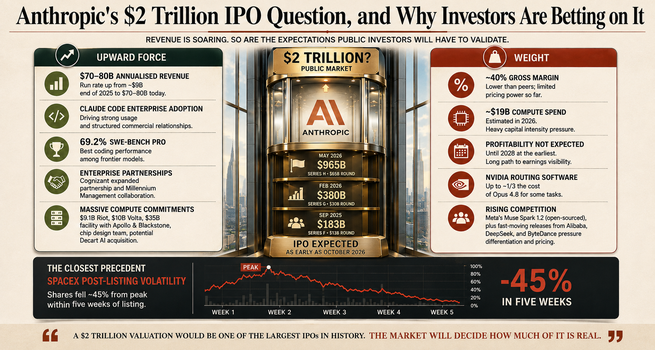
- Anthropic's valuation climbed from 183 billion dollars to 965 billion dollars in eight months, with investors now positioning for a public listing near two trillion dollars.
- Annualised Revenue has expanded from roughly nine billion dollars to an estimated 70 to 80 billion dollars, reshaping the company's standing relative to OpenAI.
- Nvidia's own open weight model and routing software claim a cost advantage over Anthropic's flagship Opus 4.8, a signal of Margin pressure from an unexpected direction.
- SpaceX's post listing volatility, including a 45 percent drawdown within five weeks, offers the closest available precedent for how markets may treat Anthropic's debut.
Investors preparing to back Anthropic's initial public offering are doing something markets rarely price cleanly: betting on a number that has never been tested. A valuation near two trillion dollars would place Anthropic among the most valuable companies ever to list, built on eighteen months of private funding rounds that have moved faster than almost any comparable Business on record. The bet is not without precedent, but the precedent is only a few weeks old, and it has already shown how quickly enthusiasm at listing can diverge from performance soon after.
The Scale of the Bet
Anthropic's valuation history compounds at a rate rarely observed in enterprise technology. The company was worth 183 billion dollars in September 2025 following a 13 billion dollar Series F round. Five months later, a 30 billion dollar Series G round pushed that figure to 380 billion dollars. Three months after that, a 65 billion dollar Series H round more than doubled it again, to 965 billion dollars, a mark that made Anthropic more valuable than OpenAI, then sitting at 852 billion dollars. Investors are now positioning for a public listing near two trillion dollars, roughly double the last private mark, when Anthropic debuts as early as October.
That figure is not company guidance. Anthropic filed confidentially for its listing on June 1, 2026, and remains in a regulatory quiet period, meaning the two trillion dollar number reflects investor expectation built on the same growth trajectory that has driven each prior round, not anything the company has stated publicly. For that expectation to hold, two things need to be true at once: Anthropic's revenue growth needs to continue near its current pace, and public markets need to be willing to price frontier AI companies at a premium that history suggests they do not reliably sustain.
The Case For
Revenue Growth and Enterprise Lock-In
The strongest argument for the valuation is revenue, and the trajectory is genuinely unusual. Anthropic's annualised run rate stood near nine billion dollars at the end of 2025, reached 47 billion dollars by May 2026, and current estimates place it between 70 and 80 billion dollars, growth driven substantially by enterprise adoption of Claude Code. That is not simply a usage spike. Anthropic has converted the interest into structured commercial relationships, including an expanded Partnership with Cognizant (NASDAQ:CTSH) to bring Claude to enterprise clients and a partnership with hedge fund Millennium Management to build an AI powered risk analyst. Deals of this kind suggest enterprise customers are embedding Anthropic's models into operational workflows rather than testing them experimentally, and embedded usage is harder to displace than a subscription that can lapse at renewal.
Infrastructure Commitment Ahead of Confirmed Demand
The Capital deployment behind that growth tells a complementary story. In recent weeks, Anthropic signed a 9.1 billion dollar, 20 year computing agreement with Bitcoin miner Riot Platforms (NASDAQ:RIOT), converting Texas Mining capacity into AI data centre capacity, and a separate 10 billion dollar deal with cloud infrastructure startup Volta Infra. A 35 billion dollar private Credit Facility involving Apollo (NYSE:APO) and Blackstone (NYSE:BX) is being structured to finance chip purchases tied to a Broadcom (NASDAQ:AVGO) partnership, and Anthropic has confirmed it is building an internal chip design team. Anthropic is also reportedly in early stage talks to acquire Israeli startup Decart AI for approximately six billion dollars, which would be its largest deal to date; if completed, Decart's team, known for its Lucy real time video model and Oasis simulation model, would join Anthropic's inference and performance organisation. Neither company has commented publicly, and the talks could still fall through. Taken together, these commitments suggest Anthropic is building compute capacity ahead of confirmed Demand rather than scrambling to catch up with it.
Frontier Model Position
The commercial case also rests on Anthropic's models remaining competitive on capability, not just price. Claude Opus 4.8, released in May 2026, leads independent aggregator Artificial Analysis's composite Intelligence index and posts the widest gap over rival models on agentic coding, scoring 69.2 percent on SWE-Bench Pro against 58.6 percent for GPT-5.5 and 54.2 percent for Gemini 3.1 Pro. Anthropic held pricing flat against the prior version despite the gains. Independent trackers do not agree uniformly on Opus 4.8's overall standing, with rankings varying by methodology, but the SWE-Bench Pro and Intelligence Index results are corroborated leads on two widely used evaluations. Anthropic has also signalled a longer term roadmap toward Mythos class models, described as more capable than Opus but awaiting additional safeguards before wider release.
The Case Against
Competitive Pressure on Pricing Power
The counter argument is built on cost structure rather than demand, and three separate competitors are converging on the same pressure point from different directions.
Nvidia (NASDAQ:NVDA) has historically supplied the chips that power Anthropic's models rather than competing with them directly. That changed in August, when it released an open weight model called Nemotron 3.5 Lightning alongside routing software the company says can match frontier level accuracy while cutting task completion cost to roughly a third of what Anthropic's own Opus 4.8 model costs when used alone. The significance is not that Nemotron is more capable than Opus 4.8, by most measures it is not, but that Anthropic's own infrastructure partner now has a direct commercial incentive to sell customers a cheaper alternative to Anthropic's software, since Nvidia's chip sales grow either way.
Meta (NASDAQ:META) has taken a parallel but distinct path, open sourcing its most capable model, Muse Spark 1.2, in a move chief executive Mark Zuckerberg framed as a challenge to Chinese open weight competition rather than to Anthropic directly. The logic differs from Nvidia's: Meta is not selling hardware that benefits from AI adoption regardless of which model wins, it is competing for developer mindshare, betting that a free, capable model attracts a larger ecosystem than a metered one.
Chinese developers add a third, faster moving front. Alibaba (NYSE:BABA), DeepSeek and ByteDance have each shipped updated models within the past two weeks, a cadence trackers estimate has roughly quadrupled since 2023. These labs face no comparable exposure to the U.S. enterprise market Anthropic depends on, which limits direct substitution risk for now, but their pace sets a bar closed frontier labs must keep clearing to justify premium pricing.
The cumulative effect of these three, differently motivated pushes is a widening set of lower cost substitutes for tasks that do not require frontier level reasoning, narrowing the range of workloads where Anthropic can defend premium pricing.
The Token Efficiency Threat
The sharper risk sits one level below model competition, in how those models get deployed. Anthropic's own fast variant of Opus 4.8 already prices roughly three times cheaper than the full model, an efficiency gain in its own right, but frontier tier pricing for Opus 4.8 itself held flat rather than falling. Nvidia's routing software, released alongside Nemotron, targets a different lever entirely: sending only the hardest queries to a frontier model while handling routine tasks on smaller, cheaper systems, which compresses blended token costs faster than any single model line can cut its own prices. That distinction matters for how the threat should be read. A better or cheaper rival model can be answered with a better or cheaper model of one's own. A routing architecture that reduces reliance on frontier models altogether is harder to compete against on Anthropic's own terms, since it does not require the substitute to match Opus 4.8's capability, only to be good enough for a growing share of everyday tasks.
The Financing Gap Behind the Valuation
That pressure lands on a cost base that is already strained. Gross margins have reportedly compressed to around 40 percent after inference costs ran ahead of projections, below what comparable enterprise software companies typically report, and profitability is not expected before 2028. Planned spending on Training and inference compute for 2026 is estimated near 19 billion dollars, roughly matching full year revenue rather than a smaller share of it.
Sequoia partner David Cahn has sized this problem industry wide, estimating that 2026 AI infrastructure spending of approximately 1.5 trillion dollars would require close to three trillion dollars in associated revenue to justify on conventional return assumptions, against combined annual Recurring Revenue at Anthropic and OpenAI of roughly 80 billion dollars. That gap has reportedly made some financial institutions more cautious about credit extended against Equity stakes in AI companies. None of this points to an imminent correction, but it reframes the valuation question as one of financing structure and revenue timing rather than a simple bet on which company builds the smartest model.
The Precedent: What SpaceX's Debut Actually Resolved
Anthropic will not be the first company this year to test whether public markets sustain a private AI valuation. SpaceX (NASDAQ:SPCX) ran a version of this experiment in June, pricing at 135 dollars a share, opening 19.2 percent higher, and trading as high as 225 dollars within days, pushing its Market Capitalisation above 2.6 trillion dollars. Five weeks later, the stock had fallen to around 124 dollars, a decline of roughly 45 percent from its post listing peak. That round trip confirmed public investors will, in the short term, pay more for a frontier technology narrative than the last private valuation implied, but it did not resolve whether that premium holds once trading Volume settles and analysts move from narrative to unit economics. CFRA initiated coverage with a sell rating and a 115 dollar price target within days of the debut, citing SpaceX's capital intensity and elevated valuation expectations. Broader historical data reinforces the caution: among the ten largest United States initial public offerings on record, only three delivered total returns exceeding the S&P 500 over the longer term.
The mechanics of SpaceX's listing also changed the environment Anthropic will debut into. Nasdaq shortened the seasoning period required before large new listings join major indices, from a multi month wait to as little as fifteen trading days for companies ranking in the top 40 by market capitalisation, a change adopted in May 2026 partly in anticipation of deals at this scale. Passive index capital will therefore flow into Anthropic's shares faster than historical norms allowed, potentially amplifying early price swings. Analysts have also noted that SpaceX's trading performance functions as a pricing signal for the AI IPO pipeline broadly, with sustained strength supporting more ambitious terms and a deeper drawdown pushing toward more conservative pricing. Some capital currently invested in SpaceX may also rotate directly into these upcoming listings, making Anthropic's reception partly a function of redistribution within AI focused portfolios rather than fresh demand.
Where the Evidence Leaves the Valuation Question
None of the evidence gathered here settles whether Anthropic's eventual listing will hold near two trillion dollars once trading begins. The growth case is real: revenue has scaled faster than almost any enterprise software company in recent history, product benchmarks corroborate a genuine capability lead, and the infrastructure being assembled suggests planning for sustained rather than temporary demand. The counter case is equally well documented, resting on measurable margin compression, a financing gap sized independently by outside analysts, and a competitive field that now includes Anthropic's own chip supplier.
What the SpaceX precedent adds is not an answer but a caution about timeframes. A strong opening trade proved little about SpaceX within five weeks, and there is no obvious reason a software business with a different margin profile and a later path to profitability should be judged on a shorter or more forgiving timeline. The two trillion dollar figure currently circulating among investors will be tested against Anthropic's next several quarters of earnings, not the enthusiasm of its first day of trading.


 Nov 13, 2026





 Please wait processing your request...