
 CA
 NZ
 UK
 AU
 IND

 US

 Share
 X (Formerly Twitter)
 Whatsapp
 Facebook
 LinkedIn
 Telegram
 Email This Article
 Copy Link
 Summarize with AI
 Chat GPT
 Perplexity
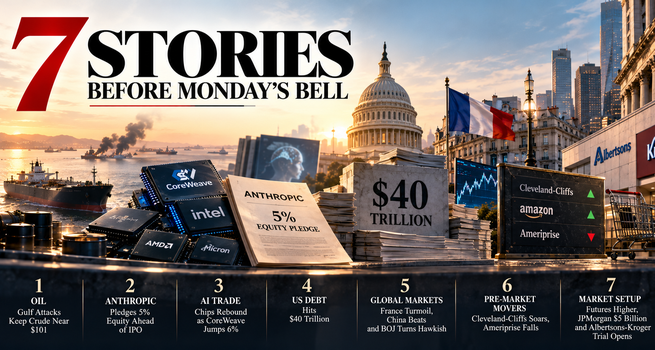
Nasdaq 100 futures rose 1.3% and S&P 500 futures gained 0.5% as chip stocks rebounded from last week's AI-driven selloff, while Dow futures slipped 88 points. Crude held near a four-week high around $101 a barrel after Gulf shipping attacks and a Russian diesel waiver. Anthropic's pledge to commit 5% of its shares to a public benefit fund and a fresh $40 trillion US Debt milestone rounded out the agenda.
1. OIL: Crude Holds Near $101 as Gulf Attacks Escalate and Trump Defends a Russian Diesel Waiver
Crude oil held near $101 a barrel Monday, a four-week high after surging 10% last week on Middle East fighting. A Saudi helicopter crash near Yemen, Houthi attacks on Yanbu and two Gulf tanker strikes cast doubt on the region's recovery, though US Energy Secretary Chris Wright said Gulf shipments have recovered to around 80% of pre-conflict levels. President Trump defended waiving tariffs and sanctions on Russian energy shipments to strike a diesel deal with Moscow, arguing pressure could derail Ukraine talks, drawing bipartisan pushback. WTI slipped 0.3% to $101.03 a barrel, while Brent fell 1.3% to $108.40.
- The Russian diesel waiver, meant to ease US fuel costs before the midterms, sits awkwardly next to bipartisan efforts to block it.
- Risk note: longer-dated Oil Futures have already moved higher on bets that infrastructure disruptions persist into 2027.
2. ANTHROPIC: Pledges 5% of Its Shares to a Public Benefit Fund Ahead of a Reported November IPO
Anthropic said Sunday it will commit 5% of its shares to a new public benefit fund, with its board able to add 2% more for every 50% rise in value above an undisclosed baseline, subject to Shareholder approval. The company has put $200 million toward studying AI's effects but said bolder approaches, including large donations or direct payments to displaced workers, may be needed; an August Pew Research survey found 71% of US adults expect AI to reduce jobs over the next two years. The fund will be an LLC rather than a nonprofit, barred from lobbying or political giving. Anthropic has told investors third-quarter Revenue reached $16.8 billion, up from $11.6 billion in the second quarter, ahead of a planned November listing. Tesla (NASDAQ:TSLA) and SpaceX (NASDAQ:SPCX) chief Elon Musk said he would rather give the shares directly to the public.
- The value-linked add-on ties the fund's size to an IPO valuation floated near $2 trillion.
- Risk note: the baseline valuation that triggers extra contributions is undisclosed, leaving room for scrutiny once a prospectus is filed.
3. AI TRADE: Chip Stocks Rebound as CoreWeave Jumps 6% and Intel Gains 4%, Even as Credit Stress Deepens
Nasdaq 100 futures added 1.3% Monday, led by AI-linked shares after a week in which the S&P 500 lost nearly 2%, its worst since late June, and the Nasdaq tumbled 4.5%. CoreWeave (NASDAQ:CRWV) gained 6% on a Goldman Sachs upgrade, having plunged more than 25% last week, its steepest drop since November 2025, on debt concerns. Intel (NASDAQ:INTC) rose 4% after JPMorgan upgraded it to neutral from underweight, keeping an $85 price objective and citing improved execution under chief Lip Bu Tan. AMD (NASDAQ:AMD) and Micron (NASDAQ:MU) each rose 3%. CoreWeave's credit-default swaps have reached distress levels, and Goldman Sachs traders called AI-linked credit spreads the widest of the year, noting equities were 15% lower last time spreads were this elevated. Meta Platforms (NASDAQ:META) and Tesla report Earnings this week, seen as a test of sentiment.
- Rising equities and widening AI credit spreads point to a debate shifting toward how the buildout gets financed.
- Risk note: a weak Meta or Tesla report could reconnect credit stress with Equity prices after a week in which they diverged.
4. FISCAL: US Debt Crosses $40 Trillion as the Fiscal 2026 Deficit Nears $2 Trillion
US government debt crossed $40 trillion in August, reviving debate over whether the world's largest economy is becoming a riskier credit ahead of the midterms, though the term premium investors Demand on US debt has not risen as sharply as elsewhere. The Treasury reported a roughly $2 trillion deficit for the fiscal year ended September 30, 12% larger than a year earlier and the biggest since the pandemic-era surge, with debt-service costs at a record $1.36 trillion. Spending exceeded receipts by about 6.2% of the economy against a sustainable 3%, and debt-to-GDP now sits near 100%, last seen during the Second World War. Rising yields are reaching consumers, with 30-year mortgages touching 7.40%, while the 10-year Treasury Yield eased to about 5.08%.
- A debt-to-GDP ratio near its wartime peak raises the stakes for whichever party controls Congress after the midterms.
- Risk note: if global term premiums keep climbing, heavier US issuance could push yields up for reasons unrelated to domestic inflation.
5. GLOBAL MARKETS: France's Bond Market Flashes Crisis Signals as China Beats on Growth and the BOJ Turns Hawkish
China's economy grew 4.5% year on year in the third quarter, ahead of the 4.4% expected, while retail sales rose 1.1% in September from 0.4% in August, improving the odds Beijing hits its 2026 growth target. In France, weekend protests over living costs turned violent, with more than 500,000 demonstrators and over 2,000 arrests, prompting Marseille to ban public gatherings; the CAC 40 fell about 1.35% and the 10-year Bond Yield rose more than 10 basis points to a multi-decade high, as investors question whether the minority government can pass a 2027 budget with a 5% deficit. Bank of Japan Governor Kazuo Ueda signalled room for a rate increase this month, saying underlying Inflation is close to the 2% target as AI demand adds price pressure. Indonesian equities fell more than 5% to a six-year low after MSCI proposed reclassifying the market to standalone status, which Goldman Sachs said could trigger about $5.6 billion in outflows.
- Foreign investors now hold nearly 60% of French debt, up from about 48% in 2022.
- Risk note: a final MSCI decision on Indonesia is expected by June, and confirmation could extend outflows further.
6. PRE-MARKET MOVERS: Cleveland-Cliffs Jumps 10% on an Earnings Beat, Ameriprise Falls on a Double Downgrade
Cleveland-Cliffs (NYSE:CLF) rose more than 10% after third-quarter adjusted earnings of 28 cents a share beat the 21 cents expected, a week after Canada threatened legal action over planned layoffs at its Stelco operations. Amazon (NASDAQ:AMZN) rose more than 1% after Morgan Stanley named it a top pick and raised its price target, citing accelerating AWS growth and its Bedrock AI platform. Ameriprise Financial (NYSE:AMP) fell after Bank of America Securities double-downgraded it to underperform from buy and cut its price objective to $445 from $570, citing a rise in financial-advisor departures.
- Cleveland-Cliffs' beat lands alongside an unresolved Canadian regulatory dispute, so the reaction may not fully reflect that overhang.
- Risk note: a confirmed Blue Owl sale process would add alternative-asset managers to the sectors facing consolidation speculation this quarter.
7. MARKET SETUP: Futures Point Higher, JPMorgan Commits $5 Billion to US Industry and the Albertsons-Kroger Trial Opens
S&P 500 futures rose 0.5% and Nasdaq 100 futures gained 1.3% Monday, while Dow futures slipped 88 points, after a losing week on Wall Street. JPMorgan (NYSE:JPM) said it has invested $5 billion in industries it considers critical to US national security, financing about $230 billion under its Security and Resiliency Initiative since launching a $1.5 trillion decade-long commitment a year ago. Albertsons (NYSE:ACI) opened a two-week Delaware Court of Chancery trial seeking more than $8 billion in damages from Kroger (NYSE:KR) over their collapsed $24.6 billion 2022 merger, arguing it is owed up to $6.88 billion in forgone premium plus a $600 million termination fee; Kroger shares have risen about 4% and Albertsons has lost nearly 30% since. September housing starts are due Tuesday ahead of the Fed's October 28 meeting.
- The scale of bank commitments, led by JPMorgan's $1.5 trillion pledge, signals a structural shift of private Capital toward reshoring and defense-adjacent sectors.
- Risk note: rulings in the Albertsons case often take months after trial, so markets are unlikely to get resolution this quarter.


 Oct 29, 2026



 Please wait processing your request...