
 CA
 NZ
 UK
 AU
 IND

 US

 Share
 X (Formerly Twitter)
 Whatsapp
 Facebook
 LinkedIn
 Telegram
 Email This Article
 Copy Link
 Summarize with AI
 Chat GPT
 Perplexity
Key highlights
- The Fed held rates at 3.75-4%, but two dissents for a hike signal hawkish drift.
- Statement upgrades activity to "strong" and drops its defence of September's hike, tilting distinctly hawkish.
- Futures price about 85% odds of a December hike; the ten-year Yield already exceeds 5%.
- Lisa Cook, whom Trump is trying to remove, dissented in favour of a rate rise.
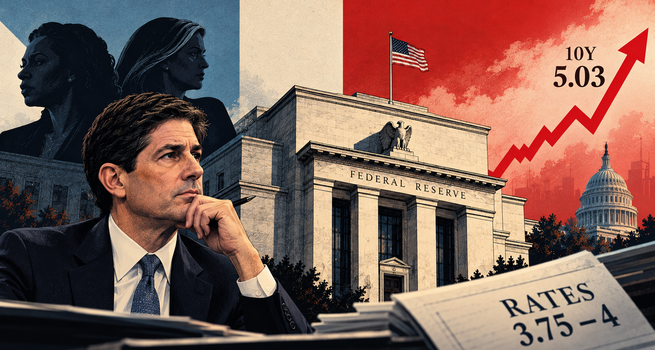
Rates stay at 3.75-4%. A sharper statement and two votes for a hike suggest the pause will be short
The Federal Reserve did what markets expected on Wednesday and left its benchmark rate at 3.75-4%. It did not do it quietly. The Federal Open Market Committee split 10-2, with both dissenters preferring a quarter-point rise, and the statement that accompanied the decision was edited in ways that point firmly towards tighter policy. Stocks pared their gains and Treasury yields kept climbing. A hold, it seems, is not the same thing as a rest.
The statement, line by line
The Fed's text rewards close reading, because the changes from September's version are few and nearly all point the same way.
The opening is the plainest. In September the committee "decided to raise" the target range by a quarter-point. This time it decided to "maintain" it. The committee also says, as before, that it is continuing its policy of maintaining ample reserves in the banking system.
The economic assessment follows. Activity, which September called "solid", is now expanding at a "strong" pace. The rest of the paragraph is unchanged: uncertainty is elevated, owing in part to geopolitical developments; domestic spending has been resilient; productivity growth is strong and Capital Investment robust; Job gains have kept pace with the workforce and Unemployment has changed little. The Fed is describing an economy that is running well.
Then come the edits that matter most. September's sentence on Inflation said the policy action "will support" a "timelier" return to the 2% goal. That sentence has been replaced. The new one says that "the accumulation of more information will help the Committee determine the policy stance appropriate" to ensure a "timely" return. Two things have happened here. The Fed has stopped explaining its previous move, which leaves the impression of a committee that does not want to be held to a path. And "timelier", a comparative that implied the pace of disinflation was too slow, has become the plain "timely". The language is less urgent, and the message is that the Fed will decide when it has seen more.
What did not change is the sentence that follows: "Inflation remains elevated." The committee ends, as in September, with a promise to "deliver price stability".
Two votes against
The vote itself is the second piece of news. In September, the committee raised rates unanimously. On Wednesday, two of its twelve voters, Lisa Cook and Beth Hammack, voted against the hold. Both wanted the target range raised by a quarter-point.
Ms Hammack's position was no surprise. The president of the Cleveland Fed said in a speech earlier this month that a restrictive policy stance was appropriate to secure a timely return to 2% inflation, and she has been among the committee's most hawkish voices all year.
Ms Cook is a different matter. The governor, appointed by Joe Biden in 2022, had never dissented from a rate decision before. Nor had her recent speeches argued for tightening; they struck a two-handed note on the economy. Her vote comes as Donald Trump tries to remove her from office over allegations about information she gave on home-loan applications. The Supreme Court halted the first attempt. The administration has since restarted the effort, and a hearing is scheduled for early November. The president has long insisted that rates should be much lower. The governor he is trying to dislodge has just voted for them to be higher.
Two officials who voted against a hold in July, Lorie Logan of Dallas and Neel Kashkari of Minneapolis, went along with the majority this time. Both have argued for higher rates; for now they have deferred.
Why wait?
The case for patience was made by the Fed's own Leadership in recent weeks. Vice-Chair Philip Jefferson and John Williams, who runs the New York Fed, both said that conditions gave the committee time to judge its next move. Chairman Kevin Warsh said on October 16 that events since September had broadly matched the Fed's expectations, which markets read, correctly, as a sign that no change was coming. Mr Warsh has also been clear about his reluctance to hand out forward guidance.
Timing helps too. Americans vote on November 3, with control of Congress at stake, and the Fed's next meeting is in December. Officials regard independence as the bedrock of their work, and nothing in the statement says otherwise. Yet the calendar means no decision has to be taken until the votes are counted.
Why the hawks have a point
The argument for moving sooner is not hard to find in the numbers. Underlying inflation, excluding food and energy, is expected to have exceeded 3% in September, and the Fed has now missed its 2% target for five and a half years. Officials fear that price pressure is spreading beyond energy, where the war with Iran has pushed oil above $100 a barrel and raised diesel costs. The longer inflation overshoots, the likelier it is that firms and households come to treat it as normal.
Growth offers no cover for easier policy. The Atlanta Fed's GDPNow tracker points to annualised growth of 3.4% in the third quarter, the best in a year. Consumers are spending, unemployment is low, and investment tied to artificial intelligence continues to lift demand. Whether a policy rate with a midpoint below 4% is restricting this at all is the question dividing the committee.
What the market heard
Investors took the decision as a delay. The ten-year Treasury Yield rose to about 5.03%, more than a point above the top of the policy range, so long-term borrowing costs are already doing some of the tightening. Short-term rate futures eased a touch as traders trimmed bets on near-term hikes, but the direction of travel did not change. Fed-funds futures put the chance of a December increase at around 85%, with perhaps one or two more in 2027. In June, the committee's "dot plot" had already pencilled in another rise this year.
So Wednesday's decision settles little. The Fed has bought itself five weeks and a chance to see more data. It has also told the market, through its edits and through its dissenters, that the burden of proof now lies with those who want rates to stay where they are.

 Oct 28, 2026




 Please wait processing your request...