
 CA
 NZ
 UK
 AU
 IND

 US

 Share
 X (Formerly Twitter)
 Whatsapp
 Facebook
 LinkedIn
 Telegram
 Email This Article
 Copy Link
 Summarize with AI
 Chat GPT
 Perplexity
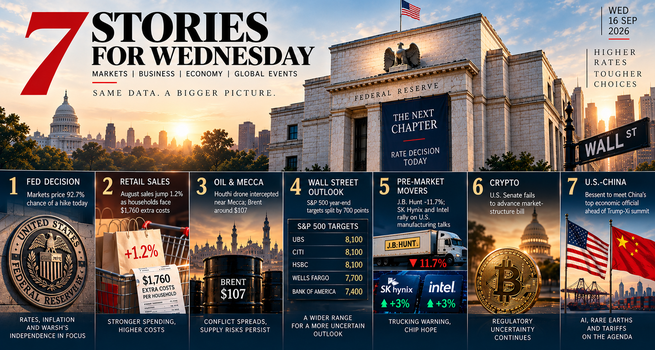
The Fed delivers its rate decision this afternoon with markets all but certain a hike is coming, the first in more than three years. August retail sales, released this morning, beat expectations sharply even as new data show the average household has absorbed roughly $1,760 in extra costs since the Iran war began, while a Houthi drone intercepted near Mecca marks the first time the conflict has reached Islam's holiest city.
1. FED DECISION: Markets Price a 93% Chance of a Hike Today in What Investors Are Calling a Test of Warsh's Independence
The Fed's rate decision lands at 2 p.m. ET, with futures pricing a 92.7% probability of a quarter-point hike, up from 33% a month ago and the first increase in more than three years. Treasury yields eased into the decision, with the 10-year slipping to about 4.97% after touching a post-2007 high above 5% Tuesday, the 30-year near 5.35%, and the 2-year at roughly 4.63%. Markets assign a 41% chance to a further October hike and 27% to December. The decision arrives under sustained White House pressure to hold rates, market has framed as the genuine independence test; one warned a hold would likely catch markets off guard and reignite doubts about political interference. Tuesday's session reflected the tension, with the S&P 500 falling 0.45% and the Nasdaq Composite down 0.78% as chip and cloud names extended losses tied to the AI-slowdown debate.
- Markets shifting from 33% to 93% odds of a hike in a single month shows how quickly the Inflation and oil shock has overridden the rate-cutting narrative from earlier in the year, leaving little room for the Fed to surprise dovish without a credibility cost.
- Risk note: with a hold now seen as more disruptive than a hike, the "safe" political choice and the "safe" market choice have diverged, raising the odds of a sharp reaction regardless of which way the committee leans.
2. RETAIL SALES: August Spending Beats Expectations Even as Households Absorb $1,760 in Extra Costs Since the Iran War Began
August retail sales rose 1.2% from July, well above the 0.8% forecast and rebounding sharply from a revised 0.5% decline the prior month, with gasoline stations posting the sharpest gain at 3.1% as rising pump prices themselves inflated the sales figure; the underlying control group used to calculate GDP, which strips out autos, gas and building materials, still climbed a stronger-than-expected 1.4%. Yet the strength in spending comes even as the average household has absorbed roughly $1,760 in extra costs since the war began, per Moody's Analytics, with about $930 tied to higher energy prices; consumers nationally have spent an extra $121 billion on energy alone.
Another $425 stems from higher borrowing costs, and $405 reflects higher military spending eventually funded through Debt or taxes. Gasoline averaged $4.32 a gallon this week, up 6% monthly and 36% annually, while diesel has pushed past $6 for the first time, roughly 70% above a year ago, a cost truckers pass through to groceries and other goods. The 30-year Mortgage rate topped 7% this month for the first time in over a year, applications fell more than 4% in the latest week, and refinancing dropped 65% year over year; Credit card debt has climbed to $1.26 trillion, near a record, as households lean on borrowing to offset a savings rate rarely seen since the 2008 financial crisis.
- The gap between an unexpectedly strong retail sales print and mounting household financial strain suggests spending is currently being propped up by rising prices themselves, particularly at the pump, rather than reflecting healthier underlying demand, a distinction the Fed will need to weigh carefully in today's decision.
- Risk note: with lower-income households spending a larger share of income on energy, this uneven burden threatens to widen the K-shaped spending divide just as today's Fed decision could push borrowing costs higher for the same households already drawing down savings.
3. OIL/SAUDI ESCALATION: Houthi Drone Intercepted Near Mecca in First Strike on the Holy City, Even as Oil Eases and Hormuz Traffic Recovers
Saudi Arabia said its air defenses destroyed a Houthi drone before it entered Mecca's airspace, marking the first time the conflict has reached Islam's holiest city; the Houthis rejected the claim, while a Saudi coalition spokesperson called it a deliberate provocation and described the city's security as a "red line." The alert was the first since a 2017 ballistic-missile attempt on Mecca, following days of intensifying Houthi attacks that have drawn Saudi Arabia deeper into a conflict now testing a month-old defense pact among Saudi Arabia, Turkey and Pakistan. Despite the escalation, oil eased Wednesday, with Brent slipping more than 1% to around $107 and WTI down 2% to about $103, as Hormuz flows have been recovering even as the broader Supply picture stays fragile; the seven-day Hormuz transit average has climbed to nearly 12 million barrels a day, the fastest pace since a brief breakout in June and July, though still less than 60% of pre-war volumes. Saudi Arabia's East-West Pipeline, knocked offline Friday by an attack Riyadh has blamed on an Iran-backed militia in Iraq, continues to threaten roughly 4 million barrels a day of capacity even as the immediate price reaction has been muted.
- Oil easing even as fighting reaches Mecca for the first time shows traders weighing Hormuz's partial recovery more heavily than the strike's symbolic weight, a read that could reverse if the incident proves the start of a pattern.
- Risk note: with Hormuz traffic still well below pre-war levels even at its fastest recovery pace since summer, the market has little cushion if the pipeline outage, Yemen fighting, or an actual strike on Saudi religious sites converge into one shock.
4. Wall Street OUTLOOK: Brokerages Split on the S&P 500's 2026 Path, With Targets Ranging From 7,400 to 8,100
Wall Street's year-end S&P 500 targets span a wide range, with Bank of America Global Research at the low end at 7,400 and UBS, Citigroup and HSBC near 8,100, a gap of roughly 700 points on an index trading in the low 7,600s. Goldman Sachs, Citigroup, Morgan Stanley, JPMorgan, Deutsche Bank and Societe Generale cluster around 8,000, betting AI-driven Earnings will offset the near-term drag from the Iran conflict and elevated energy costs. Wells Fargo sits toward the cautious end at 7,700, alongside Jefferies, Canaccord Genuity and BNP Paribas near 7,500, reflecting concerns over stretched valuations and a Fed that stays tighter for longer than expected. The spread illustrates a market divided on how much of this year's roughly 11% gain can be sustained, with bulls betting earnings absorb war-driven costs and bears betting valuations already reflect too much optimism.
- A nearly 700-point gap between the most cautious and most bullish targets is unusually wide this late in the year, underscoring how differently strategists weigh AI earnings momentum against the compounding drag from oil, yields and geopolitical risk.
- Risk note: because most bullish targets rest on AI earnings holding up, any sign infrastructure spending is slowing, whether from an industry pullback or the safety-pacing debate among major labs, could pull optimistic forecasts back toward the Wells Fargo and BofA end of the range.
5. PRE-MARKET MOVERS: J.B. Hunt Sinks 11% on Guidance Cut as SK Hynix and Intel Rally on Manufacturing Talks
J.B. Hunt Transport Services (NASDAQ:JBHT) fell as much as 11.7% pre-market after warning third-quarter earnings could decline 5% to 10% sequentially, citing purchased transportation costs rising roughly 30%; management also flagged brokerage-segment losses, about $25 million in added driver costs, and a $10 million diesel headwind, prompting price-target cuts even as the stock had been near 52-week highs. SK Hynix (NASDAQ:SKHY) and Intel (NASDAQ:INTC) each rose more than 3% pre-market after a report that the two chipmakers are in exploratory talks for SK Hynix to manufacture memory chips in the U.S. for the first time, potentially through Intel's Ohio Facility or a cloud-provider joint venture, though SK Hynix cautioned no decisions have been made; both rebounded from Monday's AI-slowdown selloff, with Intel also gaining on a price-target raise to $145. Beta Bionics (NASDAQ:BBNX) fell more than 6% after pricing a dilutive $150 million offering at $17.25, compounding a newly filed securities Fraud suit over its Mint insulin patch pump. Twist Bioscience (NASDAQ:TWST) jumped nearly 6% on a new Eli Lilly (NYSE:LLY) Partnership alongside strong results and raised guidance, while LuxExperience (NYSE:LUXE) surged more than 16% on accelerating sales and positive adjusted earnings across all three luxury segments. Elsewhere, Expedia fell more than 2.5% on a downgrade, energy stocks slid on a rising-inventories report, while Paychex and Union Pacific each gained on separate upgrades.
- J.B. Hunt's warning landing as diesel hits record highs shows the energy pressure squeezing households in today's Moody's data is now visible in corporate freight margins, a read-through other logistics names may echo this quarter.
- Risk note: the SK Hynix-Intel rally rests entirely on exploratory talks with no confirmed terms, and any deal involving advanced memory technology could face South Korean regulatory pushback given the sensitivity of the manufacturing know-how.
6. CRYPTO: Senate Fails to Advance Market-Structure Bill, Falling 10 Votes Short in Blow to the Industry
The Senate voted against advancing legislation intended to establish clearer crypto market rules, falling roughly 10 votes short of the 60 needed, a setback for an industry hoping the measure would resolve years of legal ambiguity. The House passed its version last year, but the bill stalled in the Senate amid concerns from some lawmakers over the president's own financial interests in crypto, complicating the path even among members otherwise sympathetic to clearer rules. The failed vote extends a pattern of crypto-linked Assets trading on regulatory headlines as much as fundamentals, with the sector already under pressure from this week's broader risk-off tone.
- The bill failing over conflict-of-interest concerns rather than policy disagreement suggests eventual passage may hinge less on renegotiating provisions than on resolving the surrounding political dynamics.
- Risk note: with regulatory clarity delayed indefinitely, crypto markets remain exposed to the same legal ambiguity that has periodically triggered sharp selloffs when enforcement actions or court rulings create new uncertainty over how securities law applies to digital assets.
7. MARKET SETUP: Futures Edge Higher as Asia Rallies, Bessent Set to Meet China's Top Economic Official Ahead of Trump-Xi Summit
US stock futures rose modestly, with Nasdaq-100 futures up 0.6%, S&P 500 futures up 0.3%, and Dow futures up 161 points, as markets looked past Tuesday's selloff toward the Fed decision. Asian markets closed broadly higher, led by South Korea's Kospi, up 1.37%, with Japan's Nikkei 225 up 0.69%, Australia's ASX 200 up 0.28%, and mainland China's CSI 300 up 0.68%.
Treasury Secretary Scott Bessent is set to meet his Chinese counterpart in New York this weekend ahead of an expected Trump-Xi Jinping summit next week, with talks expected to cover AI competition, rare earths and tariffs; a trade truce set to expire in November is widely expected to be extended. A Congressional Budget Office estimate put the Iran war's cost at roughly $38 billion so far, projecting an additional $2 billion to $3 billion monthly and estimating the resulting energy pressure could add half a percentage point to inflation in early 2027; the office said the Pentagon did not respond to its requests for information. In Britain, annual inflation accelerated to 3.1% from 2.9%, driven largely by fuel and energy, with the Bank of England expected to hold rates Thursday while potentially signaling a hike later this year.
- The CBO's monthly cost projection landing the same week as Moody's household estimate shows the war's fiscal and consumer burdens are now being tracked in parallel, giving markets a clearer running tally of the conflict's toll than existed earlier this year.
- Risk note: with Bessent and his counterpart set to discuss AI competition and rare earths just as chip-sector sensitivities run high over the SK Hynix-Intel talks, any friction this weekend could spill over into the same semiconductor names already reacting to today's headlines.


 Nov 03, 2026



 Please wait processing your request...