
 CA
 NZ
 UK
 AU
 IND

 US

 Share
 X (Formerly Twitter)
 Whatsapp
 Facebook
 LinkedIn
 Telegram
 Email This Article
 Copy Link
 Summarize with AI
 Chat GPT
 Perplexity
Key Highlights
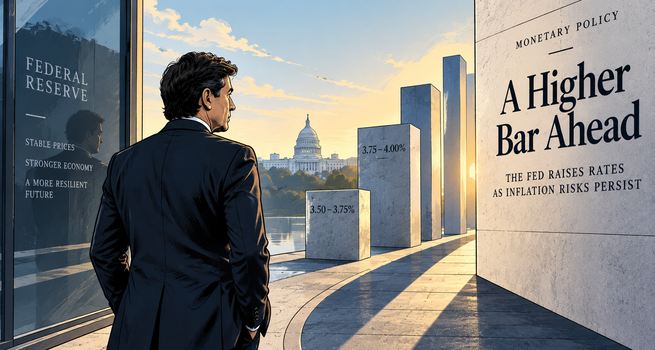
- Federal Reserve lifts target range to 3-3/4 to 4 percent on a unanimous 12-0 vote, marking its first rate hike since July 2023
- September Summary of Economic Projections raises the median 2026 Inflation forecast to 3.7 percent, up from June's 3.6 percent
- Sixteen of 18 participants project at least one more rate hike this year, with four seeing two additional increases
- Median federal funds rate projection for 2026 climbs to 4.1 percent, up 30 basis points from June's 3.8 percent
- Growth and labour market projections improve modestly, with 2026 GDP growth at 2.3 percent and Unemployment revised down to 4.1 percent
The Decision
The Federal Open Market Committee raised its target range for the federal funds rate by 25 basis points to 3-3/4 to 4 percent, up from 3-1/2 to 3-3/4 percent, aligning policy with the Federal Reserve's dual mandate of maximum employment and price stability. The vote was unanimous at 12-0, a notable contrast to the July meeting, which closed 9-3 with three participants favouring a smaller increase.
The move marks the Committee's first rate increase since July 2023, when the post-pandemic tightening cycle concluded at a range of 5.25 to 5.5 percent. The Federal Reserve subsequently held or cut rates through the following three years, making Wednesday's decision a structural turn in policy direction rather than a continuation of an existing hiking path.
Chair Kevin Warsh did not submit individual projections for the Summary of Economic Projections, consistent with his approach since taking the position. The updated dot plot showed 16 of the 18 participants who did submit projections anticipating at least one further 25 basis point increase later this year, with four of those expecting two additional hikes. Two participants projected the Committee would hold at the current level for the remainder of the year.
The shift from a split committee to a unanimous one is, on its own terms, as informative as the rate move. A divided vote signals internal disagreement over the appropriate pace of tightening; a unanimous one signals that the committee has converged on a shared read of the inflation picture, at least for this meeting. Markets tend to price unanimous decisions as carrying a lower probability of near-term reversal, since dissent is often the leading indicator of a policy pivot.
Reading the Statement Language
A comparison between the July and September statements shows deliberate recalibration rather than a routine reissue.
The July statement attributed elevated inflation partly to Supply shocks, explicitly citing energy prices. That clause has been removed. The September statement instead states plainly that inflation remains elevated and that the current policy action will support a timelier return to the Committee's 2 percent goal. The removal of an external attribution narrows the space for treating current inflation as transitory or shock-driven, and places the burden of the disinflation path more squarely on policy itself.
Growth language also firmed. Capital Investment was upgraded from strong to robust, and a new line was added noting that domestic spending has been resilient despite elevated uncertainty. The reference to Middle East conflict as a specific source of uncertainty was broadened to geopolitical developments in the statement text itself, even as the underlying driver, the ongoing U.S.-Iran conflict and its effect on oil prices, continues to be cited directly by policymakers and market commentary as the proximate cause of the current inflation pressure.
Labour market language was left largely intact: Job gains have kept pace with the workforce, and unemployment has changed little. The stability of this section, against a backdrop of more assertive language on inflation and growth, indicates that the labour market is not the primary variable driving this decision.
What the Dot Plot Shows
The Summary of Economic Projections reveals the more consequential shift. The median federal funds rate projection for 2026 rose to 4.1 percent, up from June's 3.8 percent. The 2027 median also moved higher, to 4.1 percent from 3.6 percent. The longer-run median settled at 3.2 percent, modestly above June's 3.1 percent.
|
Variable |
2026 |
2027 |
2028 |
2029 |
Longer Run |
|
Real GDP growth |
2.3% |
2.4% |
2.2% |
2.1% |
2.0% |
|
Unemployment rate |
4.1% |
4.1% |
4.1% |
4.1% |
4.2% |
|
PCE inflation |
3.7% |
2.3% |
2.1% |
2.0% |
2.0% |
|
Core PCE inflation |
3.4% |
2.5% |
2.2% |
2.0% |
— |
|
Federal funds rate (median) |
4.1% |
4.1% |
3.9% |
3.6% |
3.2% |
Source: Federal Reserve Summary of Economic Projections, September 2026
The inflation trajectory is the structural story embedded in this table. Median PCE inflation for 2026 stands at 3.7 percent, a near-term marking-up from June's 3.6 percent, before falling sharply to 2.3 percent in 2027 and reaching the 2 percent target by 2029. This is a projection that combines an acknowledgment of near-term persistence with confidence in medium-term convergence, a combination that requires the funds rate to stay elevated for longer than previously projected in order to be credible.
The Rate Path in Context
The median federal funds rate path shows the September projection sitting materially above June's through 2026 and 2027, before converging toward the longer-run estimate. The gap is largest in the near term, where the median path sits roughly 30 to 50 basis points above the prior projection. This pattern is consistent with a committee that has revised its near-term inflation expectations upward without correspondingly revising its long-run view of the neutral rate, implying the adjustment is being treated as cyclical rather than structural.
Risk Balance and Uncertainty
Beyond the median projections, the SEP records participants' qualitative risk assessments, and this is where the hawkish tilt becomes most explicit. The distribution of responses on risks to PCE inflation is overwhelmingly weighted to the upside, as is the distribution for core PCE inflation. This is a directional judgment, distinct from the level of uncertainty itself, which most participants characterised as higher than the historical average.
The practical implication is that the committee is not simply uncertain about where inflation will land. It is signalling an asymmetric expectation that inflation is more likely to surprise above its projections than below them. Historically, this kind of one-sided risk weighting has preceded periods of sustained policy tightening rather than a single adjustment.
Market Reaction
The initial market response reflected a move that had been largely priced in ahead of the announcement. Equity indices held gains through the decision, while Treasury yields showed a mixed reaction across the curve, a pattern consistent with a hike that was anticipated but accompanied by a more hawkish forward path than markets had assigned to the June projections.
Longer-dated yields, which had already risen sharply in the weeks preceding the meeting on the back of persistent inflation prints and rising energy costs, showed limited further movement on the announcement itself, suggesting much of the term-premium adjustment had already occurred ahead of the decision. Shorter-dated yields moved more directly in response to the confirmation of a higher near-term rate path implied by the updated dot plot.
Structural Implications
For capital markets, the combination of a unanimous hawkish vote, an upwardly revised inflation forecast, and a higher near-term rate path has several structural implications worth tracking rather than acting on.
Liquidity conditions are likely to remain tighter for longer than markets had priced as of the June SEP, given the 2026 and 2027 funds rate medians moved higher by 30 and 50 basis points respectively. This has direct implications for the discount rate applied to long-duration Assets and for the relative attractiveness of fixed income versus equities over the coming two years.
Capital allocation decisions premised on an imminent easing cycle may need reassessment. The longer-run median of 3.2 percent, only modestly above the current projected 2029 level of 3.6 percent, suggests the committee views the current tightening as bringing rates closer to a sustainable long-run level rather than as a temporary overshoot to be quickly unwound.
The upside-weighted risk assessment on inflation also carries implications for Volatility pricing across rate-sensitive sectors, including real estate, infrastructure, and long-duration growth equities, where valuation frameworks are particularly sensitive to the path and terminal level of the discount rate.
This analysis is based on the Federal Reserve's official statement and Summary of Economic Projections released September 16, 2026, and does not constitute investment advice. Readers should consult primary Federal Reserve publications and qualified financial advisors before making investment decisions.

 Nov 03, 2026





 Please wait processing your request...