
 CA
 NZ
 UK
 AU
 IND

 US

 Share
 X (Formerly Twitter)
 Whatsapp
 Facebook
 LinkedIn
 Telegram
 Email This Article
 Copy Link
 Summarize with AI
 Chat GPT
 Perplexity
Key Highlights
- The market is already almost certain the Fed will raise rates by a quarter point on Wednesday — that part is not the story.
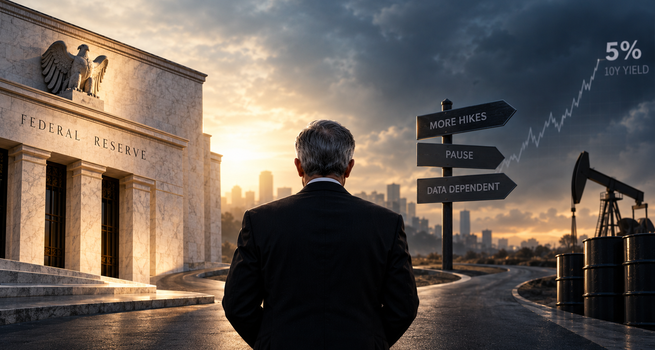
- What actually matters is the Fed's forecast for future rate hikes and how Chair Kevin Warsh talks about high oil prices during the press conference.
- A plain hike with normal comments would likely be a non-event or even a relief rally. A hike with a much more hawkish tone would be the scenario that hurts stocks.
- The note is written as a plain-language guide to positioning around the event — not a specific buy or sell recommendation.
This is a positioning guide, not a recommendation to buy or sell anything specific. The main point: the Interest Rate hike everyone is expecting on Wednesday is the least interesting part of the meeting. What actually moves markets is everything said around it.
The Bottom Line, in Plain Terms
The real action happens during the announcement window on Wednesday afternoon, not in today's trading. Markets have already priced in roughly a 90% chance the Fed raises its target interest rate by a quarter of a percentage point, to a range of 3.75% to 4.00%. That part is basically settled.
What is not settled: how many more rate hikes the Fed's own forecasts suggest are coming, whether Fed Chair Kevin Warsh treats the recent spike in oil prices as a temporary blip or as a reason to keep raising rates, and whether this is a single, one-time hike or the start of a longer series of increases.
Here is the simple version of how this could play out: if the Fed simply holds rates steady, that would be a real shock to markets. If it hikes and sounds very concerned about future inflation, that is the outcome that could hurt expensive growth stocks. If it hikes but signals it now just wants to watch the data calmly, that would likely be taken as good news.
The Numbers Going Into the Meeting
A few data points explain why this meeting is tense. The Fed's current target rate sits at 3.50% to 3.75%. The most recent Inflation report showed prices up 0.4% for the month and 3.4% over the past year, with the core measure, which strips out food and energy, still running hot at 0.3% for the month. The Fed's preferred inflation gauge is running around 3.7% annually, still well above its 2% goal. The Job Market has not weakened enough to stop a hike, with Unemployment at 4.1% and 162,000 jobs added in August.
Oil is the other big factor. Crude prices have jumped roughly 50% off their recent lows because of Supply worries tied to the Gulf region, a pipeline disruption, and tension involving Iran and the Strait of Hormuz. That oil spike is a big reason the odds of a hike jumped from around 60% a week ago to the low 90s after the last inflation report. The 10-year Treasury Yield has climbed to about 5%, its highest level since 2007, which means the Bond Market is already doing some of the Fed's tightening work on its own. Stocks, meanwhile, have been soft but calm, with the S&P 500 around 7,580 to 7,620 and a Volatility index near 17.5, a level that suggests some nervousness but nothing close to panic.
What the Market Has and Hasn't Already Priced In
Already priced in: the quarter-point hike itself, some additional tightening over the next six to twelve months, and a "new normal" of Treasury yields around 5%.
Not fully priced in: an actual pause instead of a hike, a Fed forecast that pushes rates well above where markets currently expect by the end of 2026 and keeps hiking into 2027, language suggesting oil-driven inflation will stay embedded in the economy, or a tone suggesting the Fed thinks its job is basically done after just one hike.
In short, the official rate announcement is only the opening line. The Fed's updated rate forecasts and Warsh's answers in the press conference are where the real market-moving information will come from.
Four Ways This Could Play Out
Scenario A, the most likely outcome at roughly 55% odds: the Fed hikes a quarter point, its forecasts shift only slightly more hawkish, and Warsh sounds cautious but non-committal, saying inflation is too high and oil is a risk, without locking in a fixed path forward. Under this scenario, expect choppy, back-and-forth trading for the first 15 to 45 minutes, followed by a fade of whatever initial overreaction occurs, with the S&P 500 staying in its recent range. Financial and energy stocks would likely hold up better than long-term, rate-sensitive growth stocks. The practical approach here is not to place large bets right before the announcement, keep only a small protective hedge in place, and if bond yields spike and tech stocks sell off sharply on headlines that turn out to be only mildly hawkish, consider buying the dip in high-quality large companies rather than in speculative, smaller AI-related stocks.
Scenario B, a hawkish surprise at roughly 25% odds: the Fed hikes and also signals more hikes are likely in 2026 and 2027, with Warsh emphasizing that oil price increases are spreading into broader inflation. Under this scenario, expect bond yields to rise further, the dollar to strengthen, and technology stocks, small-cap stocks, and homebuilders to be hit hardest, while energy stocks and some banks could outperform. Market volatility could jump toward the low 20s. This is the scenario worth actively protecting against before the announcement, for example through Options that limit losses if stocks fall, while favoring energy and quality financial stocks over technology and homebuilder stocks on a relative basis. Do not chase oil prices blindly in either direction, since geopolitical-driven moves in crude can reverse just as quickly as they spike.
Scenario C, a dovish surprise at roughly 15% odds: the Fed either unexpectedly holds rates steady despite the high odds of a hike, or hikes but signals it is essentially done and does not expect to move again soon. Under this scenario, expect a sharp, fast rally in technology and small-cap stocks, with the 10-year Treasury yield falling back below 5%. If you were betting against Growth Stocks heading into the meeting, this is the moment to close those bets as soon as it becomes clear the Fed's forecasts are unchanged and it is not committing to further moves. Do not bet against the market during the first 30 minutes of a surprise hold.
Scenario D, a low-probability but high-impact outcome at roughly 5% odds: the Fed hikes, but oil prices and bond yields move in a disorderly, sharp way during the decision itself, for example if crude breaks through recent highs and Treasury yields gap higher, triggering mechanical selling from large trend-following funds. Under this scenario, the priority is protecting Liquidity and reducing overall exposure, not trying to buy AI infrastructure stocks on the first sharp down day.
Wednesday Morning Isn't the Fed Meeting, But It Can Set a Trap
Retail sales data arrives at 8:30 AM Eastern, with expectations for a 0.8% increase, or 0.5% excluding autos. A hotter-than-expected number, combined with already-elevated oil prices, would raise the odds of a hawkish tone from the Fed later that day. A weaker number could create a false sense of relief in markets that gets reversed once the actual Fed decision arrives at 2:00 PM. The morning hours should be treated as a time to make small, tactical adjustments rather than a time to build strong conviction, and it is normal for buy-sell spreads to widen as the announcement approaches. Thursday's data, including housing starts, jobless claims, and a regional Manufacturing survey, should be used to fine-tune positioning afterward, not to build a brand-new market view.
Which Sectors Win and Lose Under Each Scenario
If the Fed is hawkish or oil stays elevated, energy producers, pipeline and infrastructure companies, some defense stocks, large banks that benefit from higher rates, Brokers that benefit from market volatility, and select high-quality Utility stocks tend to hold up better. In that same environment, long-duration technology stocks, unprofitable growth companies, homebuilders, real estate Investment trusts, rate-sensitive retailers, and smaller, more volatile AI-related stocks tend to underperform.
One important distinction: companies building the physical infrastructure to power AI data centers, including electric utilities and grid operators, behave differently than AI software and chip companies. A hawkish Fed can compress the valuation multiple investors are willing to pay for these power-infrastructure companies, but it does not eliminate the underlying, multi-year Demand for electricity to run data centers. In other words, if you hold these kinds of power-infrastructure stocks, the risk this week is a lower valuation multiple, not a collapse in the underlying Business case, and a rough two-day trading period around the Fed meeting is not a good reason to abandon a multi-year investment thesis.
Practical Rules for the Days Around the Meeting
The rate hike itself is not the real trade; the Fed's forecasts and the specific words used are. Consider trimming overall exposure heading into the announcement and rebuilding positions only after hearing what Warsh actually says, not immediately after hearing "quarter point hike." Protect against the hawkish scenario using limited-risk options strategies rather than simply betting against the entire market, since a hike that was already 90% expected often triggers a classic "sell the rumor, buy the fact" reaction unless the Fed's forecasts are genuinely troubling. Watch, in order: the inflation language in the official statement, the Fed's median rate forecast for 2026 and 2027, and Warsh's first answer about oil. If Crude Oil prices spike sharply during the press conference, expect the bond market to react to that regardless of how calm Warsh's words sound. Current options pricing, with volatility near 17 to 18, may not fully reflect how much this event could still move markets, making modestly priced protective option strategies more attractive than simply betting on low volatility. Treat Thursday's economic data as a chance to fine-tune positioning, not as a new starting point, since it is unlikely to override a genuinely hawkish set of Fed forecasts.
Key Levels to Watch
For the S&P 500, the recent support zone sits around 7,600; a disappointing, hawkish outcome could push it down toward the 7,490 to 7,500 area, while a dovish surprise could send it back above 7,700. For the 10-year Treasury yield, 5.00% is currently acting like a magnet; a hawkish press conference could open the door to 5.10% to 5.20%, while a dovish surprise could pull it back toward the high 4% range. For the volatility index, a sustained move above 20 on a hawkish outcome would confirm that this is a bigger deal than just a one-day headline spike.
What to Avoid
Avoid betting heavily on a surprise pause, since it remains a relatively low-probability outcome. Avoid buying the most expensive, unprofitable AI-related stocks in the final minutes before the announcement. Avoid treating oil as a one-way bet in either direction, since geopolitical price swings can reverse quickly. Avoid confusing a single hawkish Fed meeting with the end of the broader multi-year buildout in AI-related power infrastructure.
The one-line summary: stay flexible and liquid heading into Wednesday afternoon's announcement, do not overreact to a plain, expected rate hike, take seriously a genuinely hawkish set of Fed forecasts, cover any bets against growth stocks quickly if the Fed holds steady or signals it is done, and let oil prices be the tiebreaker if the Fed's words and the market's reaction seem to disagree.
This is not investment advice. Event-driven trading around Fed meetings carries two-sided risk, and prices can move sharply and unpredictably in either direction.

 Nov 02, 2026



 Please wait processing your request...