
 CA
 NZ
 UK
 AU
 IND

 US

 Share
 X (Formerly Twitter)
 Whatsapp
 Facebook
 LinkedIn
 Telegram
 Email This Article
 Copy Link
 Summarize with AI
 Chat GPT
 Perplexity
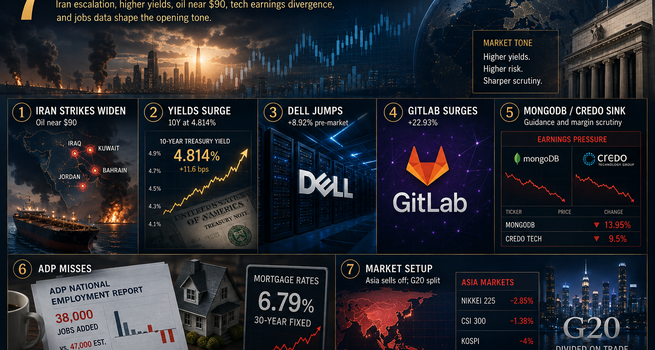
Iran struck American targets in four countries as the 10-year Treasury Yield hit its highest since November 2023, with oil near $90 fueling Inflation concerns. Dell and GitLab surged on Blowout Earnings while MongoDB and Credo sank despite beating estimates, and a weak ADP jobs report set the stage for Friday's payrolls release.
1. IRAN: Tehran Strikes American Targets in Jordan, Kuwait, Iraq, and Bahrain as Chief Negotiator Accuses US of Acting "Like Satan"
Iran launched attacks on American targets across Jordan, Kuwait, Iraq, and Bahrain in response to US strikes on Iranian military sites, a broader retaliation than Monday's action confined to Jordan and the UAE. Iran claimed an American missile killed four people at a wedding; US armed forces said they were aware of the reports but do not target civilians. Iran's chief negotiator with the United States, Mohammad Bagher Ghalibaf, accused Washington of acting "like Satan." WTI crude hit $90 a barrel this week as the US launched additional strikes, raising concern the conflict could escalate further. The war has now spread to a fourth country in under 48 hours.
- Iran hitting Kuwait and Bahrain for the first time, alongside the now-familiar Jordan target, suggests a deliberate widening of retaliation's geographic scope rather than pressure concentrated on one ally.
- Risk note: if the wedding casualty claim is verified, diplomatic pressure could force a disproportionate US response, pushing oil toward the $94.83 resistance level flagged by technical analysts this week.
2. YIELDS: US 10-Year Hits 4.814%, Highest Since November 2023, as Japan's Benchmark Holds Near 30-Year High
The US 10-year Treasury yield touched an intraday high of 4.814% Wednesday, its highest since November 2023, before settling near 4.776%, as inflation and Debt sustainability concerns pressured global borrowing costs. The 30-year held near 5.25%, above its August level when Bessent announced an expanded bond buyback program. Japan's 10-year remained near 3%, a 30-year high reached this week, while UK, German, and French yields also rose. A Macquarie strategist said higher yields are forcing analysts to discount future earnings more aggressively, pushing valuations lower. AJ Bell's head of markets said some bond investors may be waiting for yields to climb even higher before locking in current levels.
- Yields rising even as the 10-year pulled back from its intraday peak suggests investors are still actively repricing rather than settling on a new equilibrium.
- Risk note: with Bessent's buyback expansion failing to prevent yields exceeding their August levels, markets may be signaling skepticism that debt tools can offset oil-driven inflation.
3. DELL: Shares Jump 8.92% as Record AI Server Revenue Drives Blowout Quarter and Raised Full-Year Guidance
Dell Technologies (NYSE:DELL) shares rose 8.92% pre-market after fiscal second-quarter revenue of $47 billion topped a $44.9 billion estimate and non-GAAP Earnings Per Share of $7.04 crushed a $4.95 consensus. Infrastructure Solutions Group revenue hit a record $31.8 billion, up 89% year over year, with AI server orders of $60.9 billion, AI server revenue of $16.4 billion, and a record AI Backlog of $95 billion. Client Solutions Group revenue grew 20% to $15 billion. The company returned a record $4.3 billion to shareholders and generated $8.1 billion in adjusted free cash flow. Management raised full-year guidance to a $192 billion revenue midpoint, up roughly 70%, with $25.50 non-GAAP earnings per share, and guided third-quarter AI server revenue to nearly triple year over year to $74 billion.
- A $95 billion AI backlog against $16.4 billion in quarterly AI server revenue indicates Demand visibility extending well beyond the current fiscal year.
- Risk note: with infrastructure growth this concentrated in AI server orders, any slowdown in hyperscaler Capital spending could disproportionately hit Dell's backlog conversion relative to more diversified peers.
4. GITLAB: Shares Surge 22.93% on Record Bookings Quarter as Flex Pricing Model Drives Guidance Raise
GitLab (NASDAQ:GTLB) shares jumped 22.93% pre-market after second-quarter revenue of $286.3 million beat a $273.1 million estimate, up 21% year over year, with adjusted earnings per share of $0.24 topping an $0.18 consensus. Net dollar-based retention accelerated to 117%, its first acceleration since 2024, and net annual Recurring Revenue grew 34%, driven by the Flex consumption pricing model, which grew paid consumption run rate to over $40 million from $15 million, with more than 130 customers each committing over $20 million in the model's first six weeks. Management raised full-year revenue guidance to $1.129 billion to $1.133 billion and EPS guidance to $0.85 to $0.87. Needham raised its target to $65, BTIG to $60, and Rosenblatt to $55, while Bank of America stayed neutral citing an expected deceleration to 15% to 16% growth in the third quarter. The company also disclosed the resignation of its chief accounting officer.
- The retention acceleration alongside Flex's rapid early adoption suggests the pricing transition is expanding wallet share among existing customers rather than merely shifting revenue timing.
- Risk note: with Bank of America flagging a guided deceleration and Flex creating reporting headwinds of its own, the chief accounting officer's departure during this shift adds a governance variable worth monitoring.
5. MONGODB/CREDO: Both Sink Despite Beating Estimates as Investors Focus on Guidance and Margin Concerns
MongoDB (NASDAQ:MDB) shares fell as much as 13.95% pre-market despite second-quarter earnings of $1.90 per share beating a $1.61 estimate on revenue of $772 million against a $733 million consensus, up 30% year over year. Investors focused on third-quarter revenue guidance of $756 million to $761 million, implying deceleration, triggering a sell-the-news reaction after the stock had rallied roughly 34% in August to a 52-week high. Credo Technology (NASDAQ:CRDO) shares fell about 9.5% after beating on revenue, at $479 million against a $471.8 million estimate, and EPS, at $1.20 against $1.17, but non-GAAP gross margin of 64.5% missed a 68.3% expectation amid rising R&D and selling costs. Credo's pullback follows a rally of roughly 46% to 66% this year, with BofA maintaining buy while cutting its target to $275 and Rosenblatt raising its target to $235 despite a neutral rating.
- Both stocks falling on guidance and margin details rather than headline misses shows investors applying stricter scrutiny to forward metrics after substantial multiple expansion.
- Risk note: both disappointments arrive as rising Treasury yields already pressure growth stock valuations broadly, compounding rather than offsetting a less favorable macro backdrop.
6. JOBS/RATES: ADP Shows Slowest Private Payroll Growth Since January as Mortgage Rates Hit 4-Week High Ahead of Friday's Report
Private employers added 38,000 jobs in August, the smallest gain since January and below a 47,000 consensus, following an upwardly revised 46,000 in July, ADP reported Wednesday. Education and health services led with 45,000 new positions, while leisure and hospitality added 16,000 and construction added 12,000; Manufacturing lost 17,000 and professional and Business services shed 16,000, with trade, transportation, utilities, and Mining each declining by 5,000. Companies with 500 or more employees accounted for 34,000 of the gain, while firms with fewer than 50 employees added just 3,000. Base pay for job-stayers rose 3% year over year and gross pay rose 4.4%, both unchanged from July. The average 30-year fixed mortgage rate rose to 6.79%, its highest since June 2025, even as total application Volume rose 0.8% for the week, with purchase applications up 2.2% and refinance applications down 1.1%. The report sets up Friday's nonfarm payrolls, with consensus calling for a 53,000 gain after July's 23,000 decline and Unemployment expected to hold at 4.1%.
- The concentration of gains in large companies and a narrow set of sectors, with manufacturing and professional services both contracting, points to a labor market where headline growth masks uneven conditions.
- Risk note: if Friday confirms the same deceleration, a cooling labor market alongside multi-year high yields could force the Fed to weigh growth against inflation risk simultaneously for the first time this cycle.
7. MARKET SETUP: Asia Sees Sharp Selloff as G20 Fails to Reach Joint Statement Over China Surplus Dispute; Uber Cuts Jobs, Vertiv Buys Power Firm
US stock futures were mixed Wednesday, with Dow futures up 137 points, S&P 500 futures roughly flat, and Nasdaq 100 futures down 0.2%. Asian markets fell sharply, with Japan's Nikkei 225 closing 2.85% lower and South Korea's Kospi dropping 4%, while Australia's ASX 200 fell 0.97% and China's CSI 300 declined 1.38%; European markets were broadly lower, with the Stoxx 600 down 0.49% and Germany's DAX off 0.7%. G20 finance ministers failed to issue a joint statement after their two-day meeting in North Carolina, though Bessent said 19 attendees agreed to a communique condemning countries with excessive external surpluses reliant on exports, aimed at China, which ran a record $1.2 trillion Trade Surplus in 2025 and objected to the language. Uber (NYSE:UBER) shares rose as much as 1.95% after Bloomberg reported the company will cut roughly 3,300 jobs to flatten management layers, with Rosenblatt initiating coverage at buy with a $100 target. Vertiv shares slipped less than 1% after announcing a $1.45 billion Acquisition of UtilityInnovation Group. Sirius XM rose more than 3% on a Deutsche Bank upgrade to buy, while Palo Alto Networks fell nearly 2% despite beating fiscal fourth-quarter estimates.
- The scale of Wednesday's Asia selloff, far steeper than modest declines in US futures and Europe, suggests investors there are pricing regional risk, including Japan's yield surge, more aggressively than Western counterparts.
- Risk note: with China rejecting the G20 surplus language, the dispute could resurface as renewed trade tension just as markets digest a widening Iran conflict and multi-year high bond yields.


 Nov 04, 2026





 Please wait processing your request...