
 AU
AU
 UK
UK
 CA
CA
 NZ
NZ
 IND
IND

 US
US

 Share
Share
 X (Formerly Twitter)
 Whatsapp
 Facebook
 LinkedIn
 Telegram
 Email This Article
 Copy Link
 Summarize with AI
 Chat GPT
 Perplexity
Key Highlights
- Palantir Technologies Inc. is trading below a descending trendline, signaling a weakening structure
• Price action shows repeated rejection at lower highs, reinforcing bearish control
• Failure to hold above the 21-day moving average reflects fading short-term momentum
• RSI near neutral levels indicates lack of strong buying conviction
• Consolidation near support raises risk of downside breakdown
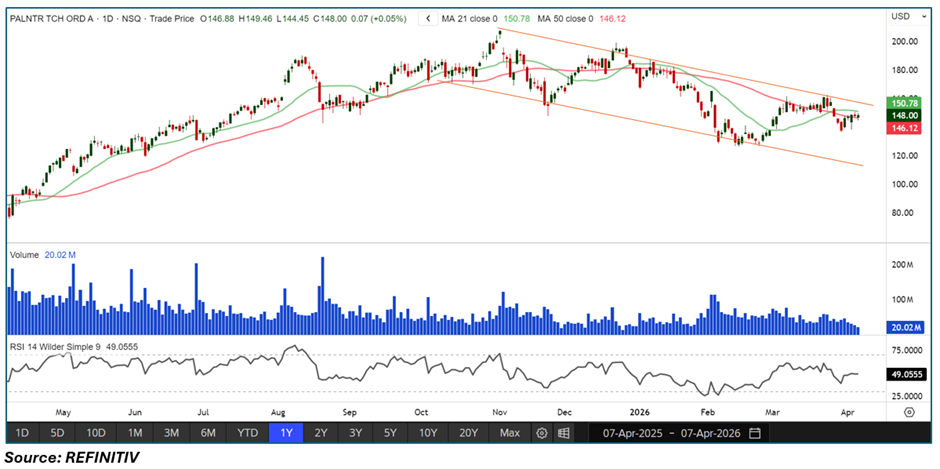
Trend Structure: Descending Trendline Caps Recovery
PLTR has transitioned into a short-term downtrend, characterized by:
• A clear descending trendline connecting recent lower highs
• Failed attempts to break above this resistance
• Gradual shift from bullish to neutral/bearish structure
Each rally into the trendline has been sold into, confirming that sellers are actively defending higher levels.
Price Action: Lower Highs Signal Seller Dominance
Recent price behavior highlights:
• Formation of consistent lower highs
• Weak bullish candles with limited follow-through
• Increasing hesitation near resistance
This suggests:
• Buyers are losing control
• Sellers are stepping in earlier during rallies
• Market sentiment is turning cautious
Such price action typically precedes either continued drift lower or a sharper breakdown.
RSI Momentum: Neutral Zone Reflects Indecision
The 14-period RSI is hovering near the midpoint (~50):
• Indicates balanced momentum but with no strong bullish edge
• Reflects lack of conviction among buyers
• Leaves room for momentum to shift in either direction
Given the bearish price structure, RSI neutrality leans slightly toward downside risk.
Moving Average Analysis: Mixed but Weakening Signals
Key moving averages show a fragile setup:
• 21-day MA (~150.78) is acting as near-term resistance
• 50-day MA (~146.12) sits below price, offering limited support
Key observations:
• Price struggling to reclaim the 21-day MA
• Lack of strong separation above moving averages
• Flattening structure suggests loss of bullish momentum
This configuration points to a transition phase with bearish bias emerging.
Support Levels: Key Zone Under Pressure
PLTR is consolidating near an important support region:
• Price hovering around the mid-$140s zone
• Multiple tests of this level weaken its strength
• Breakdown risk increases with each retest
A decisive move below support could:
• Trigger increased selling pressure
• Accelerate downside toward lower demand zones
Market Structure: Compression Before Potential Move
The broader structure reflects:
• Price compression between descending resistance and horizontal support
• Reduced volatility ahead of a potential breakout or breakdown
• Lack of bullish continuation signals
This type of setup often leads to:
• A directional expansion move, with current bias favoring downside
Key Technical Scenarios
- Bearish Breakdown (Primary Scenario)
If support fails:
• Price may break below the mid-$140s zone
• Downside momentum could accelerate
• Sellers likely to maintain control below trendline - Continued Consolidation
If support holds temporarily:
• Price may trade within a tightening range
• RSI likely to remain near neutral
• Market builds pressure for a breakout move - Bullish Reversal Attempt
If buyers regain strength:
• Break above descending trendline could shift sentiment
• Sustained move above 21-day MA needed
• Would weaken immediate bearish outlook
Risk Considerations
- Compression setups can lead to sharp, volatile moves
• RSI neutrality allows rapid momentum shifts
• False breakouts or breakdowns are possible
• Broader tech sector sentiment may influence direction
Conclusion: PLTR Shows Signs of Weakness as Resistance Holds
Palantir Technologies Inc. (PLTR) is exhibiting early bearish characteristics, with price capped below a descending trendline and momentum indicators showing limited buying strength. The ongoing consolidation near support is a critical inflection point.
Unless the stock can break above resistance and reclaim upward momentum, the risk of a downside breakout remains elevated in the near term.


 Jun 05, 2026




 Please wait processing your request...